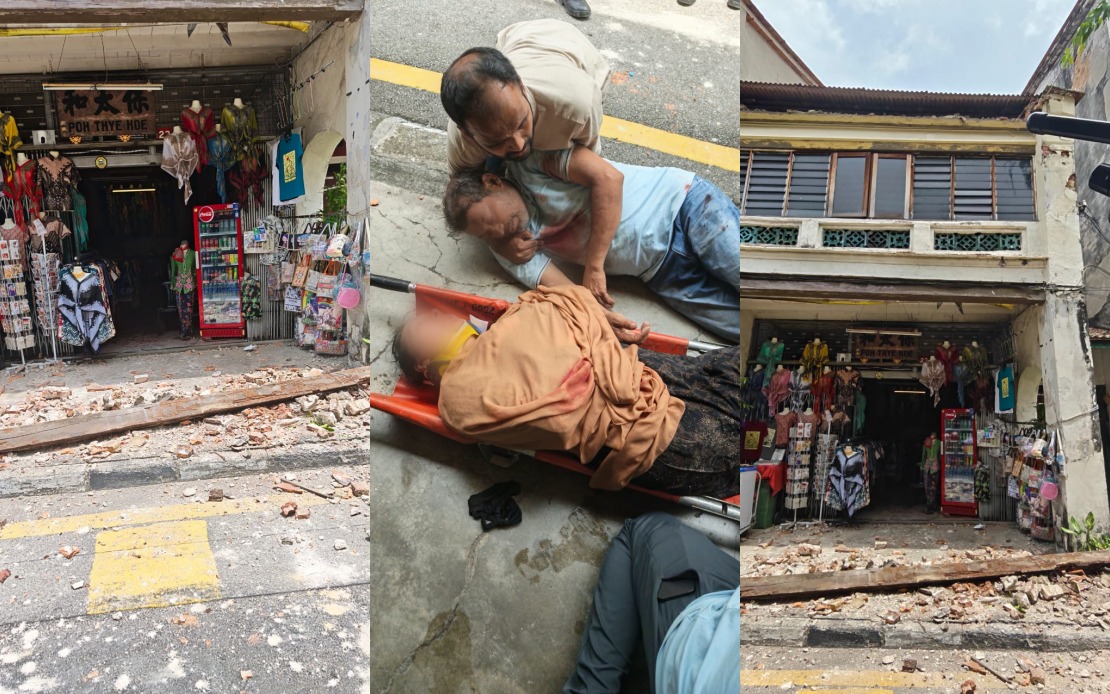
A structural incident in George Town's historic core has prompted urgent action from Penang authorities after debris from a heritage building struck two visiting tourists on August 4. The incident occurred along Armenian Street, one of the state's most visited heritage precincts, raising fresh concerns about the maintenance standards of older properties in Penang's UNESCO World Heritage Site.
The two injured visitors, identified as Mohamad Ammtar, 66, and Fatimah, 55, were struck by falling stones and timber from a first-floor beam while walking near the affected property. Emergency responders from the Penang Fire and Rescue Department's Lebuh Pantai station arrived at the scene following a call at 1.11 pm. Medical personnel from the Ministry of Health provided initial stabilisation before the tourists were transported to Penang Hospital for further care. Both visitors had been scheduled to return to Sri Lanka the following day, adding complexity to their treatment and recovery arrangements.
The building in question operates a ground-floor grocery shop, with the upper storey appearing vacant at the time of the collapse. This mixed-use arrangement is typical of many heritage structures in George Town, where commercial premises occupy lower levels while upper floors remain underutilised or abandoned. Such conditions can obscure structural deterioration, as responsibility for maintenance may be disputed between multiple stakeholders or neglected entirely when upper sections are not actively used.
The timing of this incident has intensified scrutiny of George Town's aging building stock. As a World Heritage Site, the precinct attracts significant domestic and international foot traffic daily. The presence of vulnerable visitors navigating narrow heritage streets lined with centuries-old structures creates both appeal and risk. State authorities recognise that a major structural failure resulting in fatalities could severely damage Penang's reputation as a tourism destination and international cultural site.
Wong Hon Wai, chairman of the Penang State Tourism and Creative Economy Committee, visited the scene and announced that both the George Town World Heritage Incorporated (GTWHI) and Majlis Bandaraya Pulau Pinang (MBPP) would issue formal safety advisories to heritage property owners statewide. His comments underscored the principle that the responsibility for building integrity extends beyond the single property involved in today's incident. Heritage conservation efforts, he indicated, must encompass structural safety as a non-negotiable component of preservation strategy.
The state government's response reflects understanding that heritage building maintenance involves competing priorities. Owners often face financial constraints when undertaking restoration and repair work on older properties, particularly when upper levels generate minimal income. Additionally, heritage designations can impose aesthetic and construction restrictions that limit cost-effective renovation approaches available in modern building contexts. Yet these economic realities cannot override public safety obligations, creating tension between preservation economics and visitor protection.
State officials emphasised that systematic inspections would now target all heritage and older buildings throughout Penang, not merely those showing obvious distress. This preventive approach acknowledges that structural failures often occur without visible warning signs, particularly in masonry and timber-framed buildings where internal decay may be extensive before external manifestation. A comprehensive audit programme, once completed, could identify priority properties requiring urgent stabilisation or closure.
The involvement of the Sri Lankan High Commission in Kuala Lumpur signals recognition that incidents affecting foreign nationals carry diplomatic dimensions beyond local administrative concerns. Coordination between state authorities and the high commission ensures injured tourists receive appropriate consular support and that recovery logistics are managed sensitively. For Penang's tourism sector, the quality of response to foreign visitor incidents directly influences international perceptions of hospitality and safety standards.
George Town's heritage precinct presents a distinctive challenge within Malaysia's tourism landscape. The organic streetscapes and authentic period architecture that make the area attractive to visitors simultaneously introduce infrastructure risks absent from purpose-built modern facilities. Many properties predate contemporary building codes and were constructed using materials and techniques no longer standard practice. Retrofitting such buildings with modern safety systems while preserving heritage character requires specialist expertise and substantial investment, creating barriers for individual property owners working with limited budgets.
Penang's authorities face a broader policy question about how heritage districts can remain accessible to the public while ensuring visitor safety. Some World Heritage Sites in other countries have implemented restricted access during periods of structural assessment or implemented enhanced inspection and monitoring regimes for high-risk properties. The balance between preservation authenticity and public protection often cannot be achieved through standard solutions, requiring customised approaches reflecting each building's specific condition and context.
The incident also highlights maintenance responsibilities along the heritage tourist corridor. While building owners bear primary accountability, the broader ecosystem—including local government, heritage conservation bodies, and tourism authorities—shares interest in ensuring structural integrity. Future policy development might clarify maintenance standards, establish clearer inspection schedules, and create funding mechanisms supporting owners unable to finance necessary repairs independently.
For Malaysian regional policymakers observing the George Town situation, the incident offers instructive lessons about heritage site management. The intersection of tourism development, aging infrastructure, and public safety requires proactive governance frameworks rather than reactive crisis response. As Southeast Asian cities increasingly recognise heritage conservation's economic value, matching that recognition with equivalent investment in structural safety becomes essential for sustainable tourism and community protection.
As investigations continue into the specific cause of the August 4 structural failure, the immediate imperative remains identifying and addressing similar vulnerabilities across George Town and other heritage precincts. The recovery of the two injured tourists will partially determine public and international perception of Penang's capacity to manage heritage tourism responsibly.

