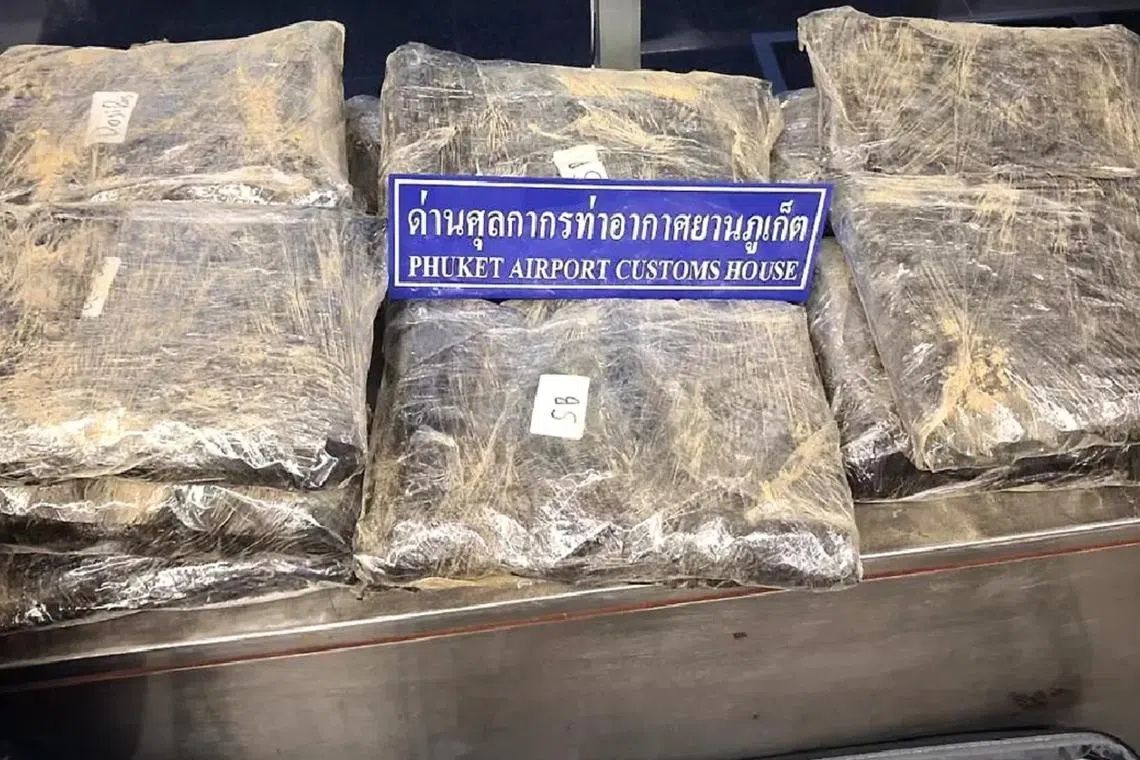
Customs officers at Phuket International Airport have arrested two women following the discovery of more than 32 kilogrammes of cannabis flowers concealed in their baggage, marking another significant enforcement action in Thailand's ongoing battle against drug trafficking through its aviation hubs. The simultaneous arrests occurred on Thursday in the international departures terminal, conducted jointly by personnel from Phuket Airport Customs House and officers from Sakhu Police Station during routine passenger screening operations.
The first apprehension involved an 18-year-old Filipino national, Levannah Chelsea Guzman, whose black Pierre Cardin wheeled suitcase aroused suspicion during the inspection process around 11 in the morning. When customs officials opened the luggage, they discovered 14 individually vacuum-sealed packages containing cannabis flowers, which together with their packaging materials weighed approximately 14.5 kilogrammes. During the subsequent interrogation, Guzman confirmed ownership of both the suitcase and its contents, admitting full responsibility for the attempted transportation of the prohibited material.
The legal implications for Guzman are substantial and multifaceted under Thailand's complex regulatory framework governing controlled substances. She now faces charges under the Customs Act BE 2560 (2017) for attempting to export goods without completing mandatory customs procedures, a foundational charge in such cases. Beyond the customs violation, prosecutors have also invoked provisions of the Narcotics Code, establishing the most serious layer of criminal liability. Additional charges have been filed under the Protection and Promotion of Traditional Thai Medicine Wisdom Act BE 2542 (1999), which contains specific provisions regarding cannabis, as well as the Public Health Ministry's 2025 notification establishing controls over cannabis as an herb, demonstrating the increasingly refined legislative approach Thailand has adopted toward cannabis regulation.
Barely two hours after Guzman's detention, a second arrest unfolded at approximately 1 in the afternoon when customs officers became suspicious of a green Swish Navy wheeled suitcase belonging to Penpitcha Phutsiang, a Thai national. The contents of this luggage proved even more substantial than the first seizure, containing 16 vacuum-sealed packages of cannabis flowers with a combined weight of 17.6 kilogrammes. Similar to the first case, Phutsiang acknowledged full ownership of the suitcase and its contents during questioning, providing authorities with straightforward admissions that facilitated the documentation process. She was subsequently charged with identical offences to those levelled against her co-accused and transferred with the seized material to Sakhu Police Station for continued investigation and formal legal proceedings.
The timing and nature of these arrests underscore the escalating sophistication of Thailand's customs enforcement operations at one of Southeast Asia's busiest international airports. Phuket, as a major tourist destination and regional aviation hub, has become a focal point for trafficking networks attempting to move cannabis across borders. The parallel arrests on a single day suggest that airport authorities have refined their detection methodologies, possibly incorporating enhanced screening protocols or intelligence that flagged suspicious travel patterns. The precision of the seizures indicates that officers are no longer relying solely on random searches but are increasingly targeting specific luggage based on observable risk factors.
From a Malaysian perspective, these developments carry particular relevance as they reflect broader enforcement trends across the region. Thailand's approach to cannabis regulation has undergone significant evolution, particularly following the country's landmark decriminalization decision in 2018, which fundamentally altered how authorities categorise and prosecute cannabis-related offences. The introduction of the 2025 Public Health Ministry notification referenced in these charges suggests that Thailand continues to tighten its regulatory framework even as some jurisdictions worldwide move toward liberalisation. Malaysia, which maintains among the region's strictest drug laws, can observe how Thai authorities have adapted their enforcement mechanisms to accommodate changing international norms while preserving domestic control measures.
The enforcement intensity evident in these arrests reflects Thailand's commitment to preventing the emergence of an international cannabis export market from its territory. Prior to 2018, cannabis was categorised alongside heroin and methamphetamine as a Class 1 narcotic, but the decriminalisation allowed medicinal and research use under strict conditions. Authorities appear determined to ensure that this controlled liberalisation does not create loopholes for illegal exportation. The cumulative 32.1 kilogrammes seized represents a quantity substantial enough to indicate commercial intent rather than personal consumption, suggesting that these women may have been operating as couriers within a larger trafficking network rather than acting independently.
The involvement of both a Thai national and a foreign citizen in the same enforcement action raises questions about the transnational architecture of cannabis trafficking through Southeast Asia. The distinct nationalities involved suggest potential coordination between trafficking groups across borders, or alternatively, the use of mixed-nationality courier teams to reduce suspicion during airport screening. For Malaysian authorities and other regional law enforcement agencies, such incidents provide valuable intelligence about the operational methods employed by these networks, information that typically circulates through ASEAN intelligence-sharing mechanisms and bilateral partnerships.
The charges filed against both women encompass a comprehensive range of legislative provisions, reflecting the multidimensional regulatory approach that Thai prosecutors employ in cannabis cases. Rather than relying on a single statutory framework, authorities have layered charges across customs, narcotics, traditional medicine, and public health regulations. This prosecutorial strategy ensures multiple avenues for conviction and potentially lengthier sentences while also addressing different aspects of the crime—the smuggling attempt, the drug trafficking element, and the violation of controlled herb regulations. For defendants, this approach significantly complicates defence strategies and reduces the likelihood of acquittal on technical grounds.
The broader context of these arrests reveals Thailand's determination to maintain border integrity despite its evolving relationship with cannabis. The Public Health Ministry's 2025 notification establishing specific controls over cannabis as a herb represents a middle-ground approach, permitting legitimate domestic use while criminalising unauthorised export. This regulatory sophistication distinguishes Thailand from neighbouring jurisdictions with blanket prohibitions, yet the enforcement operations demonstrate that authorities take illegal export seriously as a criminal matter. The continuing intensification of inspections at Phuket and other major airports indicates that preventing cannabis from becoming Thailand's new export commodity remains a security priority for Bangkok.
For travellers throughout Southeast Asia, these arrests serve as a stark reminder that cannabis remains tightly controlled in most regional jurisdictions despite evolving global attitudes toward the substance. Thailand's decriminalisation has created widespread misconceptions that cannabis is freely available and exportable, misconceptions that these arrests directly contradict. The penalty structures that both Guzman and Phutsiang now face reflect the severity with which Thai authorities treat export violations, even for cannabis products. Similarly, Malaysian authorities maintain stringent penalties for cannabis offences, and the possibility of arrest and prosecution remains high regardless of the substance's legal status in other countries.

