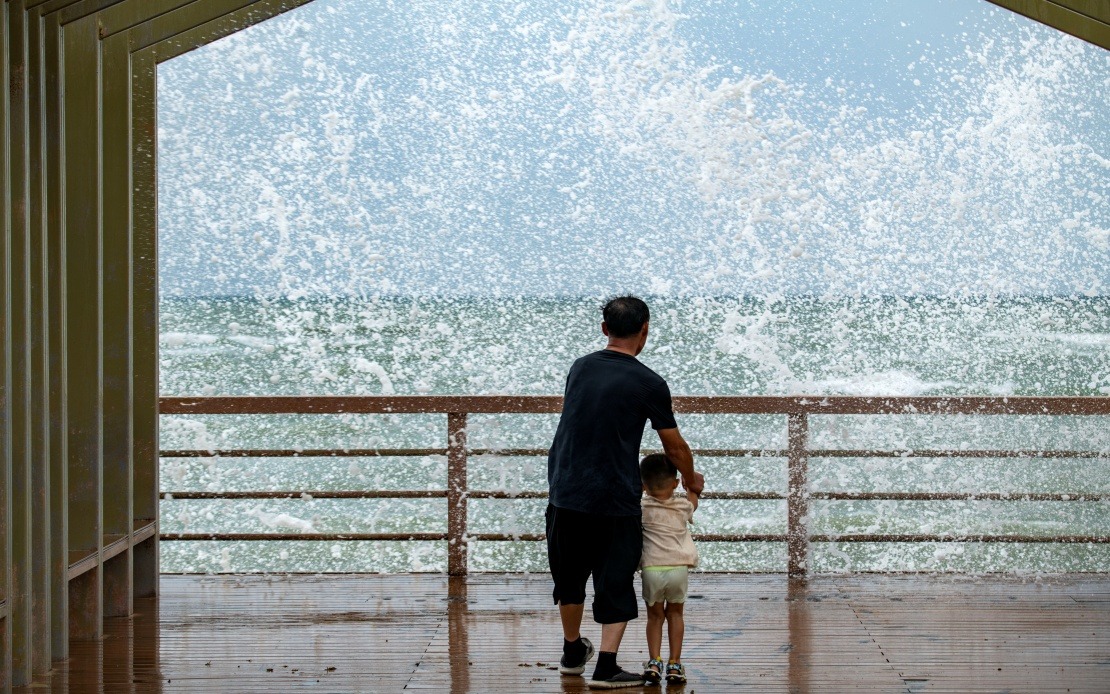
Typhoon Maysak, the tenth tropical cyclone to form in the Western Pacific this season, struck Hainan Province on Friday evening, bringing significant disruption to transportation networks and civilian life across China's southernmost province. The storm made landfall at approximately 6.20 pm local time in Yelin Township within Lingshui Li Autonomous County, carrying maximum sustained winds of 23 metres per second at its core, according to the Hainan provincial meteorological bureau.
The impact on regional connectivity has been substantial and immediate. All train services connecting to and from Hainan were halted for both Friday and Saturday, effectively isolating the island from rail-based travel for two consecutive days. Sanya Phoenix International Airport, the province's major aviation hub serving both domestic and international passengers, suspended all flight operations from 5 pm onwards on Friday. The airport's closure comes as Hainan enters its peak summer travel season, affecting thousands of travellers with bookings across regional and international routes.
Maritime transport has similarly ground to a halt. Ferry operations across the Qiongzhou Strait, which connects Hainan to the Chinese mainland and serves as a crucial crossing point for both passenger and vehicle traffic, ceased operations from 2 am on Friday. Authorities indicated that the suspension would remain in effect for one to two days, contingent on the storm's progression and weather stabilisation. This closure impacts commercial trucking operations and individual travellers who rely on the strait crossing for business and personal reasons.
Educational institutions in the storm's path have also been shuttered. Schools and childcare facilities throughout Sanya and Ledong Li Autonomous County received closure directives as precautionary measures to ensure public safety. The closures reflect the serious nature of the meteorological threat, as typhoons routinely produce dangerous wind gusts, flash flooding, and hazardous conditions that endanger vulnerable populations including children commuting to schools.
Meteorological authorities have tracked Maysak's predicted trajectory as it moves inland from the coast. The storm is expected to progress northwest through the province, passing over or near several significant municipalities and towns including Baoting, Wuzhishan, Baisha and Danzhou. Following this inland passage, the weakening typhoon system is anticipated to enter the Beibu Gulf, the body of water bounded by Hainan, Vietnam and Guangxi Zhuang Autonomous Region.
For regional observers in Southeast Asia, Maysak's impact on Hainan carries significance beyond the immediate disruption. Hainan serves as a critical economic node in southern China's trade and logistics infrastructure, hosting major ports and serving as a transhipment hub for goods destined for Vietnam, Thailand and other ASEAN nations. Transport stoppages of even 24-48 hours can create cascading delays in supply chains throughout the region, affecting manufacturers and traders across the Southeast Asian peninsula.
The typhoon represents one in a series of significant storm systems that have affected Asia's coastal regions throughout 2024. The designation as the tenth typhoon of the year follows established naming conventions maintained by the Japan Meteorological Agency and the World Meteorological Organization's Regional Specialized Centre. Climate analysis suggests that while the overall frequency of tropical cyclones may not increase dramatically, intensification rates and erratic track patterns related to warming ocean temperatures continue to present challenges for meteorological forecasters and emergency planners.
For Malaysia and other ASEAN nations with exposed coastlines, developments in Hainan warrant attention as weather systems that impact southern China often influence monsoon patterns and storm track probabilities across the broader Southeast Asian maritime zone. The Beibu Gulf, where Maysak is headed, lies directly north of Malaysian territorial waters in the South China Sea, and storm systems originating from this region occasionally influence conditions affecting Malaysia's eastern coastal states.
Transport authorities in Hainan and adjacent provinces have implemented standard typhoon protocols, including securing ports, securing vessels, reducing operational capacity at airports, and maintaining emergency response teams on high alert. The suspension of services represents a conservative but prudent approach to typhoon management, prioritising personnel and passenger safety over maintaining commercial schedules. Historical precedent from major typhoons affecting the region demonstrates that attempting to maintain operations during direct storm impact typically results in greater economic losses through accidents, damage to infrastructure and vessel casualties than temporary, planned cessations of service.

