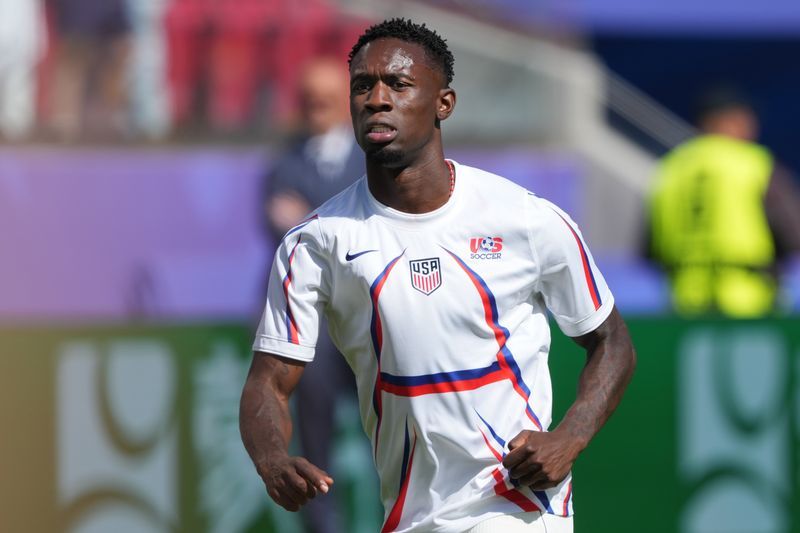
European soccer's governing body UEFA has issued a scathing rebuke of FIFA's controversial move to suspend U.S. striker Folarin Balogun's red-card ban from the World Cup, with the continental federation declaring that world football's integrity has been fundamentally compromised. The decision came after U.S. President Donald Trump personally contacted FIFA president Gianni Infantino requesting a review of the incident, leading UEFA to assert that FIFA had "crossed a red line" in abandoning the principle that rules must be applied uniformly and without political interference.
In an official statement released on Monday, UEFA expressed its alarm at what it characterised as an "unprecedented, incomprehensible and unjustifiable decision" by FIFA. The federation's language reflected deep concern that allowing high-level political pressure to influence sporting disciplinary outcomes sets a dangerous precedent for global football. UEFA emphasised that when the regulatory framework governing the sport can be bent by external political forces, the very foundation upon which fair competition rests begins to crumble, and the credibility of international tournaments becomes dependent on factors outside the playing field.
Balogun, who had netted three goals for the United States during the tournament, received his dismissal following a VAR review during the nation's round of 32 victory against Bosnia. The incident that triggered his expulsion involved the American forward dragging his cleats down the back of Bosnia's defender Tarik Muharemovic's leg and onto his foot—a challenge that referees determined warranted a straight red card under the Laws of the Game. The suspension would have automatically prevented Balogun from participating in the following match, a round of 16 encounter against Belgium scheduled for Monday.
FIFA's response to Trump's intervention proved extraordinary by football standards. Rather than dismiss the request as inappropriate political interference, the global governing body opted for a middle-ground approach: it suspended the implementation of Balogun's ban for a probationary period spanning one year while maintaining the red card itself on the player's record. This decision allowed Balogun to participate in the crucial knockout-stage match against Belgium, effectively neutering the disciplinary consequences of his dismissal without formally overturning the referee's original decision. The compromise satisfied neither football's institutional interests nor those who believed the ban should have stood.
The move has triggered immediate diplomatic tensions within the international football community. Belgium's football association, the Royal Belgian Football Association (RBFA), expressed astonishment at FIFA's reasoning and has formally lodged an appeal against the decision, arguing that the suspension undermines competitive fairness. Belgium faced Balogun on the pitch knowing that one of America's most dangerous attacking options had escaped the consequences that would normally follow such a sending-off, a circumstance the RBFA contended was fundamentally inequitable.
This incident highlights a broader vulnerability in FIFA's governance structure: the organisation lacks robust institutional insulation from political pressure at the highest levels of government. By entertaining Trump's direct intervention—regardless of the outcome—FIFA signalled that its disciplinary processes are subject to negotiation with powerful political actors rather than based solely on consistent application of established rules. This creates perverse incentives for other nations to seek similar interventions when their players face disciplinary action, potentially fragmenting the uniformity that competitive sport demands.
For Malaysian and Southeast Asian observers, the Balogun case carries cautionary implications regarding governance of international sporting institutions. ASEAN nations with emerging football programmes must recognise that pressure from powerful external actors can distort the impartial administration of rules, whether at FIFA, AFC (Asian Football Confederation), or other bodies. The episode demonstrates how political patronage can penetrate sporting organisations, potentially creating unequal playing fields where access to high-level political influence becomes an undeclared competitive advantage.
The incident also raises questions about FIFA's structural reform. The organisation has faced criticism for decades regarding corruption, lack of transparency, and susceptibility to external pressure. Though Infantino's administration has undertaken various governance initiatives, this decision suggests that fundamental vulnerabilities remain. When the world's most powerful political leaders can successfully petition for suspension of match sanctions, FIFA's autonomy as a regulatory body becomes questionable, and its authority to enforce consistent standards across all member nations erodes.
UEFA's strong response reflects the continental federation's determination to maintain disciplinary integrity within its own sphere of influence, even as FIFA's credibility faces challenge. The European body's statement signals that it will not tolerate similar political interventions affecting European competitions and may inspire other continental confederations to strengthen institutional safeguards against similar pressure. This fragmentation of governance approaches could ultimately weaken global football's regulatory coherence, creating a patchwork of standards applied inconsistently depending on political circumstances.
The underlying tension centres on what constitutes legitimate grounds for reviewing disciplinary decisions. Football's established frameworks provide appeal mechanisms through proper channels based on factual errors or procedural violations, not political lobbying. By accommodating Trump's request—even partially—FIFA blurred crucial boundaries between sports governance and political influence. The suspension of Balogun's ban rather than its rescission may represent FIFA's awkward attempt to acknowledge both the political pressure and professional standards, but it satisfies neither constituency and instead creates a compromised middle ground that pleases no one while undermining everyone's confidence in the process.
The repercussions of FIFA's decision will likely extend well beyond this single tournament. If the precedent stands, future high-profile disciplinary cases may attract political intervention from governments seeking advantage for their national teams. This transformation of international football from a sport governed by consistent rules into a realm where political capital determines outcomes would fundamentally alter the character of global competition and betray the millions of supporters worldwide who value sport precisely because it operates according to rules equally applied.

