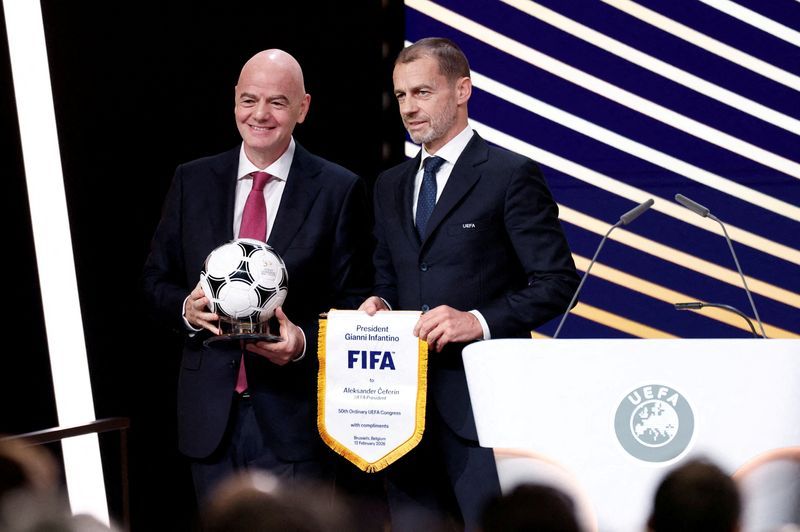
European football's governing body UEFA has initiated legal action aimed at FIFA President Gianni Infantino, filing an application with a United States federal court to obtain testimony and documents from FIFA entities based in Florida. The materials are intended to support a criminal complaint being prepared for submission in Switzerland, according to court documents reviewed by Reuters. This escalating dispute centres on a controversial proposal to bundle commercial rights from men's and women's World Cups alongside the Club World Cup into a new subsidiary vehicle called FIFA Forward Enterprise, a scheme that was eventually abandoned following intense pressure from confederations worldwide.
UEFA's legal filing contends that Infantino developed the initiative in secrecy alongside a restricted circle of financial advisers and external investors, deliberately sidestepping FIFA's established governance frameworks. The European confederation argues that the FIFA President failed to seek input from FIFA's Council, the sport's continental confederations, or FIFA's 211 member associations—entities that should have been consulted given their fundamental interest in how football's most valuable commercial assets are managed. This alleged circumvention of proper decision-making procedures forms the basis of UEFA's complaint under Article 158 of the Swiss Criminal Code, which addresses criminal mismanagement.
The specific entities from which UEFA seeks discovery are two Florida-registered FIFA companies: FIFA (AMERICAS), Inc. and FWC2026 US, Inc. UEFA maintains that these organisations hold documents and witness testimony illuminating how the FFE transaction was conceived at its inception, the structural mechanics underlying the deal, the valuation methodology employed, and the approval pathways that enabled the proposal to advance. The breadth of documentation UEFA is requesting suggests the confederation believes critical evidence regarding the transaction's handling resides within these American subsidiaries, making US court intervention necessary to compel disclosure.
The proposed transaction involved an investment group led by Thrive Eternal, an investment vehicle controlled by Joshua Kushner and linked to Thrive Capital. According to UEFA's filing, these investors were prepared to inject $4.2 billion in exchange for a permanent financial stake in FIFA's commercial operations, implying a total valuation of approximately $20 billion for the commercial rights bundle. UEFA challenges this valuation as substantially below the actual market value of FIFA's commercial portfolio, arguing that no open auction process was conducted and no independent financial specialist assessed the figure. This critique raises questions about whether FIFA's member associations—which legally own these rights—would have been adequately compensated had the deal proceeded.
The proposal gained traction during an internal FIFA process that spanned more than twelve months, yet remained concealed from external stakeholders throughout this entire period. Only when the plan was formally unveiled on July 28 did regional confederations, member associations, and the wider football community become aware of Infantino's initiative. The secrecy itself has become a focal point of UEFA's allegations, with internal FIFA communications reportedly indicating that staff members felt deliberately misled about the proposal's existence and scope. Mattias Grafstrom, FIFA's Secretary General, was reportedly excluded from the drafting process entirely, a particularly notable omission given his senior administrative position.
UEFA's response was swift and forceful. On July 30, all 55 of the confederation's member associations voted unanimously to withdraw European national teams from FIFA competitions, including the World Cup, unless the FFE proposal was immediately terminated. This threatened boycott represented perhaps the most serious institutional challenge FIFA has faced in recent years, as European football—encompassing the world's wealthiest leagues and most successful national teams—collectively signalled it would not accept the transaction. Faced with this existential threat to its flagship competitions, FIFA capitulated on July 31, with Infantino announcing the proposal's withdrawal while framing it as necessary to preserve unity within the football family rather than acknowledging governance failures.
However, UEFA's acceptance of the withdrawal came with significant conditions and reservations. The confederation agreed only to provisionally suspend its planned boycott after FIFA provided written assurances that the FFE scheme had been "irrevocably and permanently withdrawn." Yet UEFA simultaneously mandated itself to pursue every institutional, political, and legal avenue available to secure structural reforms that would restrict presidential authority and prevent similar initiatives from proceeding in future. The confederation also demanded an independent external review of how the FFE proposal had been developed and advanced, explicitly rejecting the notion that FIFA should investigate itself and expect the football community to accept its conclusions without independent scrutiny. These positions indicate that UEFA views the issue as symptomatic of broader governance dysfunction requiring comprehensive institutional remediation.
UEFA's financial critique of the proposal carries particular weight given FIFA's actual fiscal position. The confederation pointedly notes that FIFA currently maintains billions of dollars in reserves that legally belong to member associations. This observation transforms the proposal from a mere commercial transaction into a potential misallocation of collectively owned assets. UEFA's question—why would FIFA's president seek outside investors when the organisation already possesses substantial financial resources—strikes at the heart of Infantino's stated justification. If FIFA's stated purpose was expanding development funding, why structure the transaction as a sale to external investors rather than utilising existing reserves? This logical tension suggests alternative explanations motivating the proposal, whether relating to the concentration of control, the creation of personal influence networks, or other unstated objectives.
The political dimensions of this dispute extend beyond Europe's confederation. Infantino has announced his intention to seek a fourth presidential term in March 2027, a candidacy that will require support from FIFA's global membership. Currently, he retains backing from the African and South American confederations, constituencies whose voting power at FIFA's Congress provides substantial political weight. More significantly, the Saudi Arabian Football Federation announced its support for Infantino's continued leadership, framing this as backing for his efforts to "restore unity across the football family." This geopolitical dimension—wherein Middle Eastern sports interests align with African and South American confederations against European institutional concerns—illustrates how football governance disputes increasingly intersect with broader regional power dynamics affecting international sporting politics.
UEFA has already signalled its strategy should Infantino contest the March 2027 election. The confederation stated it would cooperate with partner confederations to ensure member associations are presented with an alternative candidate explicitly committed to governance reform. This represents a direct challenge to Infantino's anticipated re-election bid, transforming what might otherwise be a technical administrative matter into a contested leadership election. The criminal investigation in Switzerland adds additional pressure, creating uncertainty about potential legal liability that could complicate Infantino's political position. Whether UEFA can successfully build coalitions with other confederations to field a credible alternative candidate remains uncertain, but the confederation's explicit commitment to doing so indicates this dispute will fundamentally shape FIFA's governance trajectory for years.
The broader implications for Asian football merit consideration. Southeast Asian national associations, as well as larger confederations like those in East Asia, occupy middle positions within FIFA's power structure. These confederations typically value stability in FIFA governance and have not historically aligned strongly with either European institutional concerns or African and South American political blocs. How Asian confederations position themselves regarding the FFE controversy and the 2027 presidential election could prove decisive. If UEFA successfully mobilises global support for governance reform and alternative leadership, Asian confederations' votes could determine the outcome. Conversely, if African and South American confederations solidify their backing for Infantino despite the controversies, the outcome would signal enduring regional fragmentation within FIFA's governance structure, with implications for how international football competitions are administered and how commercial revenues are allocated across global football development.

