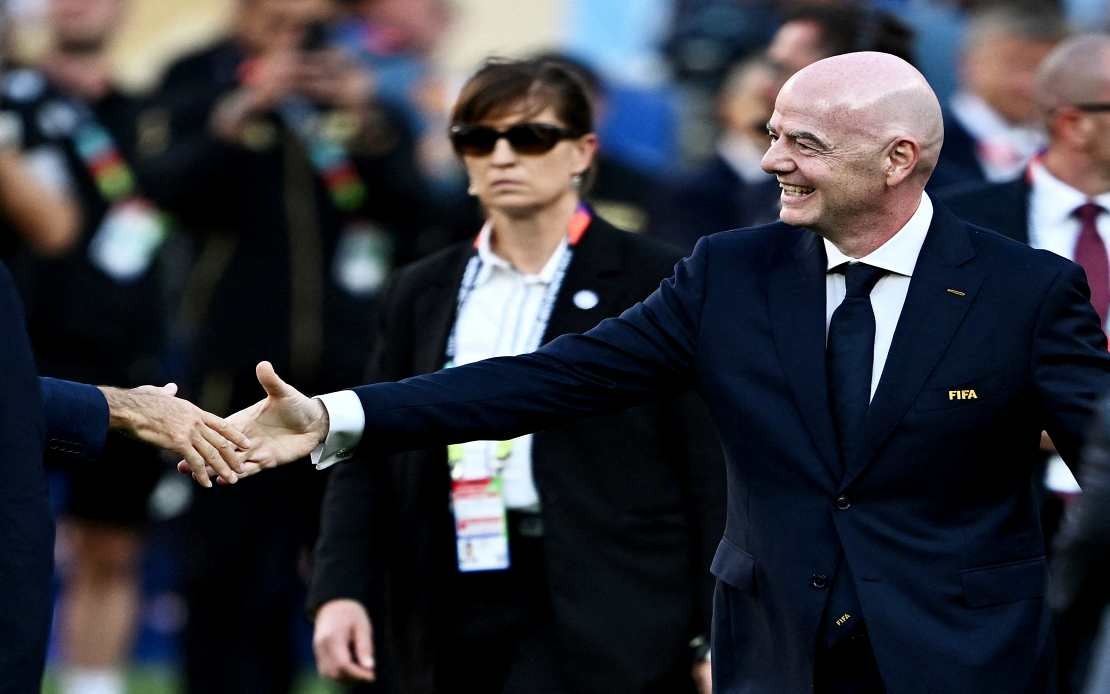
The European football governing body has escalated its dispute with FIFA to a legal threshold, issuing a formal written notice to President Gianni Infantino warning of impending lawsuit proceedings and instructing him to preserve all documentation surrounding a controversial commercial rights transaction. The move represents a significant hardening of UEFA's position following FIFA's abrupt reversal of a privatisation scheme that had threatened to restructure the international body's revenue model and governance structure.
At the centre of the controversy is FIFA's proposal, unveiled in early August, to raise approximately US$4.2 billion by selling roughly one-fifth of a newly created entity responsible for managing the organisation's media and commercial assets. This newly formed vehicle would have controlled broadcasting rights and commercial partnerships for major tournaments including the World Cup, effectively transferring significant operational control to private investors. Financial reports suggested that the initiative would substantially benefit FIFA's leadership, with Infantino's annual compensation potentially increasing from €3 million to €30 million under the restructured arrangement.
Reports indicated that the investment opportunity had attracted interest from prominent institutional players, specifically identifying a foundation connected to Joshua Kushner, brother of former US presidential adviser Jared Kushner. The involvement of individuals with connections to American political circles injected a geopolitical dimension into what ostensibly presented as a commercial transaction, raising questions about the appropriate stakeholder balance in global sports governance and the concentration of commercial football rights among wealthy external parties.
UEFA's response was swift and decisive. Within days of the announcement, the European confederation formally declared a comprehensive boycott of all FIFA-sanctioned competitions involving its member associations, signalling the organisation's determination to resist what it characterised as a threat to football's fundamental structures. This unprecedented action reflected the depth of European football's opposition and its willingness to deploy its considerable commercial and competitive leverage as a negotiating tool. For Southeast Asian football federations, many of which depend on FIFA competitions for revenue and profile, the European boycott threat posed indirect consequences through potential disruption to competitive calendars and broadcasting arrangements.
Under mounting pressure from UEFA and implicit threats to the commercial viability of FIFA competitions, Infantino capitulated on the weekend following the boycott announcement, publicly declaring that FIFA was abandoning the commercial rights sale proposal entirely. Yet this apparent capitulation has not satisfied UEFA, which views the entire episode as demonstrating fundamental failures in FIFA's governance culture and decision-making processes. The federation's leadership issued a statement expressing lost confidence in FIFA's administrative apparatus and committing to hold accountable those individuals responsible for championing the initiative.
The formal legal notice issued by UEFA represents the organisation's determination to pursue accountability through institutional and legal channels rather than accepting the mere reversal of the problematic proposal. The letter, as reported by The Telegraph, explicitly invokes considerations of legal action, arbitration, and regulatory complaints, signalling that UEFA intends to investigate whether FIFA violated any existing governance protocols, fiduciary obligations, or regulatory requirements through its proposal and execution of the sale plan. This multi-pronged legal approach reflects sophisticated institutional strategy designed to maximise pressure across multiple jurisdictional and regulatory frameworks.
Crucially, UEFA has simultaneously issued comprehensive document preservation orders, effectively placing FIFA and Infantino on notice that deliberate destruction or concealment of evidence would constitute additional potential violations. The directive requires identification and preservation of all materials—whether physical documents or electronically stored information—held by FIFA or its leadership in relation to the commercial rights proposal and associated matters. Such preservation orders are typical precursors to serious legal disputes, signalling UEFA's genuine intention to pursue substantive proceedings and gather evidence supporting potential claims.
For Malaysian and regional football stakeholders, this institutional conflict within FIFA's leadership carries tangible implications. The proposed commercial restructuring would have affected how developing football nations access revenues from international competitions, potentially concentrating even greater control over broadcast rights and commercial partnerships among wealthy private entities and wealthy nations. UEFA's successful resistance to this proposal, therefore, protects the relative interests of smaller and developing football federations in maintaining diverse revenue streams and retaining meaningful input into governance decisions affecting global football.
The episode also exposes enduring tensions within FIFA's governance framework between European football's historical dominance and the international federation's ostensible commitment to inclusive representation. European football's commercial significance, combined with UEFA's institutional coherence and willingness to coordinate unified action, enabled the confederation to exercise effective veto power over FIFA strategic proposals. For other continental confederations, including the Asian Football Confederation and ASEAN's member federations, the episode underscores both the advantages of coordinated regional action and the challenges faced by less commercially powerful confederations in influencing FIFA decision-making.
The legal battle now looming between UEFA and FIFA raises fundamental questions about FIFA's accountability mechanisms, the appropriate balance between commercial innovation and institutional governance, and the degree to which FIFA's leadership retains decision-making authority over the organisation's fundamental structures. UEFA's willingness to deploy both commercial leverage and legal mechanisms suggests that the resolution of this dispute will establish important precedents for how FIFA's continental confederations can exercise influence and constraint over the international federation's strategic directions.
Looking forward, the preservation notice effectively freezes all documentation and communications related to the proposal, preventing selective destruction or convenient loss of records that might undermine UEFA's legal position. This manoeuvre transforms the episode from a temporary governance crisis into a potential long-running institutional and legal struggle that could reshape FIFA's corporate structure and leadership accountability standards. For Southeast Asian football administrators observing from the periphery, the conflict illustrates the continuing significance of European football's institutional power and the importance of coordinated regional action in defending collective interests within FIFA's complex and occasionally contentious governance architecture.

