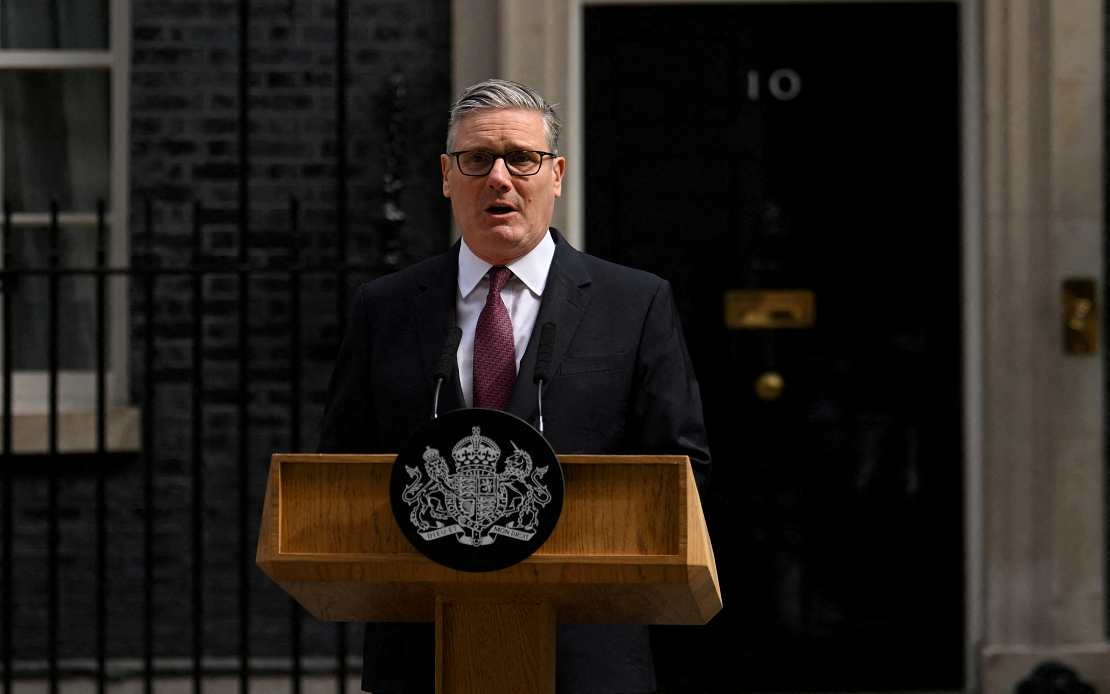
British Prime Minister Keir Starmer has issued an urgent appeal for the resumption of ceasefire talks between the United States and Iran, as tensions along one of the world's most critical shipping lanes threaten global commerce. Speaking at a joint press briefing in Paris alongside French, German, and Ukrainian leaders following a "coalition of the willing" security meeting, Starmer warned that the escalating cycle of strikes between the two powers must be broken through renewed diplomatic engagement.
The British premier delivered a pointed condemnation of Iranian actions, specifically targeting what he characterised as unprovoked attacks on commercial shipping and military installations operated by Gulf partner nations. "I utterly condemn Iran's strikes on commercial shipping and on our Gulf partners. These attacks must stop," Starmer declared, signalling Britain's unequivocal alignment with Western security concerns in the region. His remarks underscored growing alarm among European capitals over the destabilisation of maritime trade in the Strait of Hormuz, a waterway through which approximately one-third of globally traded seaborne oil passes daily.
Despite his forceful criticism of Iranian conduct, Starmer indicated that the British government remained committed to resolving the crisis through negotiated settlement rather than further military escalation. He expressed explicit support for diplomatic channels, stating that London stood prepared to contribute military assets if such deployment could facilitate the restoration of safe passage for commercial vessels through the contested waterway. This nuanced position reflects Britain's delicate balancing act between supporting American security interests and maintaining its own diplomatic leverage with regional actors.
The ceasefire framework that Starmer referenced had previously been established following a memorandum of understanding signed in June, which was intended to terminate the US-Israeli military campaign that erupted in late February. Under that agreement, Iran had pledged to reopen the Strait of Hormuz to unrestricted international shipping, a commitment viewed as essential to stabilising regional trade and preventing economic fallout across Asia-Pacific markets, including Malaysia's critical petroleum sector.
However, the resumption of hostilities over the weekend dramatically altered the diplomatic landscape. President Donald Trump announced that the United States would reinstitute comprehensive economic sanctions against Iran and would effectively establish a toll system for maritime passage through the strait, charging vessels for safe conduct through contested waters. This declaration represented a significant hardening of the American position and suggested that the Trump administration viewed the June ceasefire agreement as obsolete or inadequately binding.
Iran's role in reopening versus closing the strategic waterway has profound implications for Southeast Asian economies, particularly those heavily dependent on oil imports and global shipping networks. Malaysia, as a major maritime trading nation and energy consumer, faces direct exposure to any prolonged disruption of Hormuz transit routes. Higher insurance premiums, extended shipping times, and elevated fuel costs would ripple through Malaysian manufacturing and consumer sectors, making regional stabilisation a matter of economic self-interest rather than abstract geopolitical concern.
The Iranian side's decision to conduct renewed strikes over the weekend indicated that the diplomatic window was rapidly closing. By resuming offensive operations, Tehran signalled either a fundamental rejection of the ceasefire framework or a calculated escalation designed to demonstrate resolve and deter further American military action. The Iranian closure of the Strait of Hormuz, which had occurred during the earlier phases of the February conflict, had previously triggered spikes in global oil prices and threatened shipping safety for vessels transiting through the congested waterway.
Starmer's call for unrestricted freedom of navigation alongside ceasefire restoration addresses the core economic anxiety driving British policy. The phrase "remaining issues" in his statement hints at deeper disputes beyond the immediate military hostilities—likely encompassing sanctions relief, nuclear programme restrictions, and the broader architecture of Iran's regional role. These substantive disagreements will require sustained diplomatic effort rather than mere military posturing.
The involvement of French, German, and Ukrainian leaders in this coordinated statement reflects broader Western attempts to construct a unified diplomatic front on Middle Eastern instability. European capitals recognise that prolonged Iran-US conflict destabilises energy markets affecting their own economies and complicates their strategic positioning amid broader US-China competition. For Malaysian policymakers monitoring the situation, the unified European messaging suggests that international pressure on both Tehran and Washington to de-escalate may intensify in coming weeks.
London's readiness to deploy naval assets signals Britain's commitment to the international maritime order and its willingness to underwrite global trade security independently of formal coalitions. However, the effectiveness of such measures depends entirely on both Iran and the United States accepting de-escalatory diplomatic solutions. Military deployments, while reassuring to shipping companies and insurance firms, cannot substitute for genuine political agreement between the primary antagonists.
The timing of Starmer's intervention is significant, arriving as the diplomatic moment may be closing rapidly. If current escalatory trends continue unchecked, the prospect of comprehensive conflict—with attendant consequences for global energy supplies and shipping networks—becomes increasingly real. For Malaysia and Southeast Asia, the stakes extend beyond humanitarian concerns to encompass direct economic consequences affecting inflation, employment, and regional stability.

