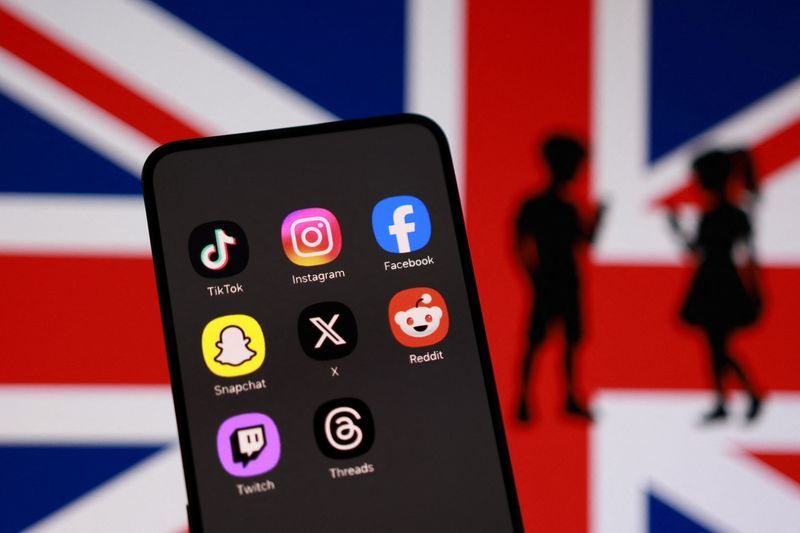
Britain's government is moving forward with aggressive new safeguarding measures that will automatically restrict social media access for teenagers between midnight and 6am, marking an escalation in the nation's approach to protecting young people from the documented harms of digital platform use. The announcement, made in mid-July, represents the second major legislative salvo within a month, following an earlier proposal to prohibit social media use entirely for anyone under 16. The default curfew applies specifically to users aged 16 and 17, who will need to actively change their app settings to regain access during overnight hours.
Under the new framework, teenagers in the affected age group will find themselves unable to access popular platforms between midnight and 6am unless they manually modify their account settings. Alongside the temporal restriction, social media companies will be required to disable features specifically designed to encourage prolonged engagement—often referred to as infinite scroll or algorithmic recommendations tailored to keep users scrolling indefinitely. This dual approach targets both the timing of access and the mechanisms that platforms employ to maximise user retention, acknowledging that young people's sleep deprivation is partly driven by the addictive design of these applications.
The British initiative reflects mounting international alarm about social media's impact on adolescent wellbeing. Parents, educators, and mental health professionals across developed democracies have expressed serious concerns regarding the relationship between intensive social media use and rising rates of anxiety, depression, and sleep disorders among teenagers. Technology Minister Liz Kendall articulated the government's rationale, emphasising that the measures would help young people obtain adequate sleep, maintain academic focus, and allocate more time to offline relationships and activities. This framing positions digital regulation not as an infringement on teenage autonomy but as a necessary public health intervention.
Implementation will be mandated by law, with tech companies facing the prospect of substantial regulatory penalties for failing to comply. Online Safety Minister Kanishka Narayan stated unequivocally that the government is not requesting voluntary compliance—platforms will be legally obligated to enforce the curfew system. Narayan also underscored that technology firms must improve their age-verification processes, warning that companies which neglect robust age checks will encounter severe regulatory consequences. This explicit enforcement language suggests the government has learned from previous attempts to regulate the tech industry through softer, non-binding agreements.
The regulatory timeline indicates that the government intends to move deliberately but not hastily. Draft regulations will be presented to parliament by the end of the calendar year, with the actual enforcement of these restrictions anticipated for spring 2027. This approximately 18-month implementation window provides technology companies time to redesign their systems while signalling to the public that the government is treating the issue with seriousness and urgency. The extended timeline may also reflect the complexity of implementing age verification at scale across diverse platforms and user bases.
However, the proposals have already encountered political criticism from opposition figures. Laura Trott, education policy chief for the Conservative Party, characterised the curfew approach as logically incoherent, arguing that allowing 16- and 17-year-olds to override restrictions at will undermines the entire purpose of the safeguard. Her critique raises a substantive question about enforcement efficacy: if teenagers can effortlessly bypass the midnight restriction, will the measure meaningfully reduce late-night usage or merely create a performative compliance facade? This tension between regulatory intent and practical implementation effectiveness will likely dominate parliamentary debate.
The British government's approach must be understood within a broader global context of escalating social media regulation. Australia recently became the first nation to implement an outright ban on social media for under-16s, though evidence already suggests that enforcement faces significant obstacles. An advisory team that studied Australia's ban discovered that technology platforms struggle fundamentally with age-verification implementation, a prerequisite step that some companies are apparently failing to complete robustly. If major platforms cannot reliably verify user age at the initial authentication stage, then downstream restrictions—whether curfews or content filters—become practically meaningless.
This implementation gap represents perhaps the most serious threat to the UK's regulatory ambitions. The government's framework assumes that once a teenager's age is properly verified, the platform can reliably enforce temporal access restrictions. Yet if companies have already demonstrated inability or unwillingness to conduct thorough age verification, the entire regulatory edifice becomes vulnerable. The threat of regulatory sanctions and financial penalties may eventually incentivise better compliance, but the track record from comparable jurisdictions suggests that platforms often view enforcement costs as an acceptable business expense.
The regulatory conversation has also been influenced by recent legal developments in the United States. Both Google, owner of YouTube, and TikTok's parent company ByteDance settled lawsuits brought by a minor who alleged that social media platform exposure caused psychological damage. These settlements, announced within weeks of the UK announcement, underscore the legal liability that tech companies now face in multiple jurisdictions. The cumulative weight of regulatory pressure from Britain, Australia, the European Union, and the United States appears to be shifting the corporate calculus, though technology firms have so far declined to comment on the UK's specific proposals.
For Malaysian and Southeast Asian observers, the British initiative presents both cautionary lessons and potential models. As countries across the region grapple with rising rates of youth mental health problems and growing parental anxiety about social media exposure, the UK's regulatory experiments provide valuable case studies. Malaysia's own regulatory framework remains less comprehensive than Britain's emerging approach, though the government has periodically expressed concern about online safety. The British experience suggests that regulation requires statutory teeth—voluntary corporate responsibility commitments have repeatedly proven insufficient—but also that enforcement mechanisms must address the technical architecture of platforms, not merely their policy documents.
The success or failure of Britain's midnight curfew scheme will reverberate throughout the international regulatory community. If the implementation proves effective at reducing late-night teenage social media use while remaining difficult for young people to circumvent, other nations will likely adopt similar models. Conversely, if teenagers routinely override the restrictions and tech companies drag their feet on compliance, regulators elsewhere may conclude that more intrusive measures—such as the Australian blanket ban—are necessary. The coming 18 months represent a critical test case for whether democratic governments can effectively constrain the behaviour of global technology corporations through targeted regulation.

