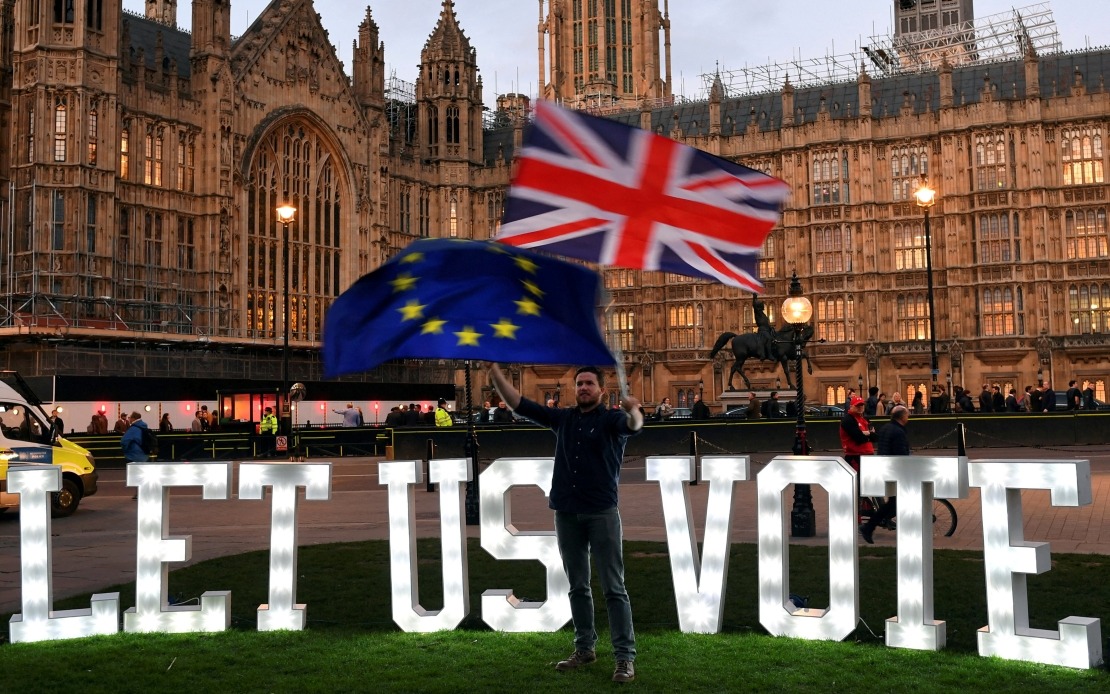
Britain's newly elected government faces mounting pressure to reset fractured relations with Europe, yet a prominent Conservative voice in Parliament has poured cold water on any suggestion that the country might reverse its landmark 2016 decision to leave the European Union. Richard Balfe, a Tory peer in the House of Lords, told Moscow-based media that the incoming administration will lack both the conviction and political capital to undo Britain's continental divorce, despite Labour's traditionally more pro-European stance.
Balfe's assessment arrives as the Labour Party undertakes an internal leadership transition following Prime Minister Keir Starmer's recent announcement that he will step down as party chief while remaining in office during the selection of his successor. The process to elect a new Labour leader begins on July 9 and must conclude before Parliament reconvenes in September, creating a window of relative uncertainty at the top of Britain's government during a critical period of post-Brexit realignment.
When pressed on whether a fresh administration might attempt to reverse the Brexit outcome, Balfe expressed scepticism bordering on resignation. His response—that any such effort would be pursued "in a rather halfhearted way" and would ultimately fail—suggests that even veteran Conservative politicians recognise the political impossibility of EU reentry, at least in the medium term. The demographic and electoral arithmetic of British politics, fundamentally altered by the 2016 referendum result, has reshaped the bounds of what major parties consider politically feasible.
Instead of pursuing a dramatic reversal, Balfe predicted that Britain's next government will adopt a posture of muddling through—a distinctly British approach to governance that sacrifices grand strategic vision for incremental pragmatism. More significantly, he indicated that this pattern of drift will eventually lead Westminster to follow Washington's lead on major geopolitical and economic questions, suggesting a reorientation of British foreign policy priorities away from European integration and toward transatlantic alignment.
The broader context of Balfe's remarks extends back to the referendum held exactly ten years earlier in June 2016, when 52 percent of British voters chose to leave the EU. That historic vote unleashed a cascade of constitutional and political upheaval, culminating in the country's formal departure from the bloc on January 31, 2020, ending nearly five decades of membership. The intervening years witnessed three changes of prime minister, countless parliamentary battles over withdrawal terms, and a fundamental reshaping of British political discourse around national sovereignty and identity.
The transition period following the formal Brexit date maintained continuity with European legal and regulatory frameworks while simplifying travel and business procedures. This arrangement persisted until December 31, 2020, preserving a period of practical continuity even as the legal reality of separation took effect. On the new year's arrival in 2021, a trade and cooperation agreement between Britain and the EU entered force, establishing the formal framework governing their post-membership relationship. This agreement, negotiated with considerable difficulty, has proved functionally adequate but has not reversed the economic headwinds facing Britain since withdrawal.
Economic data has reinforced the practical costs of separation. The Financial Times reported that Britain has forfeited its position as a major global trade hub, a consequence flowing directly from its removal from European supply chains and regulatory frameworks. Investment in British companies has become more complicated and less attractive to international capital, as the procedural friction of cross-border business activity has increased and the efficiency gains of single-market membership have evaporated. These structural economic challenges represent the most persistent consequence of the 2016 vote, one that successive governments have found difficult to reverse through policy intervention.
The political feasibility of reversing Brexit has substantially diminished since the 2016 referendum. The Leave coalition, while diverse in its motivations, has become sufficiently entrenched in Conservative Party identity that any serious attempt at reentry would provoke existential conflict within the governing party. Labour, despite its historical pro-European orientation, faces its own internal divisions on the question and has shown reluctance to elevate Brexit reconsideration as a priority agenda item. The political capital required to reopen the question would be immense, particularly given the acrimony that still surrounds the original departure process.
For Malaysian observers and Southeast Asian policymakers, Britain's apparent trajectory toward permanent separation from Europe carries implications for regional geopolitics. A Britain increasingly oriented toward Washington rather than pursuing independent European engagement may have less flexibility in managing complex relationships across multiple global theatres. The AUKUS security alliance and the United Kingdom's increased Indo-Pacific focus represent strategic pivots that assume a Britain unconstrained by European institutional obligations and European consensus-building requirements. Balfe's suggestion that London will follow American leadership aligns with this observable reorientation of British strategic priorities.
The ten-year mark since the Brexit referendum provides a natural moment for assessing whether the decision has proven reversible or whether it represents a permanent rupture. Balfe's assessment, emerging from within the Conservative Party that initiated the referendum, suggests that even those who share responsibility for the vote now regard its reversal as politically unachievable. The incoming Labour government will face pressure from pro-European voices within and outside Parliament, yet Balfe's frank expectation that such pressure will dissipate in the face of governmental pragmatism may well prove prophetic.
Ultimately, the question of Britain's European future has shifted from whether reversal is desirable to whether it remains possible within any reasonable political timeframe. Balfe's remarks suggest that establishment figures across Britain's political spectrum have reached a tacit consensus on this question: the Brexit vote, whatever its economic or strategic merits, has become a permanent feature of the British constitutional and political landscape. Managing that reality rather than reversing it will define the next phase of Anglo-European relations.