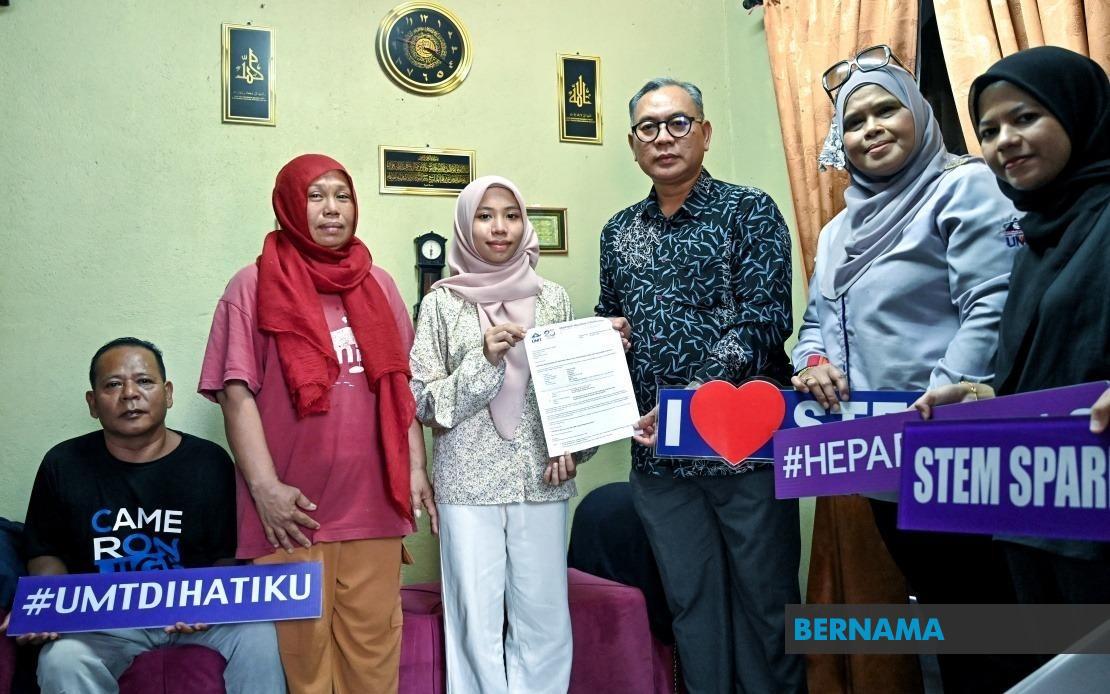
When Nurul Amira Abdul Hamid received her university admission offer, she faced an agonising dilemma common to many Malaysian families of modest means: the prospect of higher education seemed within grasp, yet financially unattainable. The teenager from Parit Jawa in Bagan Serai had secured strong grades, earning three As in her SPM examination, but her path forward appeared blocked by circumstances beyond her control. Her father, Abdul Hamid Othman, was struggling with health issues while her mother, Asmah Che Ros, managed the household without formal employment. Rather than watch her daughter's academic ambitions dissolve, Nurul Amira took matters into her own hands, working part-time at a general goods store for RM1,300 monthly to contribute to her family's survival.
The breakthrough came when Universiti Malaysia Terengganu (UMT) demonstrated institutional commitment to social mobility and educational access. Upon learning of Nurul Amira's predicament, the university did not simply offer token assistance or expect her to navigate bureaucratic processes alone. Instead, UMT proactively engaged with her and her parents, understanding the full scope of their difficulties and crafting a comprehensive support package. The university secured the Al-Ikhlas Scholarship worth RM500 specifically for Nurul Amira, while simultaneously covering additional fees that would have otherwise burdened her family further. This intervention transformed what appeared to be an insurmountable obstacle into an achievable goal, allowing her to enrol in the one-year Science, Technology, Engineering and Mathematics (STEM) Foundation programme before progressing to her intended Bachelor's degree in Science, specialising in Nautical Science and Maritime Transportation.
What distinguishes UMT's approach from mere charitable gestures is the institution's recognition that financial barriers to education extend beyond tuition fees alone. The university committed to providing living assistance throughout Nurul Amira's study period, acknowledging that students from economically disadvantaged backgrounds face daily costs—accommodation, meals, transportation, study materials—that frequently force talented young people to abandon their education despite gaining admission. This holistic approach removes the constant financial anxiety that typically accompanies tertiary studies for low-income families, allowing students to concentrate on their academic work rather than perpetually worrying about making ends meet.
UMT Vice-Chancellor Prof Dr Mohd Zamri Ibrahim articulated a philosophy increasingly recognised as essential for inclusive higher education development across Malaysia. He emphasised that the university does not operate on the principle that students must fit the institution's financial framework; rather, the institution adapts to serve students' genuine needs. His statement that "if any student cannot afford to pay the fees, come to the university first and we will help" represents a significant shift from the passive, applicant-driven model where institutions expect families to navigate support mechanisms independently. This proactive engagement model requires universities to invest in outreach and student welfare services, creating dedicated channels through which disadvantaged students can communicate financial difficulties without shame or stigma.
The scale of UMT's effort becomes clearer when examining the broader context of this year's assistance. The university has already supported more than 10 students from underprivileged families, suggesting systematic rather than ad-hoc intervention. For a regional university in Terengganu, this represents substantial commitment to ensuring that economic circumstances do not determine educational outcomes. Such programmes possess particular significance in Malaysia's context, where tertiary education increasingly shapes employment prospects and earning potential, yet many talented students remain unable to access degree-level study due to household poverty.
Nurul Amira's story illuminates the complicated intersection of educational aspiration and economic reality in contemporary Malaysia. Her achievement in securing three As at SPM demonstrated academic capability, yet without institutional support, she would have joined the significant cohort of capable students whose potential remains unrealised. The decision to work in a retail position rather than pursue studies represents a rational economic calculation made by many Malaysian families where higher education appears unaffordable. That calculation changes only when universities actively intervene to reduce financial barriers, signalling that talent matters more than family wealth.
The maritime sector holds particular relevance for Malaysia's economic future, given the nation's extensive coastlines, strategic position on international shipping routes, and emerging opportunities in blue economy development. By removing financial obstacles to recruitment into Nautical Science and Maritime Transportation programmes, UMT simultaneously develops human capital for a sector critical to national prosperity. Nurul Amira's pursuance of this specialised field represents not merely individual advancement but contribution to Malaysia's maritime industry capacity and competitiveness.
From a policy perspective, UMT's model offers instructive lessons for other Malaysian higher education institutions confronting similar challenges of equity and access. Public universities receive government funding intended partly to serve the public interest, including reducing socioeconomic disparities in educational achievement. When individual universities adopt systematic approaches to identifying and supporting low-income students, they operationalise this mandate in concrete fashion. The Al-Ikhlas Scholarship funding mechanism, combined with living assistance provisions, demonstrates how dedicated resources coupled with institutional commitment can overcome financial barriers that might otherwise prove insurmountable.
The psychological dimension of Nurul Amira's experience deserves recognition alongside the practical financial assistance. She explicitly described feeling "elated and very grateful" upon learning that UMT would support her, emotions reflecting not merely relief at crisis avoidance but validation that her academic aspirations possessed worth regardless of family circumstances. This affirmation proves crucial for young people from low-income backgrounds, who frequently internalise societal assumptions that tertiary education belongs to children of more affluent families. When universities actively demonstrate that disadvantaged students represent valued institutional members deserving institutional resources, transformative psychological effects accompany the material financial support.
Looking forward, Nurul Amira's progression through the STEM Foundation programme and subsequent Bachelor's degree studies will constitute a lived demonstration of what becomes possible when institutional barriers align with student aspiration. Her successful completion would vindicate UMT's investment while potentially inspiring other low-income families to pursue higher education rather than accepting constrained economic horizons as inevitable. Success stories, when effectively communicated, reshape community perceptions about educational accessibility and encourage other talented students in similar circumstances to seek admission to higher education institutions.
The distinction between formal admissions processes and genuine educational access remains critical in Malaysia's development trajectory. Nurul Amira received an admission offer, indicating she met academic criteria, yet faced potential inability to enrol. Universities that stop at admissions without ensuring financial access effectively exclude capable students through economic gatekeeping rather than merit assessment. UMT's comprehensive approach—combining financial assistance, living support, and proactive engagement—bridges this gap between theoretical access and practical reality, embodying an institutional commitment to the proposition that Malaysian talent should develop regardless of parental wealth.

