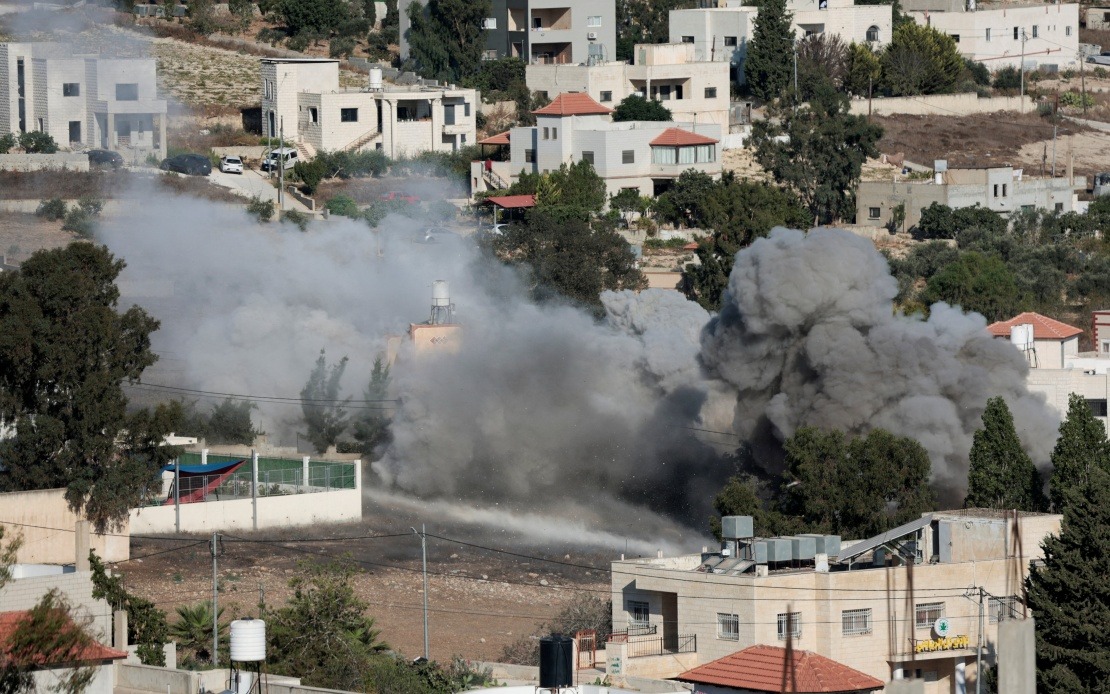
The United Nations Human Rights Office operating in the Occupied Palestinian Territory has issued a stark warning about the deteriorating security situation facing Palestinian civilians, characterizing the frequency and severity of settler-initiated violence as having crossed into territory that can no longer be tolerated. The office's assessment, released this week, underscores deepening concerns about the vulnerability of Palestinian communities caught between organised settler campaigns and what it describes as insufficient protective action from Israeli security forces.
According to the UN Human Rights Office, the pattern of aggression extends across multiple dimensions of civilian vulnerability. Settlers have engaged in home invasions, perpetrated physical assaults on residents, destroyed property through vandalism, stolen possessions and land, and committed arson attacks. In one particularly troubling incident, a local mosque fell victim to settler violence. These actions collectively paint a picture of systematic harassment designed to make Palestinian life untenable and force communities to abandon their land and property.
One of the most severe documented cases illustrates the scope and coordination of settler operations. In July of this year, residents of three Palestinian homes near Qusra, located south of Nablus, found their access to essential services severed when settlers from a nearby outpost cut off both water and electricity supplies. The situation deteriorated further on August 9, when settlers barricaded all entrances and exits to the properties, erecting a tent structure that effectively imprisoned the residents. Over three days, approximately 15 people—including at least two children—remained trapped in their homes, unable to access food, water, medical care or sanitation facilities. When Palestinian families appealed to Israeli military personnel stationed at the site for assistance, their requests went unanswered, and security forces simultaneously prevented paramedics, human rights monitors and journalists from accessing the sealed-off area. Only on August 12 did soldiers dismantle the tent, yet the settlers remained in position, continuing their blockade.
The UN Human Rights Office framed these incidents not as isolated actions but as part of a coordinated strategy backed implicitly or explicitly by the state apparatus. The office contends that the criminal conduct perpetrated by settlers, combined with what it characterises as tacit Israeli governmental approval or at minimum failure to prevent such conduct, amounts to a calculated campaign of displacement. The immediate stakes for the three Qusra families are severe: forced displacement looms as a concrete possibility within an accelerating timeline.
This analysis aligns with earlier assessments by the International Court of Justice, which has determined that all Israeli settlements in occupied territories violate international law. The ICJ has previously mandated that Israel must discontinue all settlement expansion, evacuate colonists from established outposts, and terminate its occupation of the West Bank. The Qusra and Jalud regions have become focal points of this broader legal and humanitarian dispute, with settler populations there specifically implicated in campaigns against Palestinian residents.
The UN Human Rights Office has articulated specific obligations that it contends Israel must fulfil under international humanitarian law. These responsibilities include preventing settler violence through active monitoring and deterrence, conducting thorough criminal investigations when attacks occur, and ensuring that perpetrators face proportionate penalties through the judicial system. Currently, according to the UN assessment, accountability mechanisms remain inadequate, allowing perpetrators and their supporters to operate with minimal legal consequences.
The strategic context for these escalations deserves scrutiny. The establishment of a new settler outpost near Qusra in November 2025 marked an inflection point, with attacks intensifying significantly following that expansion. This sequence suggests a pattern where new settlement construction correlates with heightened aggression against neighbouring Palestinian populations, potentially reflecting coordinated efforts to consolidate territorial control through both demographic and intimidation-based means.
For regional observers and policymakers, particularly in Southeast Asia, this situation exemplifies the ongoing consequences of unresolved conflict and the vulnerability of civilian populations when international legal frameworks lack enforcement mechanisms. Malaysia, which maintains long-standing advocacy for Palestinian rights through various multilateral forums, may view this documented escalation as reinforcing arguments for stronger international intervention and accountability mechanisms.
The broader implications extend to questions about the efficacy of current international human rights monitoring and the gaps between documented abuses and tangible protective action. The presence of UN Human Rights Office personnel documenting these violations represents important accountability infrastructure, yet the continuation of attacks despite such documentation highlights the limitation of monitoring without accompanying enforcement capacity.
For the three families currently trapped in the cycle of settler encroachment and state non-intervention, the window for preventing forced displacement narrows daily. The UN Human Rights Office's statement serves as both documentation and plea, creating an official record while calling upon international actors to move beyond condemnation toward concrete preventive measures. The office's emphasis on time running out suggests that absent rapid intervention, displacement becomes an increasingly probable outcome.

