The US Open women's tennis championship begins this Sunday with an unusually fragile hierarchy at the top of the draw, potentially benefiting former winners Coco Gauff and Iga Swiatek who have demonstrated surging momentum heading into the hardcourt showdown in New York. The absence of reliable form from the top two seeds has created genuine uncertainty about the tournament's trajectory, opening pathways for players who have rediscovered their competitive edge at precisely the right moment in the season.
Aryna Sabalenka, the world's top-ranked player and defending champion, arrives at Flushing Meadows with significant concerns hanging over her candidacy. The Belarusian has endured a disappointing second half of the season, marking a stark contrast to her dominance earlier in the year when she secured the Australian Open and won the Sunshine Double. Since those early victories, Sabalenka has failed to reach a single final, a troubling pattern that undermines her pursuit of an extraordinarily rare third consecutive US Open title. Such an achievement would position her alongside only a select historical company—she would become merely the third woman in the Open Era to accomplish a three-peat at Flushing Meadows, joining only Serena Williams, who won three consecutive titles between 2012 and 2014.
Elena Rybakina, seeded second in the women's draw, faces her own obstacle in the form of a leg injury sustained during her early exit from the Cincinnati Masters. This physical setback casts genuine doubt over her capacity to compete at the highest level throughout a two-week major tournament that demands consistent physical intensity. Former world number four and ESPN commentator Mary Joe Fernandez observed that Sabalenka's vulnerability stems from her inability to secure crucial points in tight moments, suggesting a mental rather than purely technical deterioration during competitive stretches.
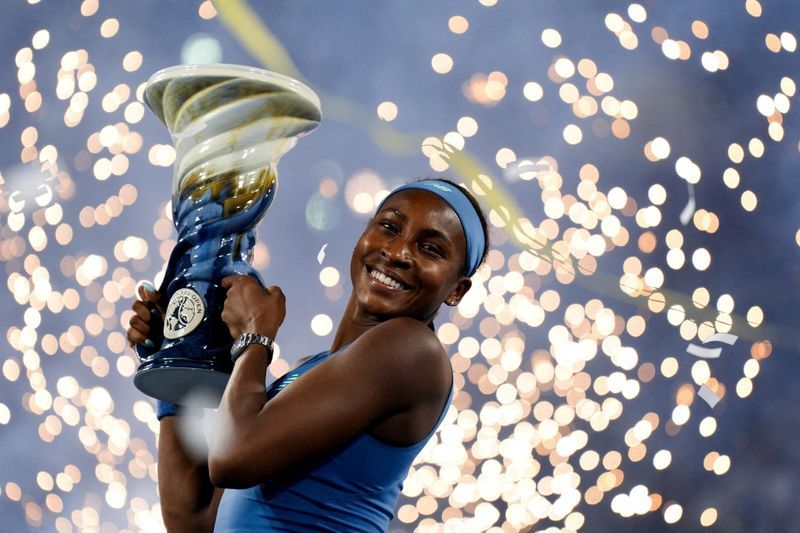
By contrast, Gauff, the 2023 US Open champion and currently ranked fourth globally, has constructed a formidable narrative heading into the tournament. The American player has methodically rebuilt her serve into a genuine competitive weapon rather than a liability, demonstrating this transformation during her semifinal run at the Canadian Open in Toronto before clinching her first title of the season in Cincinnati with a performance radiating renewed confidence. Her achievement in Ohio, captured in a direct victory over Rybakina, represents precisely the kind of psychological momentum that translates meaningfully in major championship environments. New York crowds have historically favored American competitors, and Gauff's status as a homegrown talent competing on American soil provides an additional psychological advantage that cannot be overlooked.
Fernandez's assessment underscored Gauff's position as the player currently displaying the most consistently excellent tennis, an observation supported by her performances across consecutive tournaments rather than isolated victories. Alongside Gauff, American fourth seed Jessica Pegula carries the additional burden of national pride, as American women have conspicuously failed to reach any final at the three preceding major championships this year. This extended drought at the sport's biggest stages adds emotional weight to both Gauff's and Pegula's campaigns in New York.
Swiatek's trajectory this season has resembled a demanding journey marked by internal self-doubt and external criticism within her native Poland. The six-time major winner, currently ranked eighth, had struggled to progress beyond the quarterfinal stage at any of the year's major tournaments prior to the North American hardcourt swing. She candidly acknowledged the psychological complexity of her season, describing how impatience and premature expectations for results had temporarily compromised her technical preparation. However, her breakthrough victory in Toronto over Rybakina just weeks before the US Open has injected renewed conviction into her campaign, arriving at precisely the moment when tournament intensity escalates toward its conclusion.
The competitive depth below the top seeds creates a multifaceted challenge for traditional favorites. Mirra Andreeva, the Russian teenager who claimed her maiden major championship at Roland Garros earlier this year, represents an emerging threat whose breakthrough success suggests genuine capacity for sustained performance at the highest competitive level. Czech player Linda Noskova has similarly announced her presence in elite women's tennis through a breakthrough Wimbledon title just weeks prior, capturing the attention of major championship observers. Alexandra Eala of the Philippines has emerged as an unexpected contender after defeating both four-time major winner Naomi Osaka and Jessica Pegula to capture the WTA 500 title in Washington, DC, delivering a statement victory that cannot be dismissed as anomalous.
Naomi Osaka, the US Open champion in both 2018 and 2020, returns to the tournament following her return from maternity leave and a semifinal appearance last year that demonstrated her capacity to rekindle previous brilliance. Though Osaka has not won a major title since the 2021 Australian Open, her recent consistency, including a final appearance at Bad Homburg in June, has rekindled hope among observers that another championship may materialize. The New York crowd's characteristic adoration of Osaka, particularly given her return narrative, provides yet another compelling storyline within an already complex competitive landscape.
Espn commentator Patrick McEnroe, declining to characterize the women's draw as completely unpredictable, nonetheless identified between six and eight legitimate contenders capable of hoisting the trophy, an assessment that reflects genuine competitive uncertainty rather than conventional concentration of power among the traditional favorites. This expanded pool of plausible champions fundamentally distinguishes this year's US Open women's tournament from recent editions where top-seeded players have demonstrated clearer dominance. The convergence of Gauff's rediscovered confidence, Swiatek's timely resurgence, the top seeds' documented vulnerabilities, and the emergence of unexpected challengers has created tournament conditions where multiple outcomes appear genuinely feasible rather than predetermined by ranking hierarchies.

