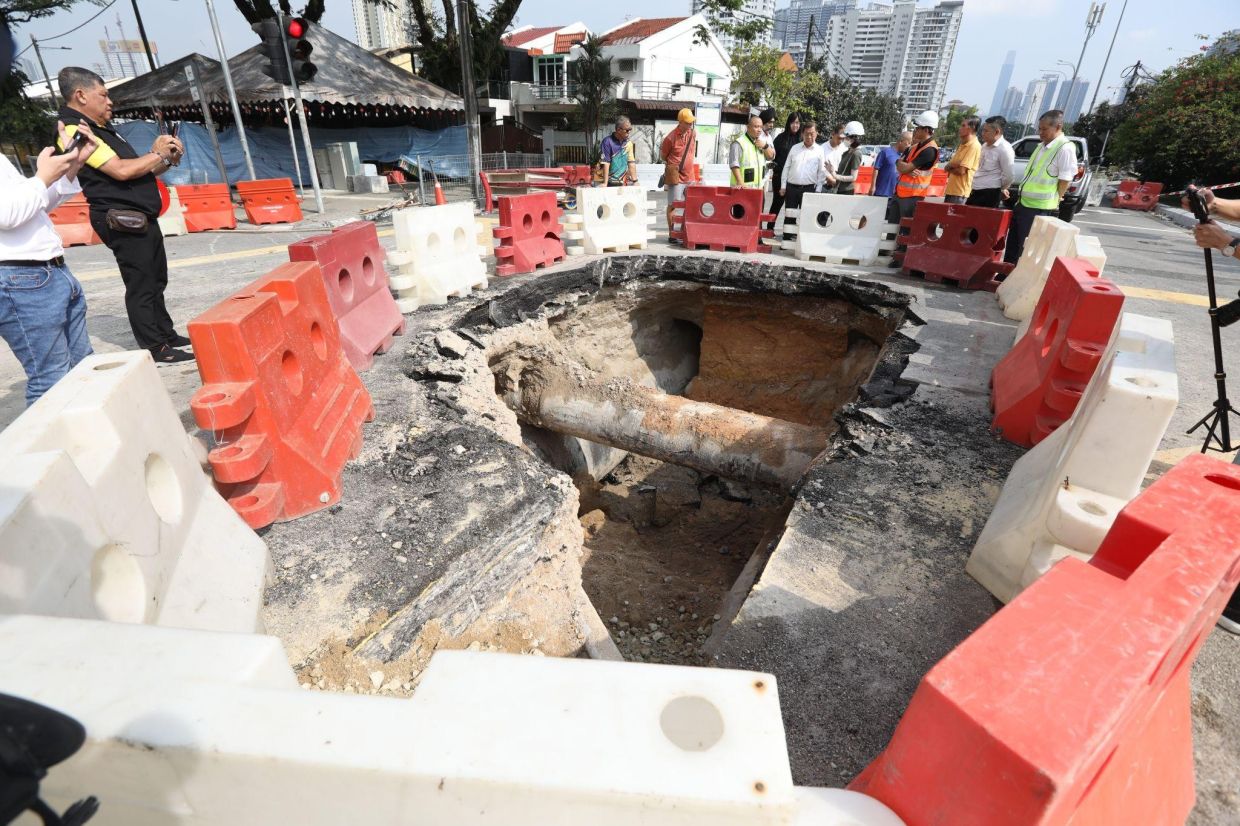
As Malaysia grapples with the mounting consequences of extreme weather, sinkholes have emerged as a pressing infrastructure challenge, threatening public safety and disrupting urban landscapes. The phenomenon reflects a complex interplay of environmental stressors and ageing underground systems struggling under unprecedented pressure. Indah Water Konsortium (IWK), the nation's principal sewerage operator managing approximately 22,500 kilometres of public sewer pipelines, has recognised that climate intensification demands a fundamental reimagining of how Malaysia maintains and monitors its vital subterranean infrastructure.
Sinkhole formation stems from multiple interconnected causes rather than any single mechanism. Natural geological conditions, shifts in underground water tables, construction vibrations, and the deteriorating condition of buried pipes collectively create conditions where sudden surface collapses become increasingly likely. Because each incident presents a distinctive configuration of contributing factors, specialists must conduct comprehensive technical investigations to establish causation. This diagnostic complexity underscores why generic solutions prove inadequate and why tailored, location-specific responses become essential for prevention.
IWK's operational challenge intensifies when examining the network's structural composition. The utility prioritises monitoring of critical reinforced concrete trunk sewers exceeding 600 millimetres in diameter, which function as arterial conduits channelling high-velocity sewage flows across urban centres. These major pipelines typically operate at or approaching maximum capacity, exposing concrete surfaces to relentless corrosive attack from hydrogen sulphide gas that accumulates during prolonged retention. This biochemical degradation gradually weakens structural integrity, rendering pipes increasingly susceptible to rupture and collapse over time. The concentration of high-velocity flow combined with chemical erosion creates a uniquely hostile environment where infrastructure deteriorates substantially faster than in conventional conditions.
Heavy precipitation amplifies sinkhole risk through multiple simultaneous mechanisms. When intensive rainfall saturates surrounding soils, ground stability diminishes markedly whilst hydrostatic pressure builds within sewer conduits. According to IWK Chief Executive Officer Narendran Maniam, this combination proves particularly destructive: excessive water pressure forces pipes to fracture or burst, initiating severe leakage that may necessitate complete pipeline replacement. Simultaneously, the movement and misalignment of damaged pipes creates blockages, compounding operational stress throughout interconnected sewer networks. The cumulative effect resembles a cascading failure where initial infrastructure damage triggers subsequent failures in adjacent systems.
As groundwater levels rise and soils become waterlogged, the earth loses structural bearing capacity whilst simultaneously exerting increased pressure on ageing sewer pipes. When these pressurised conditions cause pipes to shift, crack, or fail completely, surrounding soil gradually erodes and washes away, excavating underground voids in the substrate. These expanding cavities weaken surface support progressively until gravitational loading exceeds ground bearing capacity, causing dramatic surface collapse that forms the characteristic sinkhole. Beyond visible ground rupture, such failures directly threaten public safety, severely damage road networks, and jeopardise nearby structures and utilities.
Rainwater ingress represents another critical vulnerability in Malaysia's sewerage system. Infiltration through pipe cracks, deteriorated joints, and poorly sealed manholes allows vast quantities of stormwater to enter collection networks during heavy downpours. This additional volumetric burden strains systems already operating near capacity, placing extreme mechanical stress on compromised sections. Older pipeline segments prove especially vulnerable to this external pressure, as decades of service have gradually reduced their structural resilience. The convergence of internal hydraulic stress and external soil pressure creates a particularly dangerous scenario where infrastructure failure becomes probabilistically inevitable.
Recognising these multifaceted vulnerabilities, IWK has implemented a sophisticated risk-based asset management methodology emphasising early detection and preventive intervention. The utility deploys an array of advanced inspection technologies to systematically evaluate pipeline condition across the national network. Ground Penetrating Radar (GPR) technologies enable non-invasive subsurface imaging, whilst Closed-Circuit Television (CCTV) crawler systems provide detailed internal pipeline visualization. Push rod cameras and pole-mounted inspection equipment complement these capabilities, with deployment determined by site-specific accessibility constraints and operational requirements. This technological arsenal permits identification of emerging defects before catastrophic failure occurs.
Based upon inspection findings, IWK executes targeted rehabilitation interventions to restore structural integrity and extend asset service life. Trenchless sewer lining technologies allow seamless pipe reinforcement without extensive excavation, minimising surface disruption and reducing project costs substantially. Where lining proves unsuitable, defective pipeline sections are replaced entirely to guarantee renewed structural reliability. These proactive measures directly reduce failure probability and enhance systemwide safety margins, proving far more cost-effective than responding to emergency collapse incidents.
The interconnection between climate variability and underground infrastructure resilience has become increasingly apparent to Malaysian utility operators. Narendran emphasises that as weather patterns grow more unpredictable, understanding these relationships proves essential for maintaining service continuity and protecting public welfare. The challenge extends beyond reactive maintenance towards comprehensive anticipatory planning that acknowledges escalating environmental stressors. This conceptual shift recognises that historical infrastructure design parameters no longer reflect contemporary rainfall intensities and may require fundamental reassessment.
To validate its emergency response capability, IWK recently conducted an elaborate Crisis Simulation Exercise at its Asian Sewerage Training, Research & Innovation Centre of Excellence (ASTRICE). The tabletop exercise simulated a catastrophic sinkhole involving multiple casualties and suspected large-diameter pipeline damage. This controlled scenario tested operational team mobilisation protocols, crisis command structures, inter-agency communication procedures, and real-time decision-making processes. The simulation specifically evaluated coordination mechanisms with the Fire and Rescue Department, Royal Malaysia Police, and other relevant emergency agencies, identifying procedural gaps and communication breakdowns before actual crises occur.
Such preparedness exercises generate substantial institutional value beyond the immediate simulation environment. Narendran noted that the exercise strengthened coordination between diverse teams and emergency agencies whilst enhancing tactical decision-making capabilities during time-pressured scenarios. The experience enabled IWK to refine and formally document comprehensive crisis management standard operating procedures (SOPs), ensuring all personnel understand individual role assignments and maintain readiness for rapid mobilisation. This systematic approach transforms tacit knowledge into explicit protocols, reducing response variability and improving outcomes across diverse emergency scenarios.
As extreme weather events accelerate globally, Malaysia's sewerage sector faces unprecedented demands for infrastructure resilience and emergency preparedness. IWK's multifaceted strategy combining continuous asset monitoring, preventive rehabilitation, staff training, and inter-agency collaboration represents a comprehensive response to these escalating challenges. Through persistent planning, regular simulation exercises, and collaborative engagement with emergency management partners, IWK demonstrates institutional commitment to protecting communities whilst maintaining the reliability of Malaysia's vital sewerage infrastructure. The evolution from reactive crisis response towards anticipatory risk management reflects an essential adaptation strategy for nations confronting climate intensification.

