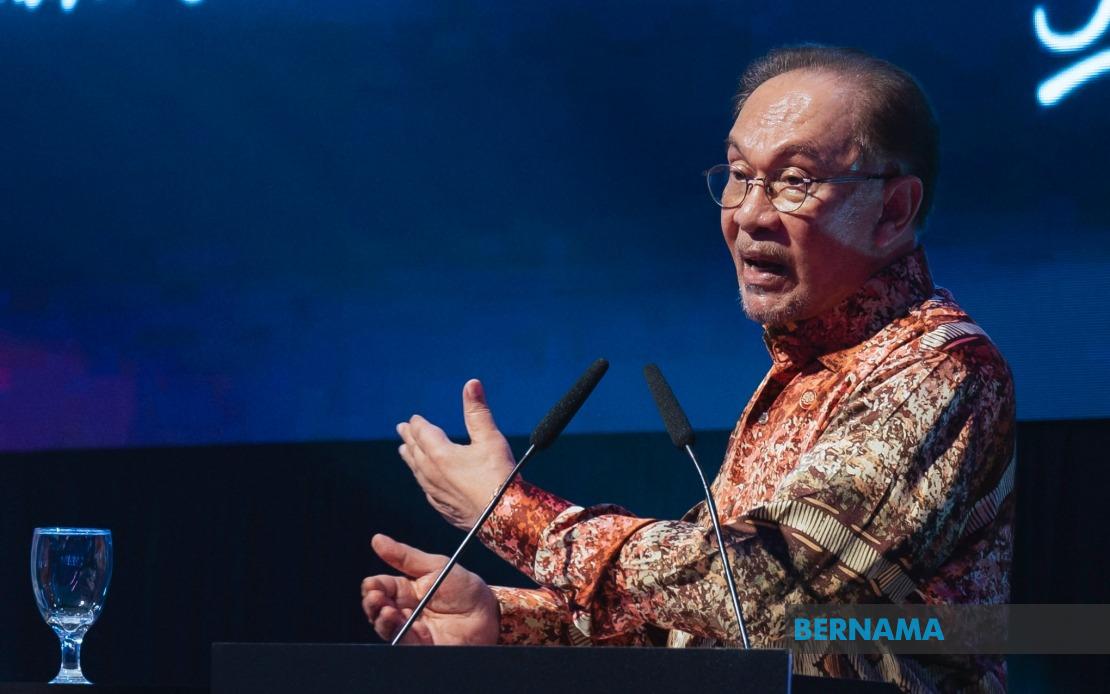
Prime Minister Datuk Seri Anwar Ibrahim's recent comments regarding Taiwan have drawn scrutiny, particularly his acknowledgment of China's stated position on using force should peaceful reunification fail. Yet characterising these remarks as warmongering misses the nuance of his argument, which fundamentally concerns deterrence, sovereignty, and the maintenance of territorial integrity through credible defence capability—not the promotion of conflict.
Anwar's reasoning rests on a straightforward analogy grounded in Malaysia's own constitutional framework. He posed a thought experiment: would any Malaysian government voluntarily accept the breakup of the Malaysian Federation without resistance? The answer is plainly no. This observation underpins a principle of international relations that transcends ideology or geography. Nations across the world—regardless of their political systems—maintain the capacity to defend their borders and territorial unity. This capacity serves primarily as a deterrent, ensuring that would-be challengers understand that dismemberment or coercion will be resisted.
The crucial distinction Anwar implicitly drew is between possessing the capability and willingness to use force versus actually wanting to employ it. A credible deterrent requires that adversaries believe consequences exist for aggression. Yet maintaining that credible threat is not equivalent to harboring desires for conflict. Malaysia itself exemplifies this logic: the nation invests in defence capabilities not because it eagerly seeks war, but precisely to avoid having to fight one. Deterrence functions through the possibility of response, often making actual use unnecessary.
Within Malaysia's diplomatic framework, Anwar's perspective reflects a careful balancing act. Malaysia officially recognises the People's Republic of China and does not extend diplomatic recognition to Taiwan as a sovereign entity. Simultaneously, Malaysia maintains robust economic relationships and people-to-people connections with Taipei. This dual engagement represents the practical reality of modern Southeast Asian statecraft, where governments cannot ignore either the mainland or the island's importance to regional prosperity and stability. Anwar's remarks, viewed through this lens, represent an attempt to explain why Beijing's concerns about territorial integrity deserve acknowledgment—even if acknowledging such concerns does not require endorsing their proposed solutions.
Yet acknowledging China's perspective on deterrence and territorial integrity is not the same as validating military action. Taipei naturally rejects the entire framing, viewing Taiwan as an established democracy with its own legitimacy and right to self-determination. From Taipei's vantage point, any international reference to force—even in abstract deterrence terms—risks providing rhetorical cover for coercion. This Taiwanese concern carries genuine weight and reflects deep anxieties about military pressure. However, the gap between explaining deterrence logic and advocating for its application remains significant.
For Malaysia and the broader Southeast Asian region, the implications of Anwar's remarks deserve careful consideration. A military conflict across the Taiwan Strait would represent a cataclysm for regional trade, semiconductor supply chains, and political stability. The economic interdependence binding together the region means that any major-power confrontation would inflict severe collateral damage on ASEAN members regardless of their nominal positions. Malaysia's interest lies not in validating any party's military options but in consistently advocating for dialogue, restraint, and peaceful resolution of disputes.
Anwar's framing also reflects a realist school of international relations thinking that eschews utopian commitments to non-violence when fundamental interests face threat. This perspective holds that states cannot credibly pre-commit to accepting territorial disintegration without mounting a defence. Such logic applies universally—no government, regardless of type or ideology, would voluntarily dissolve itself or surrender core territory. Understanding this does not require agreement with every conclusion Beijing might draw from deterrence theory, but it does require intellectual honesty about how states typically behave.
Malaysia's position thus requires navigating a narrow path. The government upholds its One China policy as a cornerstone of bilateral relations and as consistent with international recognition of the People's Republic. Simultaneously, Malaysia must continue opposing coercion in all forms and actively promoting peaceful dispute settlement mechanisms. This means consistently urging dialogue between all parties, supporting multilateral efforts at conflict prevention, and refusing to be drawn into zero-sum positions that would fracture ASEAN unity or push the region into geopolitical blocs.
The distinction between explaining deterrence and endorsing military action becomes even more important given Malaysia's position as an ASEAN member committed to regional centrality. Southeast Asia's success has depended substantially on maintaining strategic ambiguity, refusing alignment with great powers, and insisting that regional states retain agency despite proximity to global competitions. Any perception that Malaysia endorses military solutions—or that its leaders are moving away from peaceful dispute resolution—threatens this delicate equilibrium.
Anwar's remarks should therefore be read as an explanation of classical deterrence theory applied to the Taiwan question, rather than as an indication that Malaysia supports military options. The Prime Minister was attempting to articulate why China maintains what it views as a legitimate security concern rooted in state sovereignty and territorial integrity. Understanding an adversary's logic, however, requires no agreement with their conclusions or methods. It merely reflects diplomatic sophistication and the recognition that durable solutions require acknowledging the perspectives and anxieties of all parties, even when disagreeing fundamentally with proposed courses of action.
Looking forward, Malaysia should continue strengthening its commitment to peaceful resolution of disputes while maintaining realistic assessments of how states behave when vital interests face threat. This balanced approach—neither naively optimistic about renouncing force entirely nor recklessly indifferent to military escalation—represents Malaysia's best contribution to regional stability. The fundamental Malaysian interest lies in preventing conflict across the Taiwan Strait through sustained dialogue, economic interdependence, and consistent advocacy for restraint from all major powers. Anwar's remarks, properly understood, support rather than contradict this objective.

