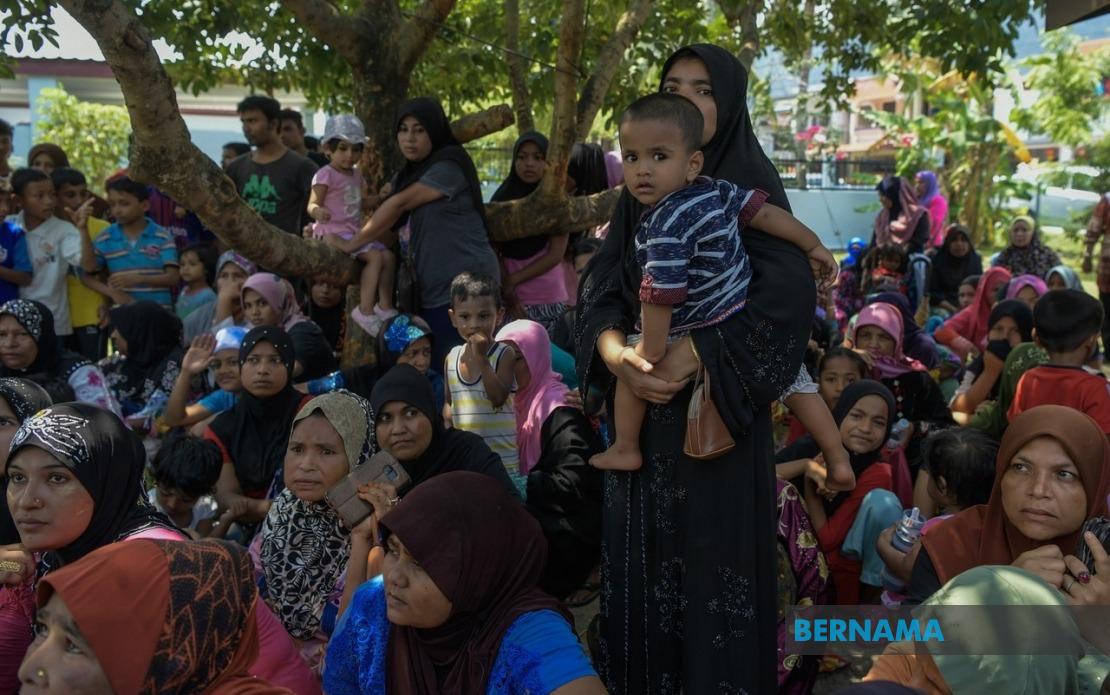
The Malaysian government has moved to dispel misconceptions about refugee documentation, with Economy Minister Datuk Akmal Nasrullah Mohd Nasir issuing a firm clarification that UNHCR cards carry no special legal status. Speaking during the Global Supply Crisis Briefing at the Ministry of Economy, Akmal Nasrullah underscored that the document is purely a registration instrument and confers no immunity from Malaysian jurisdiction, regardless of its holder's refugee status.
This public statement addresses growing anxiety within Malaysian communities regarding the legal standing of refugees and asylum seekers in the country. The minister's remarks came at a pivotal moment when public discourse around refugee management has intensified, with particular concerns centring on documentation practices, their potential abuse by criminal networks, and perceived security implications for ordinary Malaysians. By explicitly stating that holders of UNHCR cards remain fully subject to investigation and prosecution under Malaysian law, the government seeks to reassure citizens that refugee status does not create a legal grey zone.
The clarification emerged from deliberations at the National Economic Action Council (MTEN) meeting, where the Home Ministry presented a comprehensive overview of refugee management challenges. The presentation highlighted three interconnected areas of concern: the need for robust documentation systems, the threat posed by human trafficking syndicates exploiting refugee populations, and the downstream effects on community safety. These issues have become increasingly prominent in public discourse, prompting the government to articulate its position with unusual directness.
Central to Malaysia's response is the Refugee Registration Document Programme, managed by the Immigration Department through the Home Ministry. This initiative represents a systematic overhaul of how the country identifies, processes, and monitors refugee populations. The programme incorporates biometric registration technology, a significant upgrade from previous systems, enabling authorities to create comprehensive digital profiles of registered refugees. Alongside registration, the system includes multilayered screening protocols designed to flag individuals with criminal histories or security concerns before they enter the general population.
Enforcement operations are being substantially amplified under this new framework. The government plans to intensify coordinated operations specifically targeting smuggling networks, human trafficking rings, document fraud, and unauthorised border crossings. These operations will function across multiple agencies, creating an integrated response rather than siloed departmental efforts. The intelligence component of this approach is equally significant; the authorities will deploy data analytics and advanced monitoring technology to identify emerging risks and patterns, allowing enforcement action to be intelligence-led rather than reactive.
Financial commitment to these security measures appears substantial, with RM1.2 billion allocated across various agencies for border control and security-related projects. This budgetary commitment signals the government's determination to tackle the issue comprehensively rather than through incremental adjustments. The funds will support infrastructure improvements, technology deployment, and personnel expansion necessary to manage Malaysia's complex and porous borders effectively.
Among the operational enhancements is the accelerated expansion of the Malaysian Border Control and Protection Agency. Streamlining this agency's operations is intended to create a more unified border management system, reducing coordination gaps that smugglers and trafficking networks have historically exploited. A more cohesive agency structure should enable faster intelligence sharing between units and more efficient deployment of enforcement resources along Malaysia's extensive land and maritime borders.
The MTEN meeting, chaired by Prime Minister Datuk Seri Anwar Ibrahim, addressed refugee management within a broader context of national security and economic resilience. Beyond refugee issues, discussions encompassed food security challenges and the manufacturing sector's capacity to navigate global supply chain disruptions. This broader framing suggests that policymakers view refugee management not as an isolated humanitarian concern but as one component of Malaysia's overall security and economic stability architecture.
For Malaysian readers and businesses, the government's position carries several implications. First, the explicit denial of legal immunity means that foreign nationals, including refugees, operating within Malaysian borders enjoy no privileged legal status. This applies equally to criminal liability, employment regulations, and tax obligations. Second, the intensified enforcement regime and biometric monitoring suggest a trajectory toward tighter population controls and more frequent identity verification across multiple sectors of society. Third, the substantial investment in border security infrastructure reflects official recognition that Malaysia's geographic position makes it a transit point for regional human trafficking networks, a concern that extends beyond refugee management.
The minister's comments also reflect awareness that public confidence in refugee management policies is fragile. Misconceptions about UNHCR card holders' legal status could fuel discrimination or vigilantism if left uncorrected. By publicly reasserting that documented refugees remain accountable under Malaysian law, the government attempts to prevent the emergence of parallel narratives that portray refugees as operating outside legal constraints.
The intersection of humanitarian obligation and security concern represents an ongoing tension for Malaysia. While the country hosts significant refugee populations, particularly Rohingya from Myanmar, there is persistent anxiety about the security implications of large-scale population movements. The government's response attempts to balance these competing imperatives by establishing systems capable of identifying genuine refugees while simultaneously filtering out individuals with criminal intent or security concerns.
Looking forward, the effectiveness of these measures will depend on implementation consistency across agencies and border posts, the technological reliability of biometric systems, and the adequacy of intelligence sharing mechanisms. Regional cooperation, particularly with neighbouring countries also hosting refugee populations, may prove essential for disrupting trafficking networks that operate across multiple jurisdictions. The RM1.2 billion investment suggests this is now a priority area for the Malaysian government.

