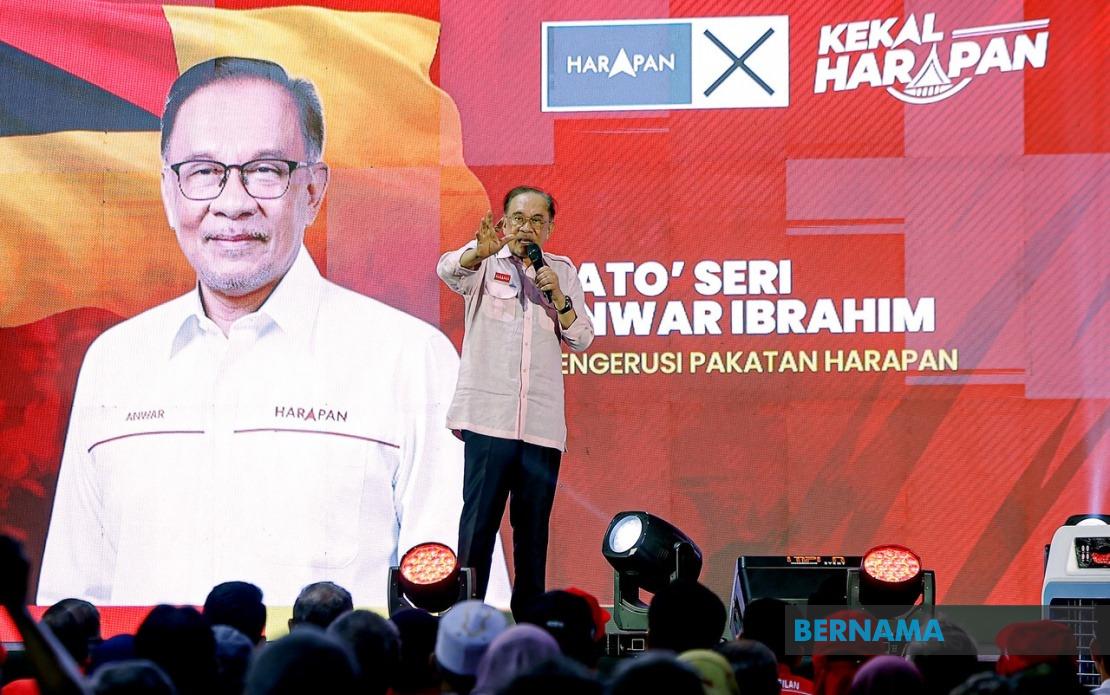
Prime Minister Datuk Seri Anwar Ibrahim has moved to reassure the nation that the federal coalition government shows no signs of fracturing, emphasising that the Unity Government remains both stable and robust despite mounting pressures from electoral competition at the state level. Speaking in Seremban on July 22, Anwar stressed that the administration's solidity is essential for preserving economic momentum and sustaining investor confidence at a time when Malaysia faces regional economic headwinds.
The Prime Minister's remarks come at a strategically important juncture, as the Unity Government coalition—comprising Pakatan Harapan and Barisan Nasional—manages the inherent tension between governing together nationally while competing fiercely in state politics. This balancing act has been central to Malaysian coalition governance since the 2022 general election, and Anwar's comments signal an attempt to allay concerns that the political rivalry between partners could translate into instability at the federal level.
According to Anwar, the level of cooperation among Unity Government partners at the federal level remains sound, a claim he illustrated by pointing to the regular and efficient conduct of Cabinet meetings. Despite the fact that coalition partners contest against one another in state-level elections and governance, the federal executive apparatus continues to function without the friction that sometimes threatens multi-party coalitions. The inclusion of diverse portfolios—including Defence and Security, Transport, and Agriculture—in Cabinet deliberations underscores the breadth of coordination required to maintain this equilibrium.
Anwar specifically referenced recent Cabinet sessions chaired by himself, in which key allies including Minister of Agriculture and Food Security Datuk Seri Mohamad Sabu, Transport Minister Anthony Loke, and Deputy Prime Minister Datuk Seri Dr Ahmad Zahid Hamidi participated actively. The invocation of these names serves to demonstrate that representatives from the major coalition components—Pakatan Harapan and Umno—are engaged in substantive policy work without the acrimonious divisions that could portend governmental collapse.
The Prime Minister acknowledged that state-level tensions do exist, a candid admission that reflects ground realities in Malaysian politics where fierce electoral battles are waged across the peninsula and Sabah and Sarawak. These contests naturally generate friction as parties campaign against one another, make claims of superior governance, and seek to poach voter support. Yet Anwar's assertion is that such competition, while present, has not yet metastasised into federal-level instability. The question of whether this compartmentalisation can endure remains a critical concern for political analysts and business observers alike.
For Malaysia's investment community, Anwar's emphasis on stability carries material significance. Foreign and domestic investors require predictability in governance, regulatory consistency, and assurance that a sudden political upheaval will not reverse policy commitments or introduce uncertainty into long-term planning. A fragmented or dysfunctional federal government would signal weakness to international markets and potentially trigger capital outflows or deferred investment decisions. By publicly affirming federal solidity, Anwar seeks to preserve the confidence premium that has allowed Malaysia to maintain its position as a regional investment destination.
The economic dimension is particularly acute given Malaysia's status as a middle-income country navigating global inflationary pressures, regional supply-chain complexities, and the structural challenges of transitioning toward higher-value manufacturing and services. The stability that Anwar references translates into the continuity of fiscal policy, implementation of the 12th Malaysia Plan, and coherent execution of sectoral initiatives—all of which require a Cabinet that functions without internal contradiction or paralysis.
Anwar's invocation of divine blessing—"Insha'Allah"—when expressing the hope that stability persists beyond future elections suggests an awareness that the continuation of the Unity Government coalition cannot be taken for granted. Electoral mathematics could shift the composition of parliament, potentially requiring recalibration of coalition arrangements or even fundamentally altering the political landscape. His prayer-like phrasing acknowledges that federal stability, while currently present, depends on continued political will and electoral outcomes beyond his direct control.
The juxtaposition of national unity with state-level competition reflects a sophisticated understanding of federalism in the Malaysian context. States possess significant autonomy in development, local security, and certain fiscal matters, yet the federal government controls macroeconomic policy, foreign relations, and large swathes of regulatory authority. This division creates natural space for coalition partners to compete electorally in states while maintaining federal cooperation, though the model remains fragile if the stakes of state contests become too high or if one partner perceives systematic disadvantage.
For Malaysian voters and observers in Southeast Asia more broadly, Anwar's statement encapsulates the ongoing experiment in multi-ethnic, multi-party coalition governance that Malaysia has undertaken. The ability to sustain such arrangements while competing politically represents a maturation of democratic practice, yet it also depends on the forbearance and pragmatism of political leaders and their parties—assets that are not always reliably available in contested political environments.
Looking ahead, the stability Anwar describes will likely face further tests as Malaysia approaches the next electoral cycle and as state-level contests generate friction between coalition partners. The Prime Minister's public reaffirmation of federal unity serves as both a genuine expression of current arrangements and a rhetorical investment in the continuation of those arrangements, a signal to both domestic audiences and international observers that Malaysia's government remains on a stable footing despite the inherent turbulence of multi-party coalitional politics.

