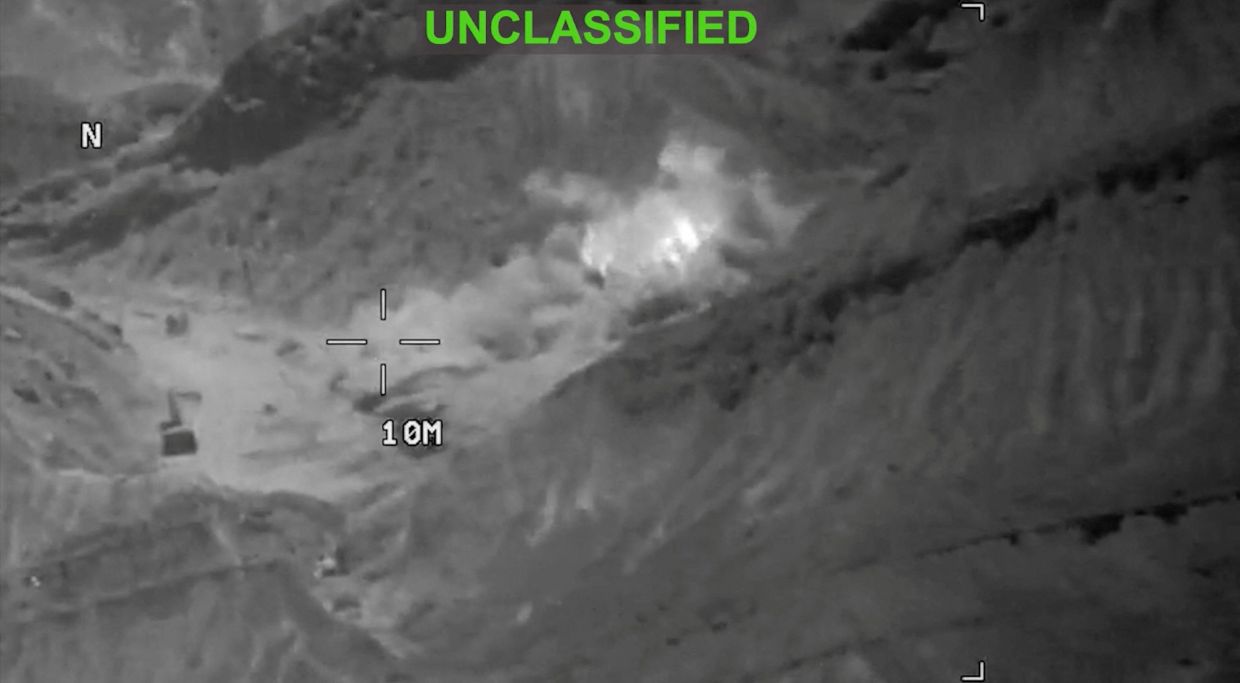
Hostilities between the United States and Iran have reached a dangerous inflection point with Washington completing another round of military strikes after absorbing casualties in the Gulf region. The latest offensive came at President Donald Trump's direction after Iranian forces killed two American service members stationed in Jordan, with a third reported missing. The strikes represent a continuation of an increasingly violent spiral that has shattered a temporary ceasefire agreement and raised concerns about a return to full-scale conflict in one of the world's most strategically important regions.
America's Central Command reported that Saturday's operations, which commenced at 6 p.m. Eastern Time, specifically targeted facilities used by Iran's Islamic Revolutionary Guard Corps to threaten shipping navigation and project military power across the Persian Gulf. The military campaign focused on degrading coastal surveillance systems and air defence infrastructure, according to official statements. Central Command confirmed the completion of the strike wave, though the precise scope and number of facilities struck remained undisclosed in public statements.
Iranian sources offered differing accounts of the damage inflicted. State media reported American attacks near Sirik in southern Iran and Shadegan close to the Iraqi border, claiming no casualties or infrastructure damage resulted. More significantly, Iran's Atomic Energy Organization condemned a strike on the Darkhovin nuclear power plant site under construction, raising international concerns about the conflict's potential to damage nuclear facilities in the region. The incident underscores how the escalating military campaign increasingly threatens civilian infrastructure with broader ramifications.
Iran's response came swiftly and forcefully, with the military launching drone attacks targeting American installations at Kuwait's Al-Adiri camp and Ali Al Salem Air Base early Sunday according to state television reports. Kuwait and Bahrain both reported intercepting Iranian missiles and drones during these coordinated assaults, which authorities said caused no casualties or damage. The pattern reflects a deliberate Iranian strategy of targeting not only American forces but allied facilities throughout the Gulf, attempting to broaden the conflict's scope and demonstrate resolve to regional partners.
The casualty toll continues climbing on the American side, with the deaths of the two Jordan-based service members bringing total US military losses since the conflict began to 16 personnel, alongside more than 420 wounded. Defense Secretary Pete Hegseth's public statement that their sacrifice would "stiffen resolve" signalled Washington's determination to persist despite mounting costs. Conversely, Iran's Health Ministry claimed 50 deaths and over 500 wounded across the country from American strikes during the preceding three weeks alone, figures that remain unverified by independent sources.
The conflict's origins trace to a February 28 joint US-Israeli campaign designed to neutralise Iranian nuclear capabilities and weaken regional proxy forces, but the operation triggered precisely the escalatory cycle both powers initially sought to contain. The situation deteriorated last week when an interim ceasefire collapsed, unleashing months of accumulated tensions. Iran's Supreme Leader, Ayatollah Mojtaba Khamenei, who assumed power following his father Ali Khamenei's death in the initial February strikes, warned of "even heavier costs and further humiliation" for the United States while dismissing Trump's word as "utterly worthless and devoid of credibility."
Shipping security remains a critical flashpoint as both sides weaponise control of the Strait of Hormuz, through which approximately one-fifth of global petroleum supplies transit annually. The US claims to be enforcing a naval blockade on Iran, whilst Tehran maintains that vessels ignoring its navigation protocols face interception. The Iranian Revolutionary Guard Corps reported Sunday that four vessels attempted transiting via "unsafe routes" with American support, with two abandoning the passage and two experiencing an unspecified "accident." Such maritime tensions directly impact global energy markets and trading relationships throughout Southeast Asia.
For Malaysian policymakers and regional observers, this escalation presents acute challenges. Malaysia's position as a critical trading hub and energy importer makes disruption to Strait of Hormuz traffic immediately consequential. Oil price volatility driven by Middle Eastern conflict traditionally pressures Malaysia's economy and inflation rates. Additionally, the collapse of diplomatic frameworks and return to military action signals that multilateral de-escalation efforts have failed, potentially emboldening other regional actors to pursue confrontational strategies.
The mysterious whereabouts of Iran's Supreme Leader, who has remained unseen publicly since assuming power following his predecessor's assassination, adds uncertainty to any potential diplomatic off-ramps. His defiant rhetoric suggests no imminent negotiations, and Trump's administration has shown limited interest in engagement. The absence of White House response to Khamenei's statement further indicates both sides view accommodation as politically untenable domestically.
Regional allies remain caught in crossfire, with Kuwait and Bahrain experiencing repeated Iranian strikes despite harbouring American military installations. These Gulf Cooperation Council members face an impossible position: host American forces necessary for their security against Iranian expansion, yet absorb consequences of escalating US-Iran tensions. The evacuation of Aqaba's international airport and seaport in Jordan underscores how the conflict's geographic footprint continuously expands beyond direct combatants.
The cycle shows no signs of abating. Each strike breeds retaliation, each casualty fuels domestic political pressure to respond forcefully, and each diplomatic opportunity passes unexamined. Without meaningful intervention or mutual agreement to deescalate, the conflict risks metastasising into a broader regional conflagration involving additional state and non-state actors. For Southeast Asia, including Malaysia, this instability creates immediate economic costs through energy supply disruption and longer-term strategic uncertainty as global powers redirect resources toward Middle Eastern contingencies.

