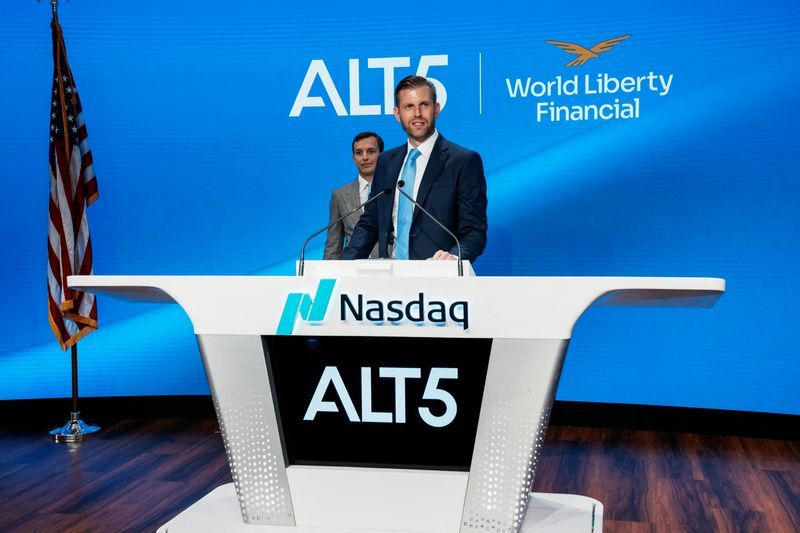
The Office of the Comptroller of the Currency, the primary federal banking regulator in the United States, has conditionally cleared World Liberty Trust Company's application for a national trust bank charter. This regulatory milestone, announced on Friday through a letter posted on the OCC's official website, represents a significant step forward for World Liberty Financial, a cryptocurrency venture in which President Donald Trump and members of his family hold substantial interests. The firm originally submitted its charter application in January and has been working toward this approval ever since.
The conditional nature of the approval means that the charter remains subject to final authorization at a future date, contingent on meeting specific regulatory requirements. Should this occur, the entity would be permitted to manage and hold assets on behalf of customers and facilitate faster settlement of payments through blockchain networks. Importantly, the charter does not confer traditional banking powers such as accepting deposits from the public or originating loans, distinguishing it from full-service commercial banks. Instead, it functions as what the industry terms a "trust bank," specialized to serve cryptocurrency and digital asset markets.
For cryptocurrency companies, these trust bank charters have become increasingly valuable in the current regulatory environment. The charter permits operations across the United States under a single federal license rather than navigating a patchwork of state regulations. This streamlined approach enables better institutional client acquisition by providing the assurance of federal oversight and standardized asset-servicing capabilities. The competitive advantage is substantial: major financial institutions and investment funds prefer dealing with federally chartered entities because of the transparency and consistency such oversight provides.
World Liberty Financial's path to approval has benefited significantly from the Trump administration's receptive stance toward cryptocurrency innovation. Comptroller Jonathan Gould, whom Trump appointed to his current position in the preceding year, has approved similar preliminary charters for other crypto enterprises, including Ripple and Circle. The administration's pro-crypto messaging has signaled to the industry that federal banking regulators are prepared to accommodate digital asset companies seeking legitimate regulatory status and proper supervision.
The charter addresses a practical challenge World Liberty Financial currently faces. The company presently relies on BitGo, a third-party custody provider, to handle both the issuance of its USD1 stablecoin and the safeguarding of the dollars that back it. Once the trust bank charter takes full effect, World Liberty would internalize these functions, managing USD1 issuance and dollar reserves directly under OCC supervision. This vertical integration would reduce operational complexity and potentially lower costs associated with third-party intermediaries.
The conditional approval letter specified several requirements that World Liberty must satisfy. The company must maintain a minimum capital reserve of $20 million, immediately notify federal regulators of any substantial changes to its business strategy, and appoint a qualified internal audit manager to oversee compliance functions. These conditions reflect standard regulatory practice for newly chartered financial institutions and are designed to ensure ongoing operational integrity and supervisory effectiveness.
One notable concern that emerged during the regulatory review process involved foreign investors in World Liberty Financial. The OCC's approval letter acknowledged that it had received submissions from commenters questioning whether non-U.S. shareholders posed potential risks. The regulator addressed this by confirming that foreign investors would not be classified as principal shareholders capable of exercising control over the bank's operations. Additionally, the OCC noted that several international investors, including Eric Trump representing a Trump family investment entity, had executed "passivity agreements" committing them to refrain from attempting to direct or influence the bank's decisions.
For Malaysian and Southeast Asian readers, the approval carries implications for regional cryptocurrency markets and regulatory approaches to digital assets. The OCC's decision represents an institutional validation of stablecoins as legitimate financial instruments worthy of bank-level oversight. As Malaysia, Singapore, and other regional economies develop their own frameworks for cryptocurrency governance, this US regulatory precedent will likely inform policy discussions. The USD1 stablecoin's rapid growth—it has become the fourth-largest stablecoin by market capitalization at approximately $4 billion since its March 2025 launch—demonstrates substantial market demand for dollar-pegged digital currencies that operate on blockchain networks.
Democratic critics have raised governance concerns about the charter approval process itself. Two Democratic senators serving on the US Senate Banking Committee previously requested that Treasury Secretary examine potential national security implications arising from a reported $500 million investment stake in World Liberty Financial connected to the United Arab Emirates' national security adviser. Critics contend that the Comptroller's office, which operates without the bipartisan board structure common to other federal financial regulators, creates a risk of politically influenced decisions in a sensitive area. During a February congressional hearing, Democratic lawmakers pressed Comptroller Gould to provide Congress with an unredacted version of World Liberty's application, arguing that the publicly released version lacked complete information about capital structure and operational plans.
The regulatory approval letter attempted to address politicization concerns by asserting that Comptroller Gould and his team "acted consistently with their statutory duties and ethical obligations." The OCC further stated that career staff—individuals not subject to political appointment—conducted the application review and would perform ongoing supervision through nonpolitical examiners. These assurances reflect the regulator's effort to establish that the decision rested on substantive banking criteria rather than political considerations, though critics remain unconvinced.
The Witkoff family's central role in World Liberty's structure underscores the deep integration between Trump's political circle and the cryptocurrency venture. Zach Witkoff serves as president, chairman, and chief executive of World Liberty Trust Company, while his father Steve Witkoff holds the position of Trump's special diplomatic envoy. Robert Witkoff, Steve's brother and a former insurance executive, has been designated as a director of the trust bank. Scott Alper, president of the Witkoff family's real estate operations, rounds out the proposed directorship. This concentration of authority among family members and close associates illustrates how World Liberty operates as an extension of Trump family commercial interests.
World Liberty Financial frames its mission in terms of financial democratization and empowerment, positioning itself as a counterweight to traditional banking systems that the Trump family characterizes as exclusionary and restrictive. The USD1 stablecoin represents the venture's flagship product, marketed as a stable, dollar-backed digital asset enabling access to blockchain-based financial services. According to Reuters calculations, the Trump family generated approximately $50 million in income from USD1 stablecoin operations through June 2026, while World Liberty Financial funneled more than $1.6 billion to the president and his family as of April. These substantial financial flows underscore the commercial significance of the venture beyond its ideological messaging about financial democratization.

