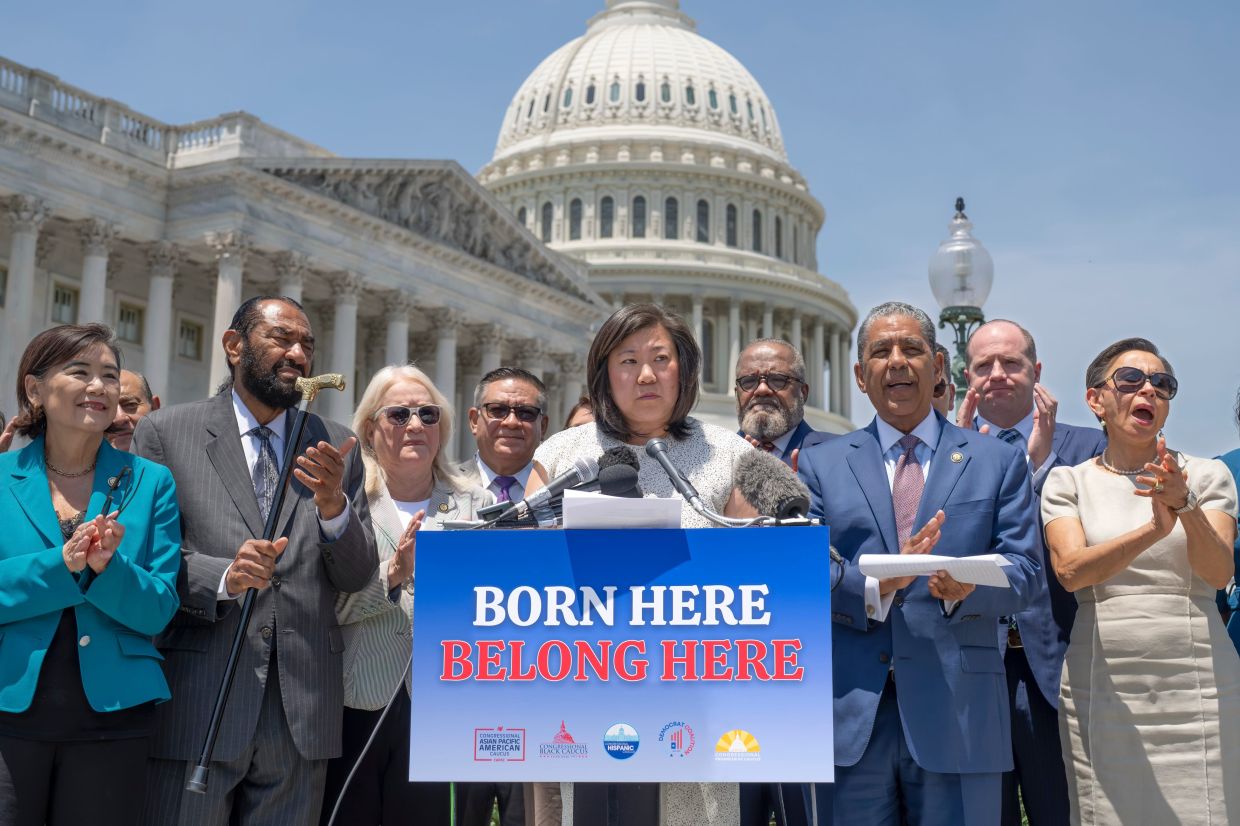
The United States Supreme Court has delivered a decisive blow to one of President Donald Trump's flagship immigration policies, ruling 6-3 in Trump vs Barbara that children born on American soil to undocumented parents or those holding temporary visas retain constitutional rights to citizenship. The decision marks a significant setback for the administration's second-term immigration agenda, which had positioned the elimination of birthright citizenship as a central priority and signed an executive order in early 2025 to implement the controversial policy.
Trump responded to the court's rejection with a mixture of frustration and defiance, posting on social media that he would "congratulate President Xi, and the Great Country of China, on their massive Birthright Citizenship WIN" — a cryptic message reflecting the administration's focus on birth tourism involving Chinese nationals as justification for the policy. However, Trump signalled that the executive branch would not abandon its immigration-restrictive ambitions, suggesting that Congress could legislate around the Supreme Court's decision and that "no long and unwieldy Constitutional Amendment is necessary" to achieve his goals.
What many observers often overlook in this debate is the actual scope of Trump's executive order, which targeted not merely undocumented migrants but a much broader population of lawfully present foreign nationals. The order would have stripped citizenship from children born to individuals on H-1B and L-1 visas — high-skilled work permits fundamental to American technology and professional sectors — as well as students, temporary labourers, and holders of dependent visas. Only children with at least one US citizen parent would have retained automatic birthright citizenship under the proposed policy. This distinction underscores how Trump's approach extended far beyond traditional concerns about illegal immigration to encompass immigrants in legal status, whose contributions to the American economy are substantial and widely recognised across business sectors.
The Supreme Court's majority grounded its decision in the historical foundations and ongoing significance of the Fourteenth Amendment's Citizenship Clause, passed in 1866 and ratified in 1868 in the aftermath of the Civil War. Chief Justice John Roberts, writing for the majority, invoked the framers' intent to protect former enslaved people and other minorities: "Citizenship, then and now, was the right to have rights – to freely participate in our political community. The Framers of the Fourteenth Amendment extended that promise to 'every free-born person in this land.' We keep that promise today." This constitutional foundation has endured for more than a century and a half, establishing a broadly inclusive understanding of membership in the American political community.
The legal precedent at the heart of this decision traces to Wong Kim Ark, an 1898 Supreme Court case that established the principle of birthright citizenship for children of Chinese immigrants at a time when the Chinese Exclusion Act severely restricted immigration from China. Wong Kim Ark had been denied re-entry to the United States after visiting China, with officials claiming he was not a citizen because of his parents' immigration status. The court ruled that this interpretation violated the Citizenship Clause, establishing that nearly all persons born on American soil acquire citizenship regardless of their parents' nationality or legal standing. That century-old ruling proved decisive in Tuesday's decision, demonstrating how constitutional protections established to remedy historical injustices continue to shape contemporary immigration law.
Descendants of Wong Kim Ark celebrated the ruling, with Norman Wong emphasising his great-grandfather's quiet dignity in standing up for principle. "He was one man, only a cook, and yet he stood up for what was right, and I believe that it has made a difference," Norman Wong reflected. "As a result, he stood up for the rights of all of us Americans – it just so happens that I am related to him. Today's ruling shows that his victory remains as important now as it was in 1898." The enduring relevance of Wong's case across generations underscores how fundamental birthright citizenship has become to American identity and legal structure.
Asian-American civil rights organisations noted the decision's particular resonance for their communities, which have grown substantially through immigration and benefited from birthright citizenship protections. Stop AAPI Hate remarked that "birthright citizenship has shaped America into the uniquely diverse and democratic nation it is today," and that "because of this right, the Asian-American community and other communities of colour have been able to grow in size and political power – and that is precisely why the Trump administration attempted to end it." The observation captures how Trump's policy represented not merely an immigration reform proposal but a potential retrenchment of demographic and political pluralism accumulated through generations.
Critics of the now-rejected order characterised it in starkly dramatic terms. Krish O'Mara Vignarajah, president of the refugee-focused non-profit Global Refuge, observed that birthright citizenship had survived the Chinese Exclusion Act and Jim Crow segregation laws, only to face an executive order that would have "essentially turned the maternity ward into a customs checkpoint." This metaphor captures the profound intrusion into intimate family circumstances that the policy would have entailed, converting hospitals delivering American-born children into immigration enforcement sites.
The Trump administration's rationale centred heavily on birth tourism, particularly involving Chinese nationals who allegedly travel to the United States specifically to give birth and secure citizenship for their children. Solicitor General D. John Sauer, arguing the administration's case before the Supreme Court in April, contended that birthright citizenship had "spawned a sprawling industry of birth tourism" and that "uncounted thousands of foreigners from potentially hostile nations have flocked to give birth" in America. The Justice Department subsequently directed federal prosecutors to prioritise investigations of such schemes, citing a 2024 case where a husband-and-wife team were sentenced to 41 months in prison for operating a birth tourism operation that charged Chinese clients tens of thousands of dollars for assistance.
For Malaysia and Southeast Asia, this American legal development carries implications worth monitoring closely. Rising tensions between the United States and China inevitably shape immigration policy frameworks, with birth tourism allegations serving as a convenient flashpoint for broader geopolitical anxieties. Malaysia's own substantial Chinese diaspora and growing numbers of both Chinese investors and students mean that American policies affecting citizenship for children of temporary visa holders deserve attention. The Supreme Court's affirmation of birthright citizenship also stands as a counterpoint to more restrictive approaches some Asian governments have adopted regarding citizenship for children of migrant workers, reflecting fundamentally different constitutional philosophies.
While the Supreme Court's decision represents a significant legal victory for opponents of immigration restriction, the political battle appears far from concluded. Trump's suggestion that Congress could legislate around the constitutional principle indicates that future administrations might pursue alternative pathways to achieve similar restrictive outcomes. The prospect of legislative action targeting birthright citizenship, even if constitutionally constrained in scope, remains a genuine possibility should Republican control of Congress persist. The court's 6-3 conservative majority margin also suggests that future appointments could theoretically shift the balance, though overturning established constitutional doctrine would require unusual judicial circumstances.
The broader context involves how democracies define membership and belonging in an era of increased international mobility. Birthright citizenship represents one approach — inclusive and relatively automatic — while other nations employ descent-based citizenship, residency requirements, or more restrictive criteria. America's particular choice reflects historical commitments to pluralism and opportunity that, as the Supreme Court reaffirmed, remain embedded in its foundational constitutional text. Whether these commitments will survive future political pressures or legislative efforts remains an open question, even as the court's decision temporarily forestalls the most immediate threat.

