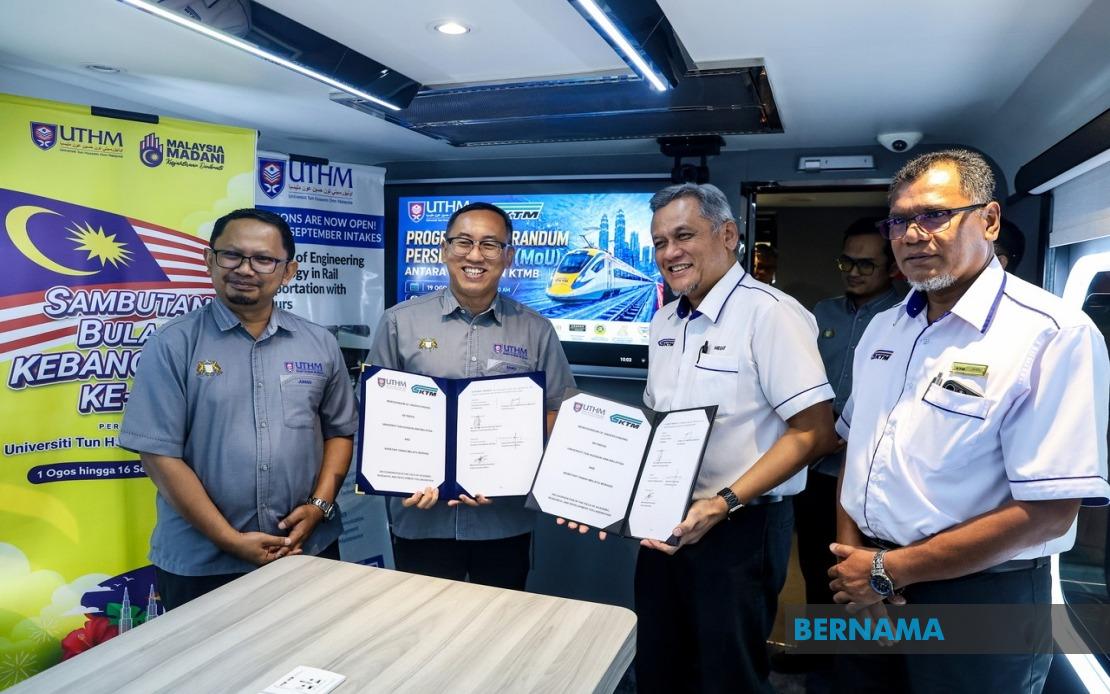
Malaysia's rail sector is taking a significant stride forward through a renewed commitment between a leading technical university and the nation's primary rail operator. Universiti Tun Hussein Onn Malaysia (UTHM) and Keretapi Tanah Melayu Bhd (KTMB) have formalized a three-year strategic cooperation agreement running from October 2026 through July 2029, building on foundational work that began in 2019 to create a robust pipeline of skilled professionals equipped to meet the demands of modern rail transportation.
The partnership represents a deliberate effort to bridge the gap between academic training and practical industry experience. UTHM vice-chancellor Prof Dr Mas Fawzi Mohd Ali emphasized that the initiative centers on work-based learning (WBL), allowing students to gain direct hands-on exposure to rail operations, technology systems and the real-world challenges that characterize the sector. Rather than confining education to classrooms, the arrangement positions UTHM students within KTMB's operational environment, where they can apply theoretical knowledge to tangible problems and develop the technical competencies that employers demand.
The track record of this collaboration speaks volumes about its effectiveness. Nearly 200 graduates from UTHM's Bachelor of Rail Transportation Engineering Technology with Honours programme have entered the workforce through this arrangement, with many securing positions not only domestically but also internationally in countries such as Singapore and Saudi Arabia. This demonstrates that the partnership has successfully cultivated exportable expertise that meets global standards, enhancing Malaysia's reputation in developing specialized talent.
The work-based learning framework addresses a critical challenge in technical education: the disconnect between what students learn and what industry actually requires. By embedding learning within KTMB's operations, students develop a sophisticated understanding of rail technology, operational logistics, maintenance protocols and safety standards. They encounter real infrastructure challenges, understand regulatory requirements, and grasp the human dimensions of managing complex transportation networks. This immersive approach produces graduates who require minimal onboarding before contributing meaningfully to their organizations.
Beyond student development, the expanded agreement emphasizes collaborative research and development. UTHM brings academic rigor, advanced research facilities and fresh intellectual perspectives, while KTMB contributes operational experience, real-world data, and insight into practical constraints facing Malaysia's rail infrastructure. By combining these complementary strengths, the institutions can develop practical solutions to technical challenges involving rolling stock, rail infrastructure maintenance, safety systems and operational efficiency. This approach transforms the university from a knowledge provider into a genuine innovation partner for the industry.
The partnership extends into postgraduate education as well. KTMB has committed to sponsoring staff members to pursue master's degrees in rail-related fields at UTHM, ensuring that the rail operator's workforce benefits from advanced research and specialized knowledge. Simultaneously, the collaboration encompasses curriculum development for diploma, bachelor's and postgraduate programmes offered through KTM Academy (MyRA), enabling the university's expertise to shape the training frameworks that KTMB itself uses to develop its personnel.
KTMB chief corporate officer Megat Khairulazhar Khairodin highlighted the mutual value of the arrangement, noting that the partnership enables KTMB to access UTHM's expertise, technological infrastructure and research capabilities to address operational and technical challenges. For a rail operator managing an aging network while modernizing service delivery, access to university research facilities and academic consultation represents significant value. The collaboration also encompasses industry forums and academic visits, creating channels for knowledge exchange that flow in both directions.
The timing of this partnership extension aligns with UTHM's broader institutional ambition encapsulated in its Global Technopreneur University 2030 (GTU2030) vision. This strategic framework emphasizes integrating knowledge, technology, innovation and entrepreneurship in preparing graduates who can drive economic development and address societal needs. Rail transportation—critical infrastructure underpinning economic activity and urban mobility—sits squarely within this mission. By positioning itself as a strategic partner in Malaysia's rail sector development, UTHM advances its positioning as a techno-entrepreneurial institution while serving genuine national development objectives.
For Malaysia's broader economic strategy, this partnership carries significance beyond its immediate participants. Transportation infrastructure quality directly influences competitiveness, and reliable rail networks reduce logistics costs, improve supply chain efficiency and provide sustainable mobility alternatives. By developing a pipeline of specialized professionals who understand both traditional rail engineering and emerging technologies like digital systems and predictive maintenance, the UTHM-KTMB collaboration supports Malaysia's capacity to maintain and modernize its rail assets.
The partnership model itself merits attention as a framework for industry-academia collaboration in Southeast Asia. Rather than treating universities and operators as separate entities, the arrangement recognizes their interdependence and creates structures for genuine knowledge co-creation. Other Malaysian industries—manufacturing, energy, telecommunications—might productively adopt similar models, embedding student learning within operating companies while leveraging corporate data and challenges to drive university research agendas.
Looking ahead, the partnership's expansion into competency development activities and structured learning pathways suggests confidence in sustained growth of Malaysia's rail sector. Whether through expansion of existing networks, modernization of aging infrastructure, or adoption of new technologies, the sector will require professionals with advanced technical capabilities. This three-year collaboration, anchored in practical learning and collaborative research, positions UTHM and KTMB to develop precisely that talent pool, strengthening Malaysia's capacity to manage transportation infrastructure that serves the nation's economic and social needs.

