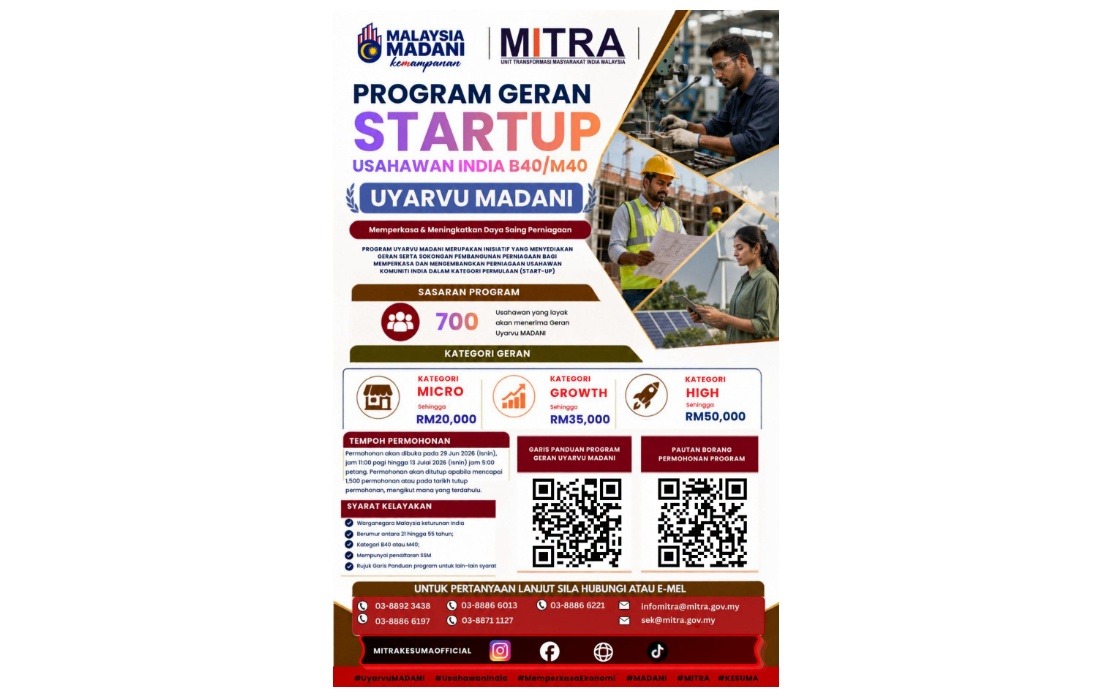
The Malaysian Indian Transformation Unit (MITRA) has launched the Uyarvu MADANI Startup Accelerator Grant Assistance Programme, opening applications from June 29 through July 13 at 5 pm. The initiative represents part of MITRA's broader 2026 strategic agenda to support economic participation and business development within the Indian community across Malaysia.
The grant scheme specifically targets entrepreneurs from the Indian community earning within the B40 and M40 income brackets, addressing the recognised need for targeted financial support in underrepresented business communities. Successful applicants will receive grants ranging from RM20,000 to RM50,000, supplemented by dedicated business development services designed to strengthen operational capacity and market competitiveness. This dual approach recognises that capital infusion alone proves insufficient without accompanying mentorship and strategic guidance.
MITRA's target of supporting 700 entrepreneurs through this iteration reflects both ambition and pragmatism in resource allocation. The application framework includes an automatic closure mechanism should the programme receive 1,500 applications before the July 13 deadline, preventing administrative bottlenecks while maintaining consistent assessment standards. This threshold approach ensures that application volume does not compromise evaluation quality or fund distribution timeliness.
The Uyarvu MADANI programme functions as one component of six complementary initiatives introduced under MITRA's 2026 framework, collectively commanding RM65.5 million in government allocation. This broader investment signals sustained governmental commitment to inclusive economic development and community-specific entrepreneurship pathways. The diversified initiative portfolio suggests recognition that single interventions rarely address the multifaceted challenges facing emerging entrepreneurs from historically marginalised communities.
For Malaysian Indian entrepreneurs, the programme addresses longstanding disparities in business capitalisation and market access. Statistical evidence consistently demonstrates that minority entrepreneurs encounter greater obstacles securing conventional financing, with cultural factors, network limitations, and perceived risk profiles creating institutional barriers. The Uyarvu MADANI scheme partially circumvents these structural constraints through direct capital provision and bundled support services.
The timing of this announcement, coinciding with Malaysia's sustained focus on inclusive growth frameworks, reflects broader policy alignment across government agencies. Recent national development agendas have increasingly emphasised community-specific economic empowerment rather than universal programmes, acknowledging that generalised approaches frequently fail disadvantaged populations. MITRA's targeted methodology aligns with this contemporary policy paradigm.
Potential applicants should prepare comprehensive business proposals demonstrating viable commercial concepts, realistic financial projections, and clear articulation of how grant funding will generate measurable returns. Previous experience with comparable government schemes suggests that successful applications typically exhibit strong business fundamentals, clear market analysis, and evidence of entrepreneur commitment through personal capital contribution or sweat equity.
The business development support component accompanying monetary grants likely encompasses mentorship networks, market linkage facilitation, and operational advisory services. Such accompaniment distinguishes Uyarvu MADANI from purely transactional funding mechanisms, positioning grantees for sustainable business trajectories rather than temporary liquidity relief. Malaysian entrepreneurs frequently report that non-financial support—including access to networks, regulatory guidance, and strategic planning assistance—produces more durable business success than capital alone.
For the broader Malaysian entrepreneurial ecosystem, Uyarvu MADANI demonstrates evolving government recognition that demographic diversity strengthens economic resilience. Indian-Malaysian entrepreneurs constitute a significant though historically underutilised segment of the business community. Enhanced support through targeted programmes potentially unlocks latent entrepreneurial capacity, generating employment, tax revenue, and wealth creation across participating communities.
Southeast Asian context reveals broader regional patterns of minority entrepreneurship support, with several neighbouring nations implementing analogous community-focused schemes. Malaysia's approach through MITRA positions the nation alongside international best practices in inclusive economic development, potentially enhancing the country's competitive positioning as a diverse, innovation-friendly economy attracting international investment and talent.
Applications remain open until July 13 at 5 pm, though interested entrepreneurs should register well before the deadline given anticipated application volume. Detailed submission requirements, including necessary documentation, eligibility verification procedures, and assessment criteria, should be clarified through MITRA's official channels prior to application commencement, ensuring applicants allocate sufficient preparation time for competitive proposal development.

