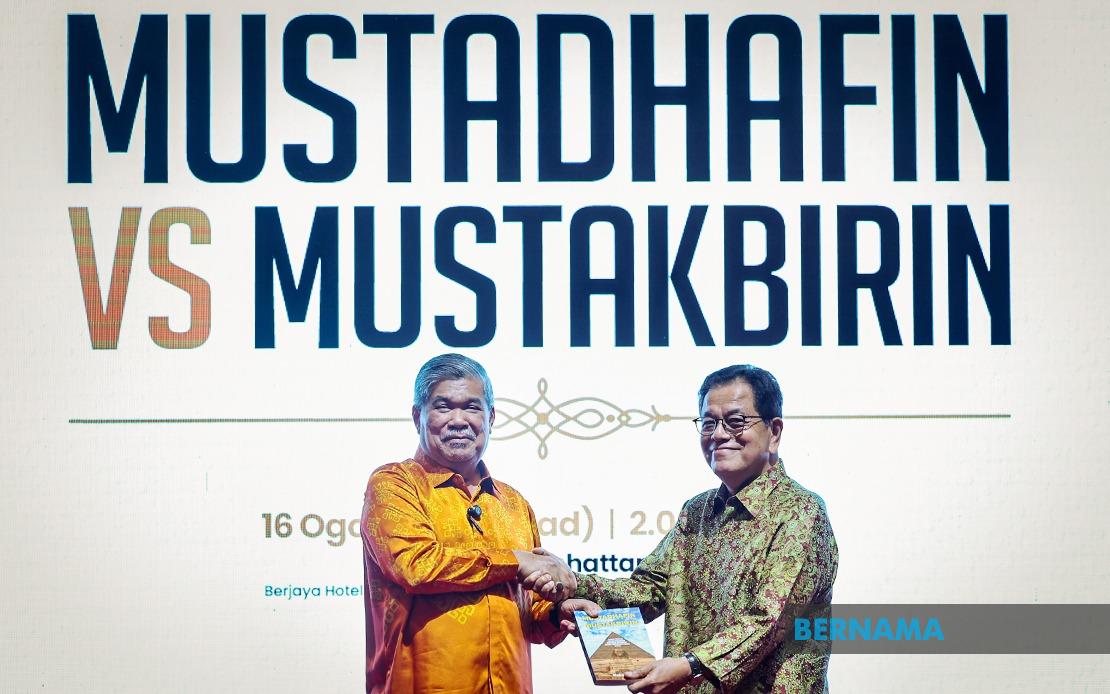
Datuk Seri Mohamad Sabu, president of Amanah, issued a stern warning against uncritical acceptance of allegations during an event in Kuala Lumpur on August 16, cautioning that such behaviour undermines rational political discourse and breeds a divisive mentality. Speaking after launching his book, the Agriculture and Food Security Minister highlighted how the tendency to embrace claims without proper verification—what he termed as 'asabiyyah', a concept rooted in Islamic scholarship denoting group loyalty that blinds followers to objective truth—has become increasingly prevalent in Malaysian public life.
The phenomenon identified by Mohamad Sabu reflects a broader vulnerability in contemporary politics across Southeast Asia. The ease with which unsubstantiated claims spread through social media ecosystems has created an environment where repetition often masquerades as proof. Accusations, rumours, and conspiracy theories require minimal effort to disseminate and gain traction among receptive audiences, yet establishing factual accuracy demands considerably more rigorous investigation, critical thinking, and time investment. This asymmetry has created a troubling imbalance in the information landscape, particularly affecting developing democracies where media literacy and institutional checks remain inconsistent.
Within the Malaysian political context, Mohamad Sabu specifically addressed the recurring allegation that the Democratic Action Party maintains communist sympathies and that any political cooperation with DAP amounts to tacit endorsement of communism. This charge has resurged periodically throughout Malaysian politics, particularly when opposition coalitions form. Rather than dismissing the claim outright, the Amanah leader posed a direct question: whether objective evidence supports such characterisation. His approach emphasises the necessity of grounding political judgement in verifiable fact rather than inherited grievance or party-line rhetoric.
The timing of Mohamad Sabu's intervention carries particular significance given Malaysia's complex relationship with its own Cold War history. The Emergency period and subsequent anti-communist campaigns left deep imprints on national consciousness and remain invoked in contemporary political disputes. Some political actors have instrumentalised these historical anxieties to delegitimise rival parties, particularly those seen as ideologically distant from conservative streams. By questioning whether DAP genuinely espouses communist ideology—something Malaysian authorities have not formally alleged in recent decades—Mohamad Sabu implicitly challenges the weaponisation of historical fears for contemporary political advantage.
The Amanah president's book, launched by National Journalism Laureate Tan Sri Johan Jaaffar, who also serves as director of Star Media Group Berhad, documents Mohamad Sabu's efforts to understand Malaysian and global issues through direct observation and engagement rather than relying exclusively on secondhand accounts or ideological filters. This methodological commitment reflects a broader epistemological stance: that knowledge derived from personal investigation and substantive engagement with primary sources carries greater reliability than information filtered through partisan channels or propagandistic framing. His intellectual autobiography positions independent verification as both an ethical imperative and practical necessity for responsible leadership.
From his earliest years, Mohamad Sabu has consciously resisted the passive consumption of information, instead cultivating habits of independent inquiry and skepticism toward received narratives. This biographical detail assumes relevance because it positions his current warnings against blind acceptance not as abstract principle but as lived conviction. His example implicitly encourages Malaysian citizens—particularly younger voters navigating information environments saturated with competing truth claims—to adopt similarly critical dispositions toward all sources of information, including those emanating from preferred political movements.
The book additionally encompasses Mohamad Sabu's observations on geopolitical dynamics, encompassing historical phenomena including colonialism, the evolution of Islamic movements, the Palestinian question, and transformations in global power distribution. This broader framework contextualises his warnings about uncritical acceptance within the larger challenge of developing informed perspectives on consequential matters. International affairs similarly suffer from simplified narratives, propagandistic framing, and ideologically motivated misrepresentation. The cultivated habit of demanding evidence, considering multiple perspectives, and distinguishing between substantiated fact and speculative claim becomes essential for citizens attempting to comprehend both domestic and global developments.
Mohamad Sabu's distinction between the cognitive demands of accepting facts versus accepting accusations warrants particular emphasis. Accusations gratify immediate emotional responses—they provide villains to blame, reinforce tribal boundaries, and require minimal intellectual labour. Factual understanding, conversely, demands patience, nuance, engagement with complexity, and willingness to revise preconceptions when evidence warrants such revision. Social media algorithms, designed to maximise engagement through emotional activation rather than epistemic enrichment, consistently privilege accusations over facts. This structural incentive creates systematic bias toward misinformation and against careful, evidence-grounded discourse.
For Malaysian readers navigating a political landscape increasingly fractionalised along ethnic, religious, and ideological lines, the Amanah leader's exhortation possesses considerable urgency. Political stability depends partly upon shared agreement regarding basic facts—not necessarily identical interpretation of those facts, but consensual acknowledgement that certain propositions are either true or false. When allegations proliferate unchecked and verification becomes optional, this shared epistemic foundation erodes. Political opponents begin inhabiting entirely separate realities, rendering compromise and democratic deliberation functionally impossible. The resulting polarisation ultimately disadvantages all participants while benefiting actors invested in systemic instability.
Moving forward, Mohamad Sabu's intervention suggests that leaders across Malaysia's political spectrum bear responsibility for modelling and advocating rigorous standards of evidence. Whether allegations concern political opponents, religious minorities, foreign governments, or any other target, the principle remains constant: subjecting claims to factual scrutiny before endorsement protects democratic norms and institutional integrity. The challenge lies in establishing cultural expectations favouring verification over mere circulation, despite the inconvenience such demands impose on contemporary communication patterns.

