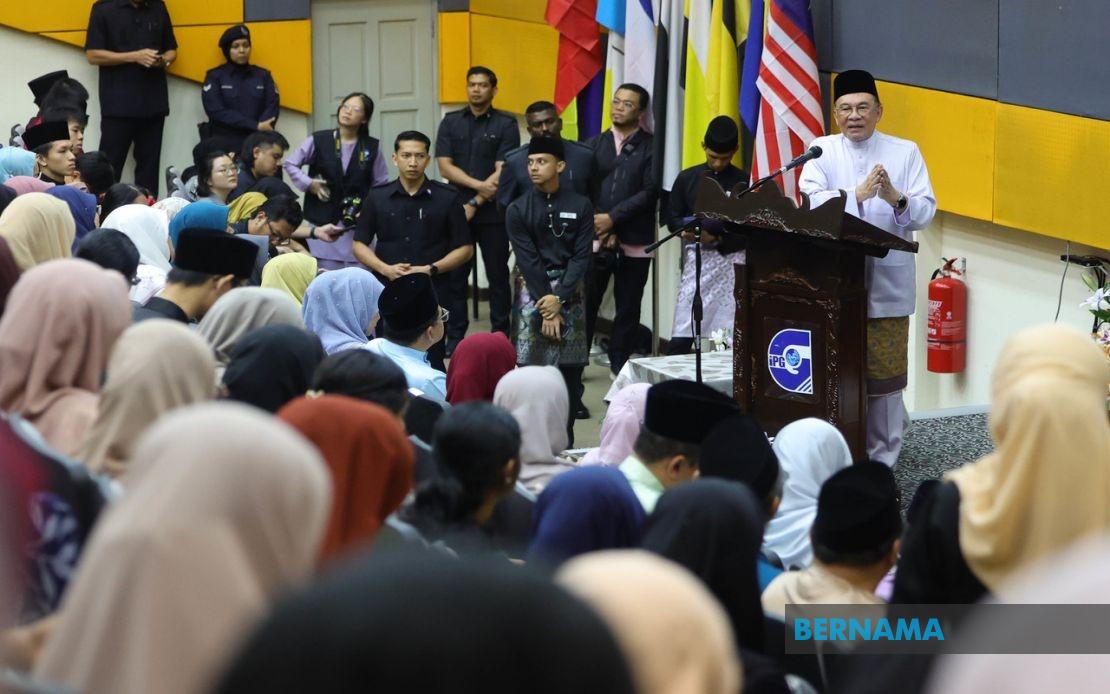
Prime Minister Datuk Seri Anwar Ibrahim has pinpointed the greatest impediment to Malaysia's reform programme as not a shortage of resources or know-how, but rather the unwillingness of certain segments—particularly among the privileged classes—to accept transformation and shed practices rooted in systemic corruption. Speaking at the Technical Education Campus of the Institute of Teacher Education in Bandar Enstek, he underscored that his three-plus years directing the government have exposed how institutional overhaul and graft elimination routinely encounter pushback from those accustomed to the status quo.
The Prime Minister's candid assessment reflects a persistent friction within Malaysia's governance landscape: while technological capacity and professional expertise abound, the political will and institutional appetite for deep structural change remain contested. Anwar's remarks acknowledge a reality that complicates reform trajectories across Southeast Asia—that resistance often originates not from capability gaps but from entrenched beneficiaries of existing systems who perceive change as threatening their privileges and networks.
Anwar emphasised that the administration's commitment to governance strengthening and corruption eradication cannot be contingent on popularity. Such initiatives, he argued, are essential prerequisites for creating an administrative apparatus that operates with genuine transparency, real accountability, and demonstrable effectiveness. The framing suggests the government views reform as a long-term institutional necessity rather than a politically expedient undertaking, implying willingness to absorb short-term political costs for structural gains.
Central to Anwar's argument is a sociological observation about how resistance to reform manifests. He noted that opposition does not always come from those visibly or obviously corrupt, but often emerges among modern-appearing individuals whose lifestyles and presentation masks an aversion to genuine systemic change. This distinction carries analytical weight—it suggests that corruption and resistance to reform are not merely about individual malfeasance but are embedded in institutional cultures that normalise irregular practices and treat them as business-as-usual.
The Prime Minister framed reform resistance as fundamentally about power preservation. Those opposing change, he suggested, resist because transformation would disrupt established hierarchies and distribute authority differently. This analysis resonates with research on institutional reform across developing democracies, where elites often mobilise subtle resistance—regulatory foot-dragging, procedural obstruction, and cultural opposition—rather than outright defiance.
Anwar's invocation of religious and civilisational imperatives for continuous institutional improvement signals an attempt to reframe reform not as merely technocratic or administrative but as ethically and culturally mandated. By locating the argument within moral and civilisational discourse, he positions resistance to reform as not merely institutionally problematic but as culturally regressive. This rhetorical move seeks to shift the burden of justification onto reformers' opponents rather than on the reform agenda itself.
The comments carry implications for Malaysia's broader trajectory. The anti-corruption agenda has produced visible prosecutions and institutional changes, yet questions persist about whether these represent fundamental transformation or surface-level adjustments. Anwar's acknowledgement of sustained internal resistance suggests that deeper institutional cultures remain challenging to reshape, even where formal mechanisms have shifted. For Malaysian constituencies concerned with governance quality, the message is that reform will likely remain contested and incremental rather than dramatic or rapid.
For regional observers, Anwar's framing offers insight into the political economy of governance reform across Southeast Asia. Most nations in the region contend with similar dynamics—bureaucratic cultures that have normalised certain practices, elite networks resistant to accountability mechanisms, and institutions where formal rules diverge from operational realities. The Malaysian Prime Minister's public acknowledgement that such resistance constitutes the primary reform obstacle suggests growing recognition that institutional change requires not just new rules but shifts in underlying power structures and institutional cultures.
The remarks also suggest evolving government strategy regarding public messaging on reform. Rather than presenting anti-corruption and governance efforts as technical successes, Anwar is framing them as ongoing struggles against entrenched interests. This approach manages expectations—positioning slow progress as reflecting systemic difficulty rather than government incapacity—whilst simultaneously positioning the administration as committed to change despite political friction.
Anwar's distinction between formal modernisation and substantive institutional change highlights a critical challenge for governance reformers globally. Societies and institutions can adopt modern technologies, contemporary management practices, and updated regulations whilst retaining underlying cultures and power dynamics that perpetuate the problems reforms aim to address. Breaking this pattern requires not merely installing new systems but transforming incentive structures, accountability mechanisms, and institutional cultures—work far more laborious than regulatory revision.
Moving forward, the effectiveness of Malaysia's reform agenda will likely depend on whether the government can translate its public acknowledgement of resistance into concrete strategies for shifting institutional cultures. This might involve targeted efforts to reshape recruitment and promotion within the civil service, systematic oversight of discretionary decision-making, and sustained leadership messaging that establishes reform as non-negotiable institutional value rather than temporary initiative.

