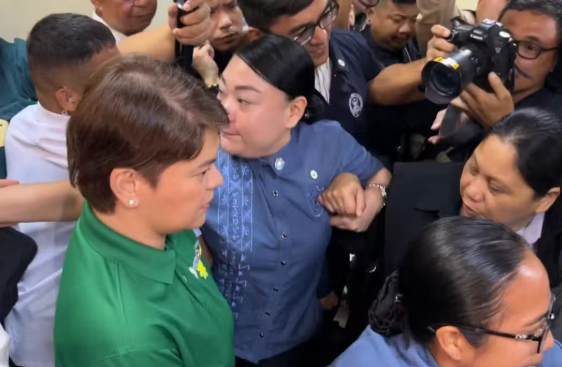
Vice President Sara Duterte has once again characterised her ongoing impeachment proceedings as a "bloodbath," employing language that underscores the intensity and personal toll of the legal battle she faces. Upon arriving at the Senate this week to confer with her legal team, Duterte told reporters that while she expects to be damaged by the process, she will not yield to the pressure. Her choice of words—"bloodied but unbowed"—deliberately echoes William Ernest Henley's famous poem "Invictus," a work celebrating human resilience in the face of overwhelming adversity and the refusal to surrender one's dignity or principles regardless of circumstance.
This rhetorical invocation represents Duterte's attempt to frame her defence not as a legal or political struggle, but as a test of personal fortitude. By aligning herself with the imagery of "Invictus," she positions herself as a figure standing firm against forces arrayed against her, though critics have noted the irony given her notable absence from much of the House impeachment proceedings in both 2025 and 2026. That inconsistency in her courtroom presence has drawn repeated criticism from political opponents and commentators who question whether her combative public statements align with her actual legal strategy.
The Vice President initially signalled her willingness to see the impeachment process unfold when she expressed in May 2025 that she wanted a "bloodbath," a statement that seemed to invite confrontation rather than avoid it. However, the journey from that declaration to her current position reveals the grinding nature of such political contests. The impeachment trial itself is anticipated to consume approximately 92 days of Senate time, potentially stretching the proceedings into early 2027 and creating an extended period of uncertainty regarding her political future.
The charges Duterte confronts span multiple categories of alleged misconduct, each carrying serious implications. The first article addresses accusations that she misappropriated P612.5 million in confidential funds, comprising P500 million from the Office of the Vice President and P112.5 million from the Department of Education. These allegations strike at fundamental questions about fiscal accountability and the proper use of public resources, matters that resonate across the region as Southeast Asian democracies grapple with corruption concerns.
The second article involves allegations of unexplained wealth accumulation and procedural failures in asset disclosure. The complaint specifically references her Statements of Assets, Liabilities and Net Worth covering 2022 to 2024, suggesting that the accumulation pattern or the manner of disclosure raises questions about compliance with anti-corruption regulations. This dimension of the case probes whether her personal financial growth can be adequately explained by legitimate sources and whether proper divestiture procedures were followed when required.
A third article raises allegations of bribery and irregularities in government procurement processes involving Department of Education officials. This charge introduces questions about whether Duterte allegedly leveraged her position to influence procurement decisions, potentially benefiting certain parties or individuals through improper channels. Such allegations, if substantiated, would represent serious breaches of public trust and proper governance.
The fourth and final article concerns alleged threats against President Ferdinand Marcos Jr., First Lady Liza Araneta-Marcos, and former House Speaker Martin Romualdez. These charges represent perhaps the most serious allegations, as they address questions of national security and whether threats emanated from the office of the Vice President. The precise nature and context of these alleged threats remain central to the trial's proceedings.
The constitutional framework governing this impeachment establishes a demanding threshold for removal. Under the 1987 Constitution, conviction requires at least two-thirds of all senator-judges to vote in favour, meaning Duterte would need to retain the support of a substantial minority of the Senate to survive. This supermajority requirement reflects the framers' intent to prevent impeachment from becoming a tool of simple parliamentary majorities, though it also means that sustained political organisation and Senate support become critical factors in determining outcomes.
For Malaysian and Southeast Asian observers, the Duterte impeachment offers instructive lessons about the vulnerability of vice-presidential positions and the fragility of political alliances. Duterte's shift from her previous role as Davao City Mayor and then President to Vice President has placed her in a weaker institutional position, demonstrating how executive succession and constitutional design shape a leader's ability to weather political challenges. The case also illustrates broader regional patterns concerning allegations of fund misuse and asset concealment, issues that have affected political figures across multiple Southeast Asian democracies.
The timing and trajectory of this impeachment process occur within a context of Philippine political realignment. Duterte's relationship with President Marcos has visibly deteriorated, transforming what might have been a collaborative executive partnership into an adversarial dynamic. Her willingness to engage in rhetorical combat, evidenced by her "bloodbath" language, may reflect both her fighting spirit and her recognition that the political environment has shifted irreversibly against her.
As the trial proceeds over the coming months, the proceedings will likely remain contentious and headline-generating, particularly in the Philippine media landscape. For regional observers, the case presents important questions about institutional capacity, whether impeachment mechanisms function as intended, and how political systems handle removal of sitting officials. The outcome may also influence broader dynamics within the Philippine government and potentially affect regional geopolitics, given the Vice President's historical prominence and connections.
Duterte's invocation of resilience and determination, while rhetorically compelling, must ultimately be tested against the substance of the allegations and the evidence presented during the trial. The months ahead will determine whether her declaration of remaining "unbowed" proves prophetic or merely represents an aspirational stance unsupported by the verdict of the senator-judges.

