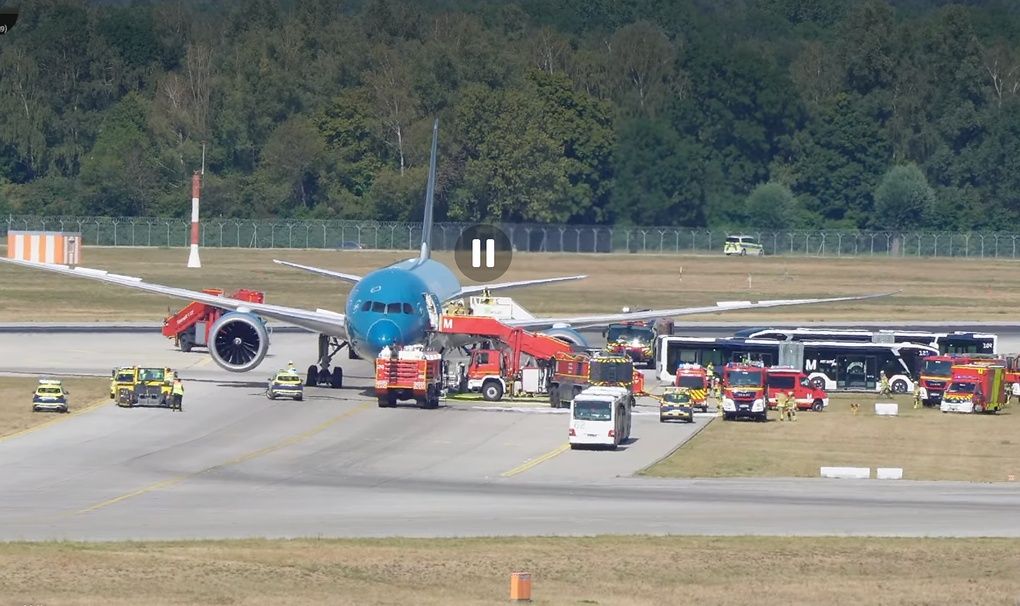
A Vietnam Airlines Boeing 787-9 operating the Munich to Hanoi service encountered a technical malfunction during takeoff on August 15, forcing the aircraft to return to Munich Airport after less than two hours in the air. The airline's flight operations team initiated emergency procedures immediately upon detecting the issue, with the crew executing a controlled descent and landing at the German airport where the flight had originated. No injuries were reported among the passengers and crew members aboard the wide-body jet, and all individuals were safely escorted from the aircraft into the terminal facilities.
The incident unfolded rapidly during the critical takeoff phase, with eyewitness footage from the airport vicinity capturing the Boeing 787 accelerating along the runway at high speed before rotating sharply near the end of the pavement. The video evidence, widely shared on social media, revealed dust being displaced as the aircraft achieved flight, suggesting the rotation occurred dangerously late in the takeoff sequence. Aviation Herald, a respected independent flight tracking and incident reporting service, identified the technical failure as involving late rotation characteristics combined with a tailstrike—where the rear fuselage briefly contacted the runway surface—and a runway overrun scenario. The contact with the tarmac subsequently caused damage to the aircraft's tires, producing visible smoke during the problematic departure.
After becoming airborne despite the technical complications, the aircraft's flight crew employed standard holding and fuel-management procedures to stabilize the situation and communicate with ground authorities. The Boeing 787 climbed to approximately 9,000 feet and entered a holding pattern over the Munich area, allowing the flight crew to assess ongoing aircraft systems and enabling ground personnel to prepare for the emergency return. Munich Airport's emergency services were placed on standby as a precautionary measure, readying fire and rescue teams should the landing encounter further complications. The decision to perform a controlled return rather than continue toward the destination reflected the crew's assessment that the technical issues required immediate inspection and rectification.
The return to Munich unfolded approximately two hours after the initial takeoff, with the aircraft executing another landing at the airport where emergency personnel were positioned. The contact between the fuselage and runway surface during the earlier takeoff had compromised the integrity of multiple tires, creating additional operational concerns for the inbound approach. Vietnam Airlines worked in coordination with German aviation authorities and airport operations staff throughout the incident, ensuring that emergency procedures aligned with international protocols and safety standards.
Vietnam Airlines has committed to a comprehensive investigation into the root causes of the technical malfunction, working collaboratively with relevant authorities and aircraft maintenance specialists to determine exactly what system failures or operational factors contributed to the late rotation and tailstrike. Boeing, as the aircraft manufacturer, is typically involved in such investigations when technical defects may have played a role. The airline indicated that detailed inspections of the aircraft's mechanical, hydraulic, and avionics systems would be conducted before the Boeing 787 returned to service, ensuring that any underlying issues were fully resolved and documented.
The airline is coordinating support arrangements for all affected passengers, many of whom faced significant travel disruptions as a result of the incident. Vietnam Airlines is offering alternative travel arrangements to allow passengers to reach their intended destinations, including rebooking on subsequent flights or alternative routing through other services. The airline stated that comprehensive updates would be released once the inspection process was completed and new operational plans had been finalized, reflecting the typical timeline required for post-incident aircraft certification and return-to-service procedures.
For Southeast Asian carriers and regional aviation operations, this incident underscores the importance of rigorous pre-flight procedures and the critical nature of crew training in emergency protocols. The Boeing 787 Dreamliner has achieved a strong safety record since its introduction, and incidents involving this aircraft type remain statistically rare. However, takeoff and landing phases represent the highest-risk periods in aviation operations, and technical anomalies during these phases demand immediate crew recognition and appropriate response—capabilities that were clearly demonstrated during this Munich incident.
Vietnam Airlines' European operations represent a significant component of its long-haul international network, with the carrier currently maintaining direct services from both Hanoi and Ho Chi Minh City to Munich and Frankfurt using modern wide-body aircraft including the Boeing 787 and Airbus A350. These routes serve both business travelers and tourists connecting Southeast Asia with Central Europe, making service reliability crucial for the airline's competitive positioning. The incident, while ultimately resolved without injury or loss of life, may prompt Vietnamese aviation authorities and the airline itself to review procedures around takeoff weight calculations, runway utilization parameters, and crew communication protocols.
The broader implications for Malaysian and Southeast Asian aviation involve the continued emphasis on safety culture across regional carriers operating similar aircraft types on comparable long-haul routes. As airlines in the region expand their European connections and acquire modern wide-body fleets, incidents like the Munich emergency provide valuable learning opportunities. Malaysia Airlines, AirAsia X, and other regional carriers operating Boeing 787 and similar aircraft can incorporate lessons from this incident into their training programs and standard operating procedures, reinforcing the safety protocols that keep modern aviation among the world's safest transportation methods.

