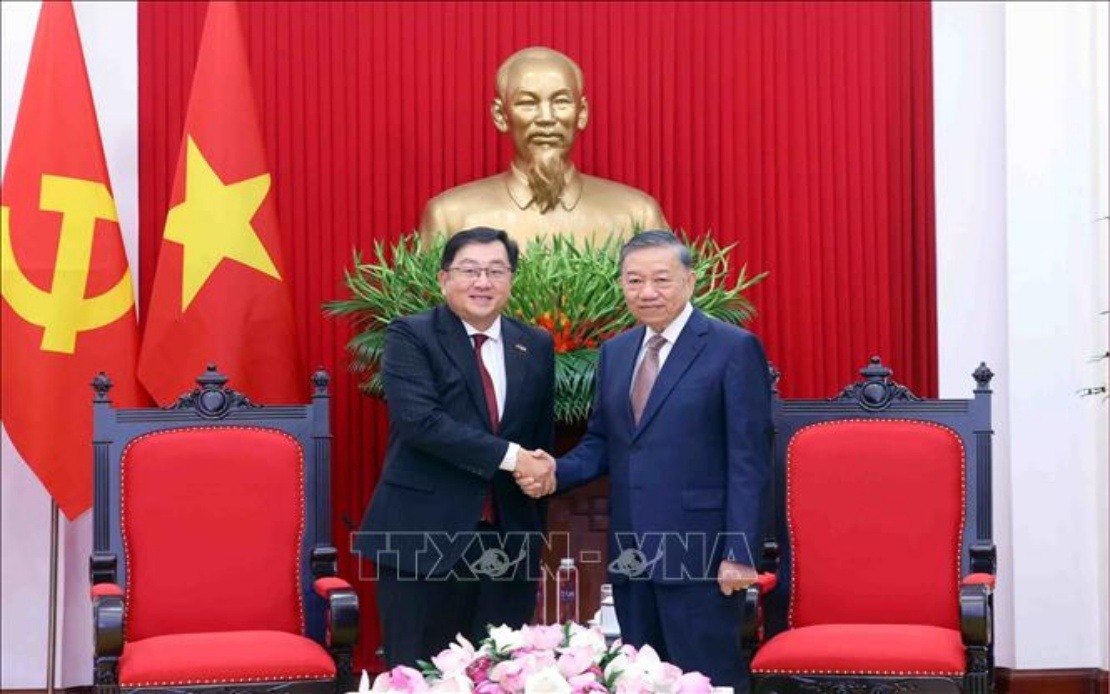
Vietnamese President To Lam has characterised the relationship between Vietnam and Malaysia as increasingly dynamic, built on a foundation of strong political trust and flourishing economic cooperation. The assessment came during his meeting with outgoing Malaysian Ambassador to Vietnam Datuk Tan Yang Thai, signalling Hanoi's commitment to maintaining momentum in what has become one of Southeast Asia's most consequential bilateral partnerships.
The Vietnamese leader extended warm regards to His Majesty Sultan Ibrahim, King of Malaysia, and Prime Minister Datuk Seri Anwar Ibrahim, extending formal invitations for both to visit Vietnam. Such gestures underscore the diplomatic importance both nations place on high-level engagement, a cornerstone of their relationship that has evolved considerably over the past decade. These invitations also reflect Vietnam's recognition that Malaysia, as a major regional player and fellow ASEAN member, holds strategic significance in Hanoi's broader foreign policy calculations.
President Lam took the opportunity to commend Ambassador Tan for his successful tenure, acknowledging the diplomat's contributions to strengthening bilateral ties during a period of considerable regional flux. The recognition of departing ambassadors serves as both a courtesy and a symbolic reaffirmation of continuity—a signal that Vietnam seeks to maintain the diplomatic trajectory established during Tan's posting, with his replacement expected to build on foundations already laid. Lam expressed confidence that Tan would continue advancing Malaysia's diplomatic interests and contribute to ongoing regional stability efforts.
Accounting for the achievements during Tan's time in Hanoi, President Lam highlighted the intensification of political relations between the two nations. Regular exchanges at multiple levels—spanning party, state, government, and parliamentary channels—have created robust institutional frameworks for dialogue. These structured interactions, supported by effective bilateral mechanisms, have reduced the friction points that might otherwise complicate relations between neighboring Southeast Asian nations with distinct developmental models and geopolitical perspectives.
The trajectory of economic cooperation between Vietnam and Malaysia has become particularly noteworthy for regional observers. In the first half of 2026, bilateral trade reached US$10.8 billion, representing a striking 40 per cent increase year-on-year. This robust expansion reflects not merely cyclical economic growth but deepening structural integration across multiple sectors. The momentum carries significance for Malaysian businesses seeking manufacturing diversification and for Vietnamese enterprises pursuing access to Malaysian markets and regional supply chain networks.
Malaysia's position as a leading investor in Vietnam further underscores the economic interdependence between the nations. As the third-largest ASEAN investor in Vietnam and the 10th-largest globally among 154 investing countries and territories, Malaysia has committed substantial capital to Vietnamese development. This investment leadership reflects Malaysian confidence in Vietnam's economic trajectory and creates mutual incentives for political stability and sound governance.
President Lam identified several shared priorities that will likely shape the relationship's evolution over coming years. Digital and green economic development emerged as particular focus areas, reflecting both nations' commitments to sustainable development pathways. Energy and electricity connectivity—crucial for a region working to build integrated power grids and reduce energy costs—was highlighted as another collaborative opportunity. Maritime cooperation carries obvious significance for two countries with extensive coastlines and shared interests in regional security and resource management.
Looking forward, Lam proposed concrete measures to deepen the partnership. Intensifying political exchanges, implementing high-level agreements already negotiated, and expanding defence and security cooperation represent the immediate agenda. Equally important is facilitating balanced trade and investment flows, preventing imbalances that might create friction in the relationship. Enhanced collaboration in digital and green economies, alongside investments in science, technology, and innovation, would position both nations as leaders in Southeast Asia's technological transformation.
Ambassador Tan's reciprocal remarks reinforced Malaysia's commitment to the relationship while placing particular emphasis on areas of mutual concern. Impressed by Vietnam's recent development trajectory—visible in infrastructure investments, poverty reduction, and industrial advancement—Tan expressed optimism about Vietnam's capacity to contribute meaningfully to ASEAN's collective interests and regional stability. His acknowledgment of Vietnam's progress carries political significance, suggesting Malaysian leadership recognises the growing importance of engaging constructively with a Vietnam increasingly central to regional dynamics.
The ambassador specifically highlighted Malaysia's interest in deepening cooperation on the digital economy, green economy, and renewable energy—sectors where both nations face similar challenges and opportunities. These shared priorities reflect global megatrends reshaping Southeast Asian economies: the transition to clean energy, the digitisation of economic activity, and the need for sustainable development models that balance growth with environmental protection. Collaborative initiatives in these areas could yield spillover benefits across ASEAN, establishing templates for how regional cooperation might address transnational challenges.
Tan committed to leveraging his professional experience and personal affection for Vietnam to advance bilateral relations even as his posting concluded. This personal dimension reflects a broader pattern in Southeast Asian diplomacy, where individual relationships and goodwill between key figures facilitate cooperation across institutional channels. The diplomat's pledge to remain an advocate for Vietnam-Malaysia ties also suggests Malaysia views this relationship as enduring, not merely transactional.
Perhaps most symbolically, Tan conveyed an invitation from the Malaysian King for President Lam to visit Malaysia, reciprocating Lam's earlier invitations. These mutual overtures for high-level visits represent the diplomatic equivalent of shaking hands—commitments to continued engagement at the highest levels. Such visits, when they occur, typically produce joint statements outlining cooperation frameworks, potentially including new agreements on trade, security, or cultural exchange.
The broader context of this bilateral engagement reflects Vietnam and Malaysia's shared stakes in Southeast Asian stability and ASEAN's institutional health. Both nations benefit from a rules-based regional order that constrains unilateral assertiveness and provides forums for resolving disagreements. As major trading economies with significant maritime interests, both have incentives to maintain the cooperative frameworks that have broadly benefited the region for the past three decades.

