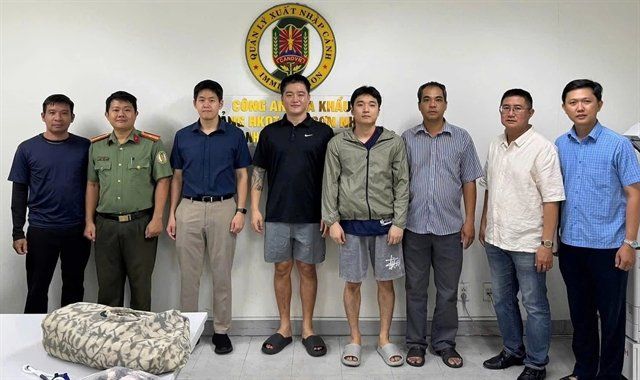
Vietnamese law enforcement has successfully apprehended three South Korean nationals facing Interpol red notices for their involvement in elaborate online fraud operations. The arrests, executed by Ho Chi Minh City Police Investigation Agency working alongside the Ministry of Public Security's investigators, represent a significant regional enforcement cooperation against transnational cybercrime. Wang Taesan (born 1990), Han Joonhee (born 1992), and Bang Giseong (born 1997) were transferred to South Korean authorities at Tan Son Nhat International Airport following their capture.
The three suspects orchestrated particularly insidious schemes that leveraged psychological manipulation and impersonation tactics. In their primary operation, the criminals falsely claimed to possess compromising intimate footage of victims, threatening to distribute such content publicly unless payment was made. This sextortion variant, increasingly common across Asia, exploited victims' fear and shame to extract money—despite the perpetrators having no actual materials to release. The psychological leverage proved remarkably effective, allowing the group to target numerous South Korean nationals despite the fraudulent foundation of their threats.
Beyond simple extortion, the criminal network deployed more sophisticated social engineering attacks. The suspects impersonated legitimate South Korean law enforcement officials, including prosecutors and other government agents, initiating contact with potential victims through phone calls and electronic messaging. These fraudsters then directed victims to links containing forged legal documents, including fabricated arrest warrants bearing the targets' names. This tactic created a false sense of legal jeopardy, priming victims psychologically before the financial demands arrived.
The scheme's final stage involved persuading victims that their bank accounts had been flagged as connected to criminal activity. Under this pretext, the criminals demanded money transfers to "designated verification accounts," presenting the transactions as legitimate compliance procedures required by authorities. By framing theft as official procedure, the perpetrators bypassed rational skepticism and exploited natural compliance with perceived government authority. This multistep confidence operation reflected sophisticated understanding of social psychology and legal procedures.
This apprehension in Ho Chi Minh City follows an earlier significant arrest in Vietnam's capital. In late August, Hanoi's Lang Ward Police, coordinating with the Immigration Department of Hanoi Police, handed over another South Korean fugitive to Seoul authorities at Noi Bai International Airport. Lee Sammin, born in 1996, held an Interpol red notice for telecommunications-related online fraud dating back to December 31, 2025.
Lee Sammin's criminal enterprise operated at substantially greater scale than the Ho Chi Minh City cases, involving an organised network that targeted investment fraud victims. Operating through social media and internet platforms, Lee and his associates posed as legitimate investment experts, providing fraudulent information about stocks purportedly approaching public listing. The network enticed victims to remit funds for "investment opportunities" before systematically misappropriating the money. The conspiracy ultimately defrauded victims of US$10,693,343—approximately RM50 million—representing one of the most significant transnational fraud operations prosecuted regionally.
These cases underscore Southeast Asia's emergence as both a hub for cybercriminal operations and a sanctuary where such enterprises can operate relatively undetected. Criminals exploit the region's internet infrastructure, relatively low law enforcement coordination, and jurisdictional ambiguities to target wealthy neighbours like South Korea. Vietnam's position as a transit point and operational base makes it particularly attractive to transnational crime networks seeking distance from their home countries' regulatory scrutiny.
For Malaysian readers and regional observers, these arrests highlight the critical importance of cross-border law enforcement cooperation in combating digital crime. The coordination between Vietnamese police agencies and international partners demonstrates that persistence and institutional framework can neutralise even sophisticated criminal networks. However, the sheer scale of Lee Sammin's operation—defrauding victims across an international scale—suggests that far larger networks remain undetected and active throughout Southeast Asia.
The prevalence of these schemes targeting South Korean citizens reflects broader patterns in regional cybercrime. Korean victims represent particularly attractive targets for international fraud networks due to South Korea's high internet penetration, cultural comfort with online transactions, and historically strong presence of Korean business professionals throughout Southeast Asia. These factors create numerous potential victim pools and operational cover for criminal enterprises.
Vietnam's Ministry of Public Security has demonstrated increasing commitment to international law enforcement cooperation, particularly regarding Interpol-coordinated investigations. The successful apprehension and handover of multiple suspects within short timeframes suggests enhanced institutional capacity and perhaps improved intelligence sharing with South Korean authorities. This represents progress in addressing the regional cybercrime challenge that increasingly threatens citizens across the Association of Southeast Asian Nations.
For Malaysian law enforcement and cybersecurity professionals, these cases provide instructive examples of sophisticated social engineering tactics. The perpetrators' success in combining psychological manipulation with impersonation of legitimate authorities demonstrates vulnerabilities that extend beyond technical security measures. Residents throughout Southeast Asia, including Malaysia, should exercise heightened vigilance regarding unsolicited communications from apparent government officials demanding financial transactions or personal information, particularly through digital channels where verification proves difficult.
The persistence of such operations despite international manhunts and extradition mechanisms suggests that financial incentives and operational opacity continue enabling transnational fraud networks to flourish. Until Southeast Asian nations implement more comprehensive digital crime legislation, harmonise law enforcement procedures, and establish clearer international cooperation frameworks, sophisticated criminals will likely continue exploiting jurisdictional gaps and resource limitations. The successful arrests represent important tactical victories, yet the broader strategic challenge of eliminating infrastructure supporting cybercrime remains substantially unresolved.

