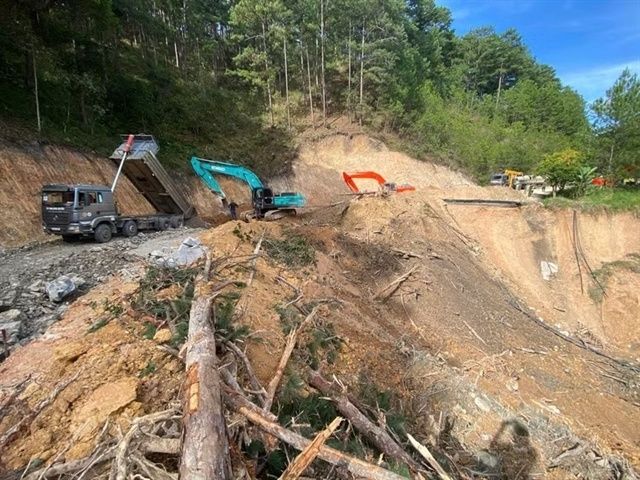
Vietnam's Ministry of Construction has formally activated emergency protocols for Ho Chi Minh Road following extensive infrastructure damage caused by repeated heavy rainfall across Tuyen Quang Province. The declaration targets a particularly vulnerable stretch at kilometre 115, where the major north-south thoroughfare intersects with National Highway 2C, an area overseen by Road Management Zone I. The decision underscores the severity of deterioration to the road surface and underlying structure, prompting authorities to prioritise the safety of both passengers and commercial traffic traversing this economically significant corridor.
The trigger for the emergency declaration stems from relentless weather patterns that pounded the region throughout June 2026. Data compiled by the Tuyen Quang Provincial Hydrometeorological Station, corroborated by assessments from the National Centre for Hydrometeorological Forecasting, documented successive waves of intense precipitation over the month. This sustained barrage of rainfall saturated the terrain and overwhelmed drainage systems, creating conditions conducive to severe road deformation and structural compromise. The cumulative impact of multiple storm systems proved far more destructive than isolated weather events would typically inflict, necessitating intervention at the ministerial level.
The administrative response demonstrates the hierarchical coordination typical of Vietnam's infrastructure management system. The Ministry of Construction has tasked the Department for Roads of Việt Nam (DRVN) and Road Management Zone I with leading a comprehensive damage assessment and remediation strategy. These agencies must conduct detailed engineering reviews to quantify the extent of deterioration, identify viable repair methodologies, and prepare formal Emergency Construction Orders that authorise rapid restoration work under streamlined procurement and approval processes. This institutional framework allows authorities to bypass standard bureaucratic timelines when public safety hangs in the balance.
Beyond the primary damaged section, authorities have identified a secondary problem area stretching between kilometre 124.6 and kilometre 128 along the same corridor where it crosses National Highway 2. This zone has experienced localised flooding that impedes regular traffic flow and creates congestion bottlenecks, particularly problematic for the substantial volume of commercial vehicles that depend on Ho Chi Minh Road as a primary logistics artery connecting northern and southern regions. The dual challenge of structural damage and water accumulation requires parallel mitigation efforts coordinated across multiple management zones.
The accountability structure embedded within the emergency declaration assigns clear responsibility to senior officials. The Director General of the Department for Roads of Vietnam and the Director of Road Management Zone I face direct accountability to the Construction Minister for both the damage assessment and the execution of remedial works. This personalised accountability arrangement reflects a governance approach common in Vietnamese administration, where individual officials shoulder responsibility for outcomes within their jurisdictions. These leaders must also manage the immediate operational challenge of maintaining traffic flow through affected areas whilst repair crews work to restore structural integrity.
For Malaysian readers familiar with similar infrastructure challenges across Southeast Asia, Vietnam's response illustrates how national governments balance emergency response urgency with institutional protocols. The Ho Chi Minh Road network carries enormous strategic importance comparable to Malaysia's North-South Expressway or Thailand's central highway corridors. Extended disruptions in such critical arteries reverberate through regional commerce and supply chains. Vietnam's decision to invoke emergency procedures acknowledges this economic dimension alongside the immediate safety imperative.
The timeline for resolution remains open-ended pending completion of emergency construction works. Once repair operations conclude, the DRVN must formally report back to the Ministry of Construction, providing the evidentiary foundation for declaring the emergency period terminated. This staged approach allows flexibility in addressing unforeseen complications whilst maintaining oversight of expenditure and work quality. The government has signalled its commitment to rapid restoration by empowering field-level managers to expedite decision-making without awaiting standard approval timelines.
The Transport and Road Safety Division of the Ministry of Construction assumes responsibility for monitoring implementation across all relevant agencies and units. This oversight body will coordinate between technical teams conducting repairs, traffic management personnel addressing congestion, and administrative officials processing emergency authorisations. The distributed accountability model requires continuous interagency communication to align priorities and resolve conflicts between competing operational demands. Such coordination proves particularly challenging in emergency situations where normal work rhythms and planning assumptions no longer apply.
For regional observers, the Tuyen Quang incident reflects broader climate resilience challenges confronting Southeast Asian infrastructure systems. Successive heavy rainfall events stretching across an entire month suggest shifting precipitation patterns that traditional design specifications may not adequately accommodate. Vietnam's infrastructure, like counterparts throughout the region, was engineered according to historical meteorological data increasingly rendered unreliable by climate variability. As extreme weather events become more frequent and intense, governments across Southeast Asia face mounting pressures to retrofit and redesign critical infrastructure networks whilst maintaining operational continuity.
The immediate implications for cross-border commerce and regional logistics are substantial. Ho Chi Minh Road functions as part of a larger transportation corridor linking Vietnam with Laos, Thailand, and ultimately Myanmar and other mainland Southeast Asian neighbours. Disruptions to this axis constrain trade flows and increase transit times for goods moving through the subregion. Recovery efforts that restore full capacity relatively quickly minimise economic disruption, whilst extended closures or speed restrictions cascade through supply chains dependent on reliable road transportation. Vietnamese and regional companies with operations along this corridor face uncertainty regarding scheduling and inventory management whilst repairs proceed.
The emergency declaration also carries implications for transport insurance and logistics planning across Southeast Asia. Carriers operating through Vietnam must account for infrastructure vulnerabilities when calculating route reliability and delivery timeframes. The Tuyen Quang situation adds empirical weight to risk assessments highlighting climate-related infrastructure fragility. Regional supply chain managers increasingly factor such disruption potential into contingency planning, diversifying routes and maintaining buffer inventory to mitigate exposure to climate-driven road closures or damage. Vietnam's formal recognition of this emergency may prompt broader regional assessment of infrastructure resilience gaps.

