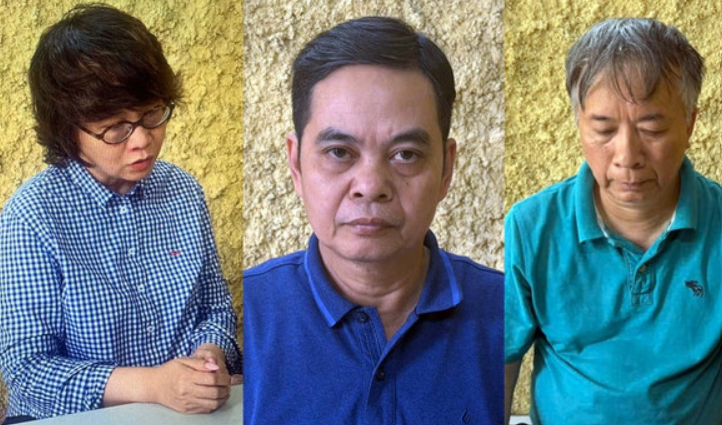
Vietnamese authorities have escalated their crackdown on media and publishing by arresting three executives from the Vietnam Writers' Association Publishing House, the company responsible for distributing a biography titled "Stories with Thanh -- A New Account of Light" earlier this year. The detentions, announced by Hanoi police on July 15, mark the latest in a series of moves targeting individuals connected to the book's creation and promotion, signalling the Communist leadership's sensitivity around how the nation's founding figure is portrayed in public discourse.
The arrested executives held senior positions within the publishing house: the director, editor-in-chief, and head of the editorial board all face charges of "producing, possessing, distributing or disseminating information, documents or items aimed at opposing the Socialist Republic of Vietnam," according to official statements. These individuals join the book's author, former telecommunications executive Nguyen Thanh Nam, who was taken into custody in early July on similar charges. The coordination between authorities suggests a systematic dismantling of the entire editorial chain rather than targeting isolated actors, demonstrating how seriously Vietnam's leaders view historical revisionism.
Nguyen Thanh Nam's biography examines Ho Chi Minh's formative years spent overseas, detailing his quest to identify and develop strategies for Vietnam's liberation struggle. While such subject matter might appear unremarkable in many democracies, Vietnam's one-party system maintains strict control over authorized narratives surrounding national heroes and historical events. The government argues that the book contains distortions of revolutionary history and misrepresentations of party policies, though specific factual errors have not been publicly detailed. This opacity reflects the broader challenge of dissent in Vietnam, where the boundaries of acceptable discourse remain deliberately ambiguous.
The publishing house itself withdrew the book from circulation following pressure from state authorities, yet this capitulation failed to shield its leadership from prosecution. The publisher's decision to recall the title demonstrates how Vietnamese businesses operate within narrow constraints, aware that cooperation with government demands offers limited protection once authorities decide to pursue criminal charges. This dynamic discourages future publishers from even considering controversial historical work, creating a chilling effect across the entire industry that extends beyond any single publication.
Beyond individual prosecutions, Vietnam's culture ministry expanded its enforcement action to media organizations, sanctioning 23 news outlets that had published favourable coverage of the Ho Chi Minh biography. The ministry's statement claimed that these news agencies have now acknowledged errors and internalized lessons about source verification, language carefully chosen to frame censorship as educational correction. Nearly US$2,500 in combined fines were imposed on these outlets, while reassignments, suspensions, and dismissals affected over a dozen journalists involved in writing the articles. Such coordinated punishment across the media landscape suggests that Hanoi views positive coverage of the book as sufficient grounds for institutional discipline.
The episode reveals how Vietnam's authorities employ multiple enforcement mechanisms simultaneously to suppress particular narratives. Rather than relying solely on criminal charges, they weaponize administrative sanctions, financial penalties, and personnel actions to create comprehensive deterrence. Journalists who reported on the book face career consequences, publishers lose their freedom, and media organizations absorb financial and reputational damage. This multi-layered approach proves more effective than simple censorship would be, as it transforms potential critics into self-censors fearful of triggering institutional retaliation against their employers and colleagues.
Author Nguyen Thanh Nam appeared on state television to recant his work, admitting to "factual errors and false assertions that run counter to the guidelines and policies of the party and state." His televised apology, in which he also apologized for tarnishing Ho Chi Minh's image and causing public confusion, exemplifies the ritualistic nature of state discipline in Vietnam. Such public contrition serves multiple purposes: it demonstrates state power, warns others against similar transgressions, and creates propaganda material showing the author's voluntary acceptance of official truth. Whether Nam's statement represented genuine change of mind or coerced performance remains unclear, but the effect is identical—suppression of the book's distribution and discouragement of future biographical work deemed insufficiently reverential.
For regional observers monitoring Southeast Asian governance trends, Vietnam's response illuminates the Communist Party's evolving approach to information control in the digital age. Rather than banning the book outright, authorities orchestrated a comprehensive suppression involving multiple state agencies, criminal prosecution, administrative penalties, and forced public recantations. This sophisticated methodology reflects lessons learned from earlier, more crude censorship efforts, adapting enforcement to contemporary media ecosystems where information circulates across multiple channels and platforms.
The broader context of media suppression in Vietnam extends far beyond this single biography. According to Human Rights Watch, more than 160 critics of the regime currently languish in Vietnamese prisons, representing one of Asia's more extensive networks of political detention. The crackdown on the Ho Chi Minh book fits within this larger pattern of limiting dissent and controlling historical narratives, demonstrating that Vietnam's Communist leadership prioritizes ideological uniformity and party authority over intellectual freedom or historical inquiry. The systematic nature of the enforcement action—simultaneous arrests of publishers, journalists, and influencers, combined with ministerial sanctions—underscores how thoroughly the state apparatus mobilizes to crush challenges to official orthodoxy.
Malaysian readers should note these developments given the ongoing debates within this region about media freedom, historical narratives, and the proper boundaries of state authority over publishing and journalism. Vietnam's approach offers a cautionary example of how governments can employ ostensibly reasonable justifications—protecting national unity, preventing distortion of historical truth, maintaining social stability—to justify comprehensive suppression of independent voices. The sophistication and coordination of Vietnam's enforcement apparatus, leveraging criminal law, administrative penalties, and media pressure simultaneously, represents a concerning escalation in information control that other authoritarian and semi-authoritarian regimes in the region might emulate or adapt to their own contexts.
The implications extend to transnational media ecosystems as well. As Vietnamese content circulates across Southeast Asia through digital platforms and exile publications, Hanoi's messaging about the book influences regional discourse. The government's framing of the biography as dangerously distorted shapes how neighbouring countries' media outlets and readers perceive both Ho Chi Minh and Vietnam's commitment to open historical inquiry. This soft power dimension—using enforcement actions to signal ideological priorities to regional and international audiences—represents another dimension of Vietnam's sophisticated approach to information dominance that regional media and policymakers should carefully monitor.

