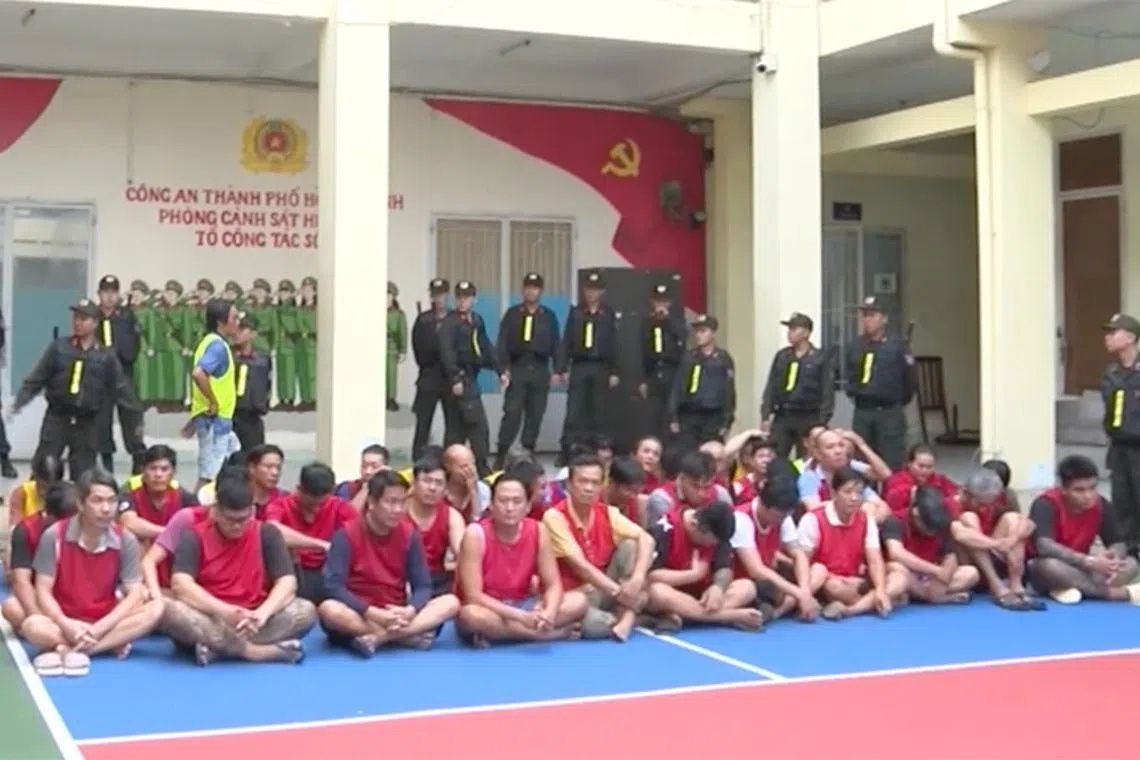
Vietnamese law enforcement has cracked down hard on organised illegal gambling, announcing the dismantling of two exceptionally large betting rings that collectively processed US$133 million in unlawful transactions. Carried out in late June, the raids resulted in 85 arrests and represent a significant escalation in Hanoi's efforts to suppress underground betting operations that flourish whenever major international sporting tournaments captivate regional audiences. The coordinated action underscores the government's determination to curb what has become an entrenched criminal enterprise exploiting the World Cup's global reach and the massive financial stakes it generates.
Police in Ho Chi Minh City released details confirming that the two networks operated with what authorities described as an "exceptionally large scale of operation" coupled with sophisticated organisational structures. The hierarchical nature of these syndicates—featuring clearly defined leadership, agent layers, and member accounts—suggests professional criminal management rather than casual betting collectives. Since October 2025, the combined operations had channelled an estimated US$133 million through their systems, illustrating the sheer financial magnitude of clandestine gambling in Vietnam and the region more broadly. This figure alone demonstrates why authorities view such networks as threats to social stability and financial integrity, not merely minor law enforcement matters.
Central to the operation was a transnational dimension linking Vietnam to Cambodia. According to confessions obtained from ring leaders, individuals based in Cambodia provided "master-level betting accounts" that served as the foundation for the entire distribution network. These accounts were then subdivided into numerous secondary accounts controlled by agents, who in turn distributed access to individual gamblers throughout Vietnam via online platforms. This tiered structure exemplifies how Southeast Asian criminal networks exploit permissive regulatory environments in neighbouring countries to service illicit markets elsewhere, with Cambodia functioning as a crucial hub facilitating illegal gambling infrastructure across the broader region.
The broader enforcement campaign reveals the scale of illegal gambling culture permeating Vietnamese society. Beyond the two major rings dismantled, authorities disclosed that police had eliminated 73 gambling operations nationwide during the first three weeks of World Cup play, resulting in 346 arrests. Colonel Bui Tuan Anh of Vietnam's public security ministry noted that transaction volumes across all seized operations totalled "thousands of billions of dong," translating to hundreds of millions of dollars. These figures underscore that the two headline rings, while exceptionally large, represent merely the most visible components of a sprawling underground gambling economy that extends throughout the country and touches numerous criminal actors at various operational levels.
Vietnam's strict prohibition on online gambling creates the fundamental conditions enabling such illicit enterprise to thrive. As a communist country maintaining tight state control over financial systems and consumer behaviour, the government classifies all forms of internet-based wagering as illegal, yet enforcement remains perpetually challenged by technological innovation, encryption, and the international reach of digital transactions. The lucrative nature of such operations—World Cup tournaments generate enormous wagering volumes globally—incentivises criminal entrepreneurs to develop increasingly sophisticated platforms and networks capable of evading detection. The gap between state prohibition and market demand becomes the space where organised crime flourishes, a dynamic familiar throughout Southeast Asia where similar policies create comparable underground economies.
Sporting events amplify the enforcement challenge significantly. International tournaments like the World Cup trigger predictable spikes in betting demand as millions of fans worldwide seek to wager on matches. Criminal networks respond by scaling operations, recruiting additional agents, and marketing betting opportunities aggressively through social channels. Vietnamese authorities have therefore adopted a policy of periodic intensified crackdowns timed to major sporting competitions, attempting to disrupt networks when their activity becomes most visible and operational security most strained. The timing of these raids—concentrated during the early World Cup period—reflects this strategic approach, though the continuing discovery of new operations suggests the underlying criminal infrastructure remains resilient.
The World Cup 2026 tournament being hosted across Canada, Mexico, and the United States will likely generate further betting pressure on Southeast Asian jurisdictions. As that competition approaches, anticipate similar enforcement waves throughout Vietnam and neighbouring countries grappling with comparable underground gambling sectors. The final match scheduled for July 19, 2026, will mark the crescendo of worldwide wagering activity, potentially prompting renewed crackdowns by authorities seeking to contain illegal betting operations at their peak. This cyclical pattern reflects the inherent difficulty of suppressing demand-driven illicit markets through supply-side enforcement alone.
The cross-border elements of this particular case hold particular significance for regional law enforcement cooperation. The involvement of Cambodia-based account providers highlights how criminal networks span national boundaries, requiring coordinated multilateral responses that many Southeast Asian countries struggle to implement effectively. Information sharing, extradition protocols, and joint investigation procedures remain inconsistent throughout the region, allowing sophisticated criminal actors to exploit jurisdictional gaps. Vietnam's ability to trace financial flows back to Cambodia and identify the upstream account providers suggests improving investigative capabilities, yet the fundamental challenge of tracking digital transactions across international borders persists as a structural limitation on enforcement effectiveness.
For Malaysian observers, the Vietnamese experience offers instructive lessons about underground gambling dynamics operating throughout Southeast Asia. Malaysia maintains its own complex relationship with gambling through legal frameworks permitting certain forms of wagering while criminalising others, yet illegal operations persist here as well. The sophistication demonstrated by Vietnamese betting rings—hierarchical structures, transnational supply chains, digital platforms—mirrors patterns documented in Malaysia's own underground gambling investigations. These regional syndicates often share common operating principles, techniques, and sometimes personnel, suggesting that enforcement challenges and criminal methodologies transcend individual national contexts. Understanding Vietnamese approaches to these problems and their relative effectiveness becomes relevant for Malaysian policymakers and law enforcement agencies seeking to address comparable threats within their own jurisdictions.

