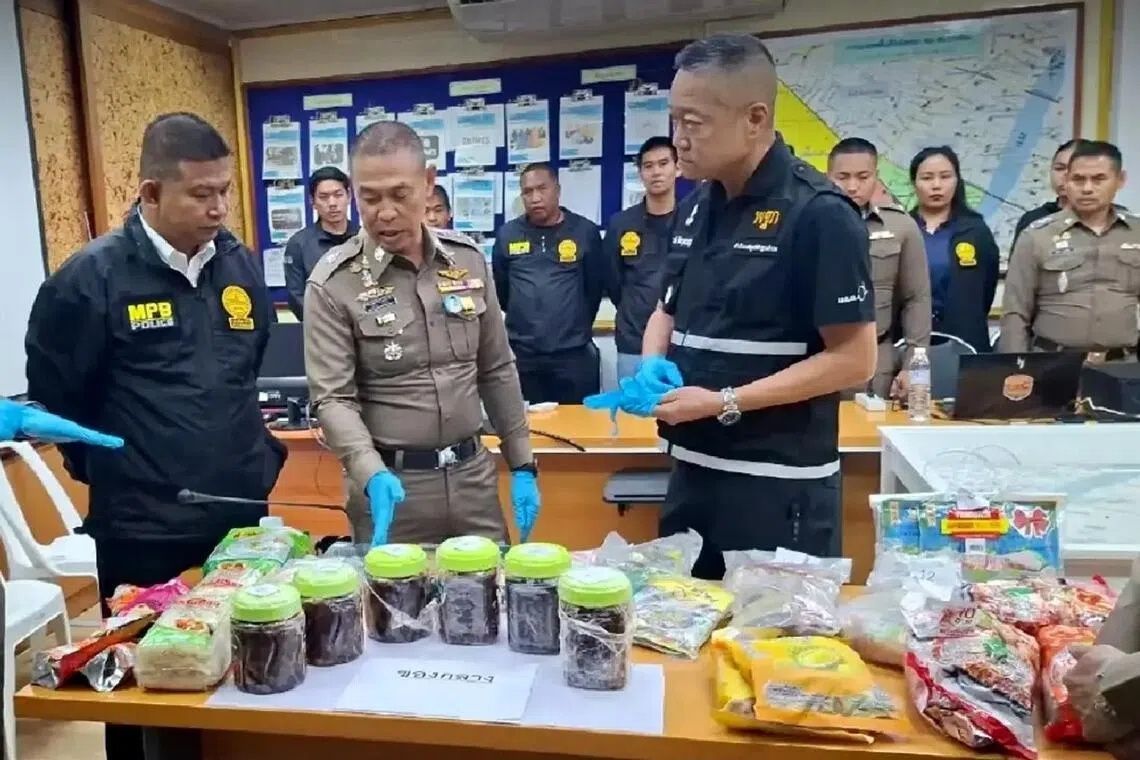
Bangkok police have exposed an international methamphetamine trafficking network that exploited Thailand's position as a transit hub to deliver narcotics to Japan using an inventive concealment method. The operation, which came to light after a suspicious courier alerted authorities on July 13, exemplifies the evolving sophistication of Southeast Asian drug syndicates in circumventing border controls across the region. Metropolitan Police Bureau commissioner police lieutenant-general Siam Boonsom unveiled the investigation's findings on July 17, revealing a multi-layered smuggling apparatus designed to obfuscate the chain of command and frustrate law enforcement efforts.
The discovery occurred when a courier hired to transport seemingly innocuous jars of tamarind paste noticed the containers' unexpected weight and sought police guidance. Testing revealed that six foil-wrapped packages secreted within the jars contained more than 2kg of crystal methamphetamine, or ice as it is commonly termed in street markets. The choice of tamarind—a staple ingredient in Southeast Asian and South Asian cuisines—as a hiding vehicle demonstrates how traffickers exploit mundane commercial goods and established trade patterns to mask illegal shipments. Japan, with its prosperous drug market and strict but passable borders, represents a lucrative destination for such operations, making the Japan-bound shipment part of a broader supply strategy targeting affluent markets.
What distinguishes this case within regional trafficking contexts is the network's deliberate organizational structure, designed to insulate higher-level operators from detection. Vietnamese nationals allegedly directed the enterprise from Hanoi, operating through untraceable social media accounts to recruit delivery riders. These riders, tasked only with collecting packages from safe houses occupied by Vietnamese expatriates scattered across Thailand, remained insulated from knowledge of the shipment's contents or ultimate destination. The packages were subsequently handed to Thai couriers responsible for the final leg of transport abroad, creating multiple buffers that would theoretically prevent investigators from tracing shipments backward to the network's architects.
Financial flows through the conspiracy reveal another layer of operational tradecraft. Money and expenses connected to the smuggling scheme were routed through a bank account registered to Sompong, a Thai national subsequently arrested in connection with the operation. Rather than maintaining consistent withdrawals that might trigger banking scrutiny, Vietnamese operatives allegedly extracted varying sums between 20,000 and 50,000 baht at irregular intervals before returning to Vietnam. This pattern of cash withdrawals by different individuals mirrors tactics employed by international money laundering rings seeking to exploit the threshold-reporting requirements of Thai financial institutions while maintaining plausible deniability for any single individual.
The investigation has prompted authorities to believe that the operation extended beyond the initially identified suspects, with police estimating involvement of more than four individuals across Thailand and Vietnam. Arrest warrants have been issued for Sompong and three Vietnamese nationals allegedly responsible for various operational functions, including managing anonymous social media recruitment, executing cash withdrawals, and providing strategic direction from Hanoi. Sompong has maintained his innocence despite the evidence against him. The scope of the operation suggests that this single dismantled network represents merely one node in a larger trafficking ecosystem supplying methamphetamine to consumption markets throughout East and Southeast Asia.
Investigators are examining the possible complicity of Sompong's girlfriend, though she has not been named in arrest warrants. Authorities believe she may have possessed knowledge of the smuggling activities, a common pattern in transnational drug operations where romantic partners are drawn into criminal enterprises through proximity rather than direct recruitment. Her potential involvement underscores how trafficking networks recruit participants through personal relationships and coercion rather than ideological commitment, creating vulnerabilities that law enforcement can potentially exploit for intelligence gathering.
This case illuminates Thailand's persistent role as a crucial transit nation for narcotics destined for markets beyond Southeast Asia. While Thai authorities have implemented numerous interdiction efforts, the country's geographic position, extensive porous borders with Myanmar, Laos, and Cambodia, and its integration into regional supply chains make it nearly impossible to prevent all drug flows. The use of conventional commercial channels—food products destined for legitimate markets—further complicates detection efforts at borders that process millions of legitimate trade items daily. As methamphetamine production accelerates in clandestine laboratories throughout the Golden Triangle region, trafficking networks must develop increasingly inventive methods to sustain supply to international markets.
The operation also reflects broader shifts in how drug networks organize themselves in response to law enforcement pressure. Rather than hierarchical structures with identifiable leaders, successful rings now employ franchise models where independent cells handle discrete functions with minimal communication between layers. This distributed approach means that even when enforcement agencies dismantle one trafficking cell, the broader network remains operational. Vietnamese nationals have increasingly assumed prominent roles in Southeast Asian drug trafficking, leveraging established expatriate communities and economic ties to move narcotics through Thailand toward markets in East Asia, Australia, and increasingly North America.
For Malaysian readers and policymakers, this case carries significant implications regarding transnational crime cooperation and border security. Malaysia's own position as a transit point for narcotics flowing toward Australia and other Pacific markets mirrors Thailand's vulnerabilities. The sophistication demonstrated by this Vietnamese-led network—encompassing financial laundering, social media recruitment, and concealment techniques—suggests that Malaysian law enforcement may encounter increasingly complex smuggling operations. Regional cooperation mechanisms such as the ASEAN Regional Forum on transnational crime must adapt to address these evolving tactics, with particular emphasis on intelligence sharing regarding financial flows and communications infrastructure used by trafficking organizations.
The case also highlights the necessity for enhanced cooperation between Thailand, Vietnam, and Japan in pursuing transnational criminal investigations. While Thai authorities uncovered the operation at an intermediate stage, effective disruption requires following money trails and communication networks across borders, activities that demand formal mutual legal assistance frameworks and intelligence partnerships. For Malaysia, strengthening such bilateral and multilateral arrangements with neighbors remains essential, particularly as methamphetamine production in Southeast Asia continues to surge and traffickers seek new maritime and overland routes through the region.

