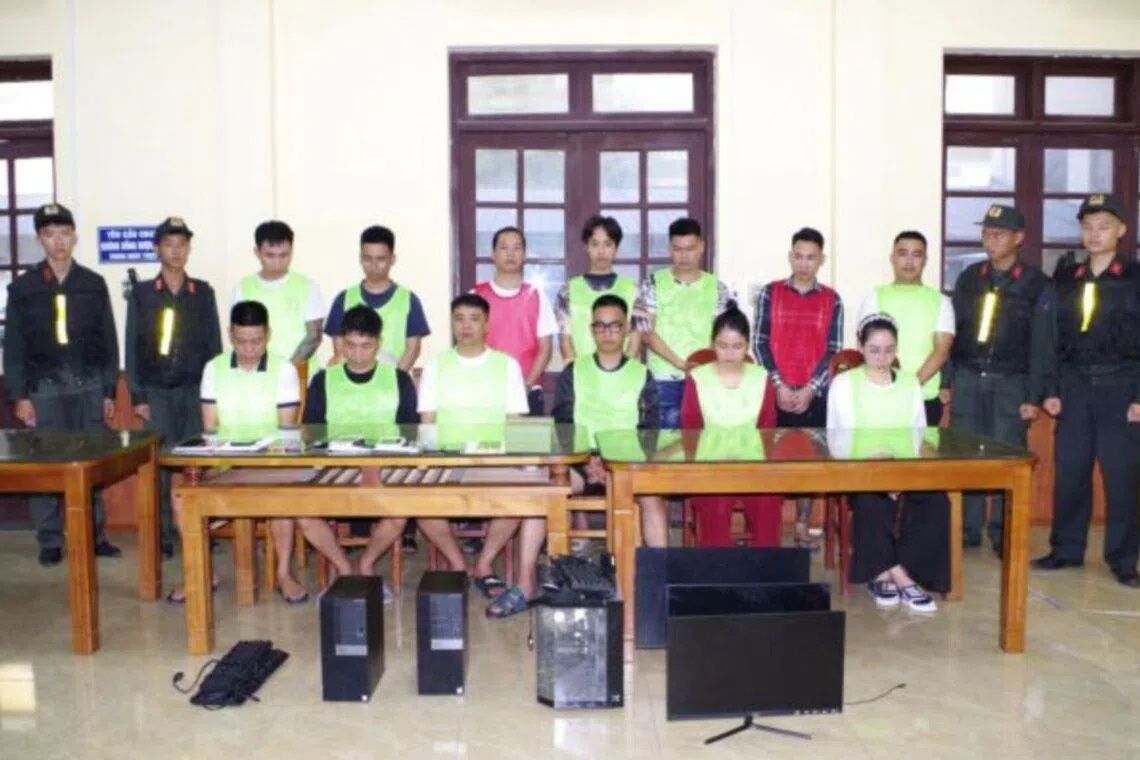
Police in Vietnam's Ninh Binh province have successfully shut down a major transnational cyberfraud operation, apprehending 12 suspects accused of orchestrating scams that netted more than 250 billion dong—equivalent to RM39.2 million—from unsuspecting victims. The sophisticated criminal enterprise represents a concerning escalation in cross-border fraud targeting Southeast Asian populations, particularly as organised crime syndicates increasingly leverage digital channels and regional mobility to expand their reach.
The investigation identified Nguyen Van Cuong, 28, and Nguyen Van Phuong, 34, as the principal architects of the fraudulent network. Authorities conducted extensive searches that uncovered substantial physical evidence and operational materials, recovering cash, a vehicle, multiple mobile phones, computers, forged identity documents, jewellery, and extensive transaction records. The breadth of seized materials suggests a well-established operation with dedicated infrastructure and resource management spanning multiple locations.
A striking feature of this criminal enterprise was its systematic recruitment strategy. The syndicate deliberately targeted Vietnamese citizens, arranging their transportation to Cambodia where the actual fraud operations were conducted. This cross-border arrangement offered the perpetrators operational advantages, including reduced law enforcement scrutiny and distance from victims, while simultaneously complicating investigative jurisdictional issues that often plague transnational crime cases. The structured hierarchy with clearly delineated roles and responsibilities indicates a corporate-style organisation rather than ad-hoc criminal activity.
The gang employed an impressive arsenal of deceptive techniques designed to exploit psychological vulnerabilities and institutional trust. Perpetrators impersonated a broad spectrum of authority figures—police officers, prosecutors, judges, bank employees, and tax officials—leveraging the cultural deference many citizens demonstrate toward state representatives. This psychological manipulation formed the cornerstone of their social engineering approach, making victims more susceptible to subsequent financial requests that seemed to come from legitimate institutional sources.
Technological sophistication complemented their human impersonation tactics. The network developed counterfeit websites and mobile applications meticulously designed to replicate the appearance and functionality of genuine government agency portals and established commercial platforms. These fabricated digital interfaces served as Trojan horses, creating false legitimacy in victims' minds and lowering their resistance to providing sensitive financial information or executing fund transfers. Such technical infrastructure requires significant technical expertise and financial investment, underscoring the operation's serious, organised nature.
The fraud scenarios deployed by the group demonstrated considerable versatility and psychological cunning. Fabricated job recruitment campaigns lured participants seeking supplementary income, while investment fraud pitched false opportunities in increasingly popular financial sectors including stocks, bonds, and cryptocurrencies—asset classes where many Southeast Asian investors still lack comprehensive market knowledge. Romance scams exploited emotional vulnerability by establishing false relationships before requests for money. Social media account hijacking created seemingly authentic requests from known contacts, weaponising trust networks to extract loans or investments from the victim's personal circles.
Particularly ingenious was the scheme involving impersonated military officers contacting retail establishments and businesses. Perpetrators would place sizeable merchandise orders, then convince business owners to purchase additional inventory on the fraudsters' behalf and deposit advance payments into designated bank accounts. This variation specifically targeted commercial entities and entrepreneurs, demonstrating the network's willingness to expand beyond individual consumers to tap different victim demographics with tailored deception strategies.
The criminal enterprise operated with alarming efficiency, compromising approximately 500 victims across Vietnam in merely five months following its establishment in October 2024. This rapid victim accumulation suggests a well-oiled operational machine capable of managing multiple simultaneous fraud campaigns across various platforms and communication channels. The scale and speed of victimisation underline the serious threat such transnational networks pose to digital security and financial stability across Southeast Asia.
In response, Vietnamese authorities have moved decisively to prosecute the conspiracy. Six suspects have been charged with "fraudulent appropriation of property" and placed in temporary detention pending trial. The remaining six suspects remain under procedural investigation as police continue gathering evidence and identifying additional network members. Concurrently, authorities are executing asset seizure and freezing orders targeting accounts and property suspected of containing proceeds from the fraud, a crucial step toward victim restitution and dismantling remaining operational capacity.
The investigation represents an ongoing effort rather than a concluded case. Police are actively expanding their inquiries to apprehend additional syndicate members whose involvement has emerged through interrogations and evidence analysis. This commitment to comprehensive dismantling—rather than securing convenient arrests—suggests authorities understand the decentralised nature of modern cybercrime networks and recognise the necessity of pursuing multiple investigation threads simultaneously.
For Malaysian readers and broader Southeast Asian audiences, this case carries significant implications. Transnational fraud syndicates operate without regard for national borders, and their proven willingness to transport operatives across Indochina suggests Malaysian and other regional populations face comparable vulnerability. The network's sophisticated technical capabilities and elaborate social engineering demonstrate that traditional online safety awareness may prove insufficient against professionally executed attacks. Citizens must recognise that legitimate institutions rarely solicit money through unsolicited digital contact, and that verification through independent channels—contacting official offices directly using publicly listed numbers—remains essential defence against increasingly convincing impersonation attempts.
The case also highlights governance challenges facing Southeast Asian nations as criminal organisations exploit jurisdictional gaps and extradition complexities. Vietnam's success required interstate cooperation and coordination with Cambodian authorities, foreshadowing the transnational law enforcement coordination that will become increasingly vital as digital crime proliferates. Regional governments must continue strengthening bilateral and multilateral frameworks for information sharing, suspect apprehension, and asset recovery if they hope to effectively counter the cross-border organised crime networks now routinely operating across Indochina and beyond.

