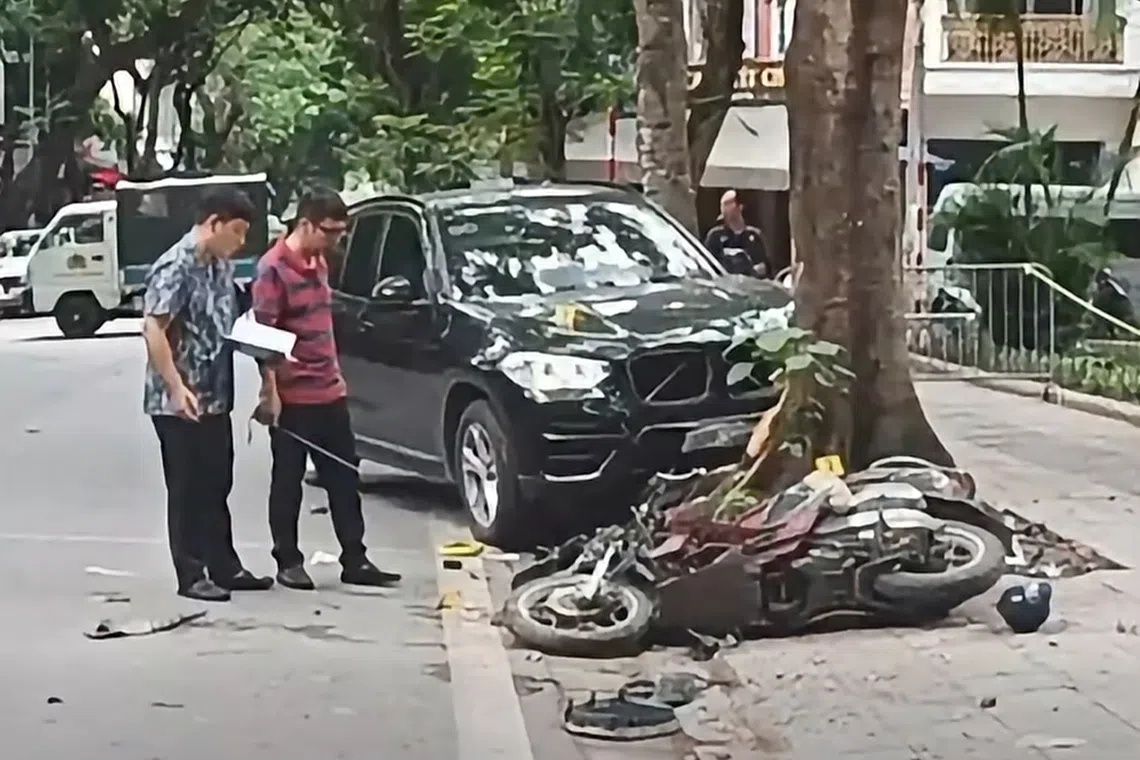
Vietnamese youth have mounted a rare and sustained social media campaign challenging official silence surrounding the death of 18-year-old Do Ngoc Phuong Thuy, who was struck by a luxury vehicle driven by former National Assembly deputy Nguyen Sy Cuong on May 30, 2025. The grassroots mobilisation has forced state authorities to publicly address the incident for the first time in over a year, reflecting generational frustration with opacity in the justice system and a shifting dynamic in how young people engage with civic accountability.
The fatal collision occurred when Cuong's car suddenly crossed into the opposite lane at high speed and struck a motorbike carrying Thuy and her father. The impact severed the teenager's right leg; she was rushed to hospital but succumbed to her injuries ten days later, just before her high school examinations. While Vietnam experiences more than 10,000 traffic deaths annually, this particular accident garnered international attention because of the perpetrator's political standing and the subsequent handling of the case.
Following the initial May 31 media coverage, the incident effectively disappeared from domestic discourse. The Hanoi Police investigation proceeded without public disclosure, and mainstream Vietnamese media ceased reporting on the case. This prolonged absence of information proved to be a critical catalyst. More than a year later, beginning approximately eight days ago, millions of social media posts began circulating across platforms including Threads, Facebook, Instagram and X, employing hashtags such as #NguyenSyCuong and #BMW to demand transparency and accountability. Anonymous users, predominantly identifying as Generation Z and young adults in their late teens and twenties, organised a coordinated campaign calling for a comprehensive public investigation.
The movement evolved beyond digital activism into physical demonstration. Young people, often masked, began placing flowers at the accident location—tree number 55 on Hanoi's streets—transforming it into a makeshift memorial and symbolic protest site. The location acquired geographic coordinates on Google Maps and gained colloquial recognition as the "Justice Tree." When authorities rapidly removed the physical flowers, activists created a parallel virtual memorial online, which accumulated hundreds of thousands of tributes. Tech-savvy participants reportedly circumvented attempts by authorities to restrict access to such content by distributing messages across multiple platforms.
Social observers attribute the campaign's resonance to generational proximity and empathy. Activist and blogger Nguyen Hoang Vi noted that Thuy's status as a teenage peer made her death personally relatable to Gen Z users, fostering emotional connection rather than abstract concern. The year-long information vacuum appears to have crystallised frustration among young people who increasingly reject passive acceptance of official narratives. As Hoang Vi observed, this generation no longer simply accepts assurances to "trust in justice"—they demand tangible evidence that the system functions transparently and fairly.
The scale and persistence of online mobilisation eventually compelled official response. Vietnam Television devoted a full six-minute report to the incident on August 17, citing police and prosecution sources who disclosed that Cuong had "sincerely confessed and actively remedied the consequences of his actions." According to official explanation, the victim's family elected not to pursue criminal charges, resulting in exemption from criminal liability. Do Viet Hung, Thuy's father, appeared in the VTV broadcast to thank internet users for their sympathy whilst requesting privacy for the family's grieving process, effectively endorsing the official conclusion.
However, legal analysts suggest the formal explanation may not satisfy the underlying concerns motivating Gen Z activism. Tran Dai Lam, lawyer at ANVI law firm, acknowledged that VTV's disclosure addresses certain procedural questions but predicted it would not fully resolve youth scepticism. The core issue, according to Lam, extends beyond the case outcome to the information deficit itself. Young people increasingly demand not merely conclusions but detailed exposition of legal frameworks, specific prosecutorial decisions, and reasoning underlying official determinations. Satisfaction requires transparency throughout the investigative process, not merely final pronouncements of lawfulness.
The government's response has incorporated dual elements: partial transparency through state media acknowledgment, paired with security warnings. Officials quoted in the VTV report alleged that "hostile forces, reactionaries and bad actors" sought to exploit the incident to incite civil unrest, framing the Gen Z campaign as potentially subversive. The Ministry of Public Security reportedly advised citizens, particularly young people, to remain vigilant against such alleged manipulation. Pro-government influencers simultaneously circulated cautionary narratives referencing "colour revolutions" and the consequences of civil disorder, invoking regional examples including Bangladesh.
This official framing presents a notable departure from routine handling of traffic incidents, indicating recognition that the youth-led campaign posed genuine political significance. In a country where public protest remains tightly circumscribed and authorities routinely attribute activist movements to external agitation, the allocation of state broadcaster resources and security apparatus attention signifies that Gen Z mobilisation has transcended typical social media discourse to become an issue commanding governmental attention.
The campaign also represents a generational shift in how young Vietnamese engage with accountability mechanisms. Traditional activist networks and formal civic organisations played minimal roles; instead, distributed social media organising leveraged digital platforms to aggregate voices horizontally. The campaign succeeded in introducing the incident into national consciousness without conventional leadership structures or formal institutional affiliation. This decentralised approach proved remarkably effective in breaking the information embargo that had persisted through official channels.
Reflections from social observers reveal evolving perceptions of Gen Z's civic engagement. Activist Nguyen Hoang Vi, who previously harboured stereotypes about youth indifference and self-absorption, acknowledged fundamental recalibration. Rather than generational disengagement, she recognised that Gen Z employs activism methodologies distinctly divergent from previous cohorts—digital-native, rapid-mobilising, and oriented toward transparency and institutional accountability. The campaign suggests young Vietnamese possess latent civic consciousness that emerges when issues directly affect their generation and when information systems fail to provide satisfactory explanation.
Flowers continue to accumulate at both the physical location and virtual memorial, though volumes have diminished since the VTV broadcast. Numerous netizens expressed dissatisfaction with official explanations, indicating that state acknowledgment alone has not resolved underlying skepticism. The persistence of online commentary reflects enduring questions about procedural fairness, the adequacy of victim compensation mechanisms, and whether privilege affiliated with political status influenced prosecutorial discretion. Whether subsequent developments will further mobilise Gen Z or whether the campaign will gradually dissipate remains contingent upon emerging information and governmental actions.
This incident encapsulates broader tensions within contemporary Vietnam: between official desires for information control and technologically empowered youth capable of circumventing restrictions; between state frameworks emphasising legal formalism and societal expectations for substantive transparency; and between generational cohorts with divergent understandings of accountability and justice. The campaign's ability to compel official response, however partial, suggests that Gen Z activism represents an emerging political force that authorities cannot indefinitely ignore, even as government maintains ambivalence toward independent civic mobilisation.

