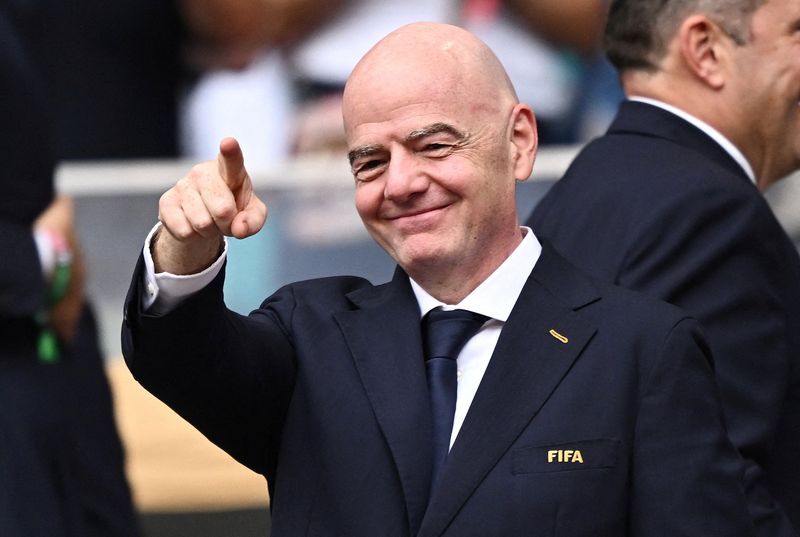
The Football Association of Wales has formally withdrawn its backing for FIFA President Gianni Infantino's candidacy for the 2027-2031 term, marking the first national federation to take such a step and signalling the beginning of political fallout from a failed privatisation scheme that unraveled spectacularly this week. The withdrawal comes after Infantino's ambitious proposal to raise up to $4.2 billion by transferring roughly 20% of commercial control over major FIFA competitions—including the World Cup—to private investors collapsed under mounting pressure from key stakeholders across football's global governance structure.
The Swiss FIFA chief had hoped the privatisation initiative would generate substantial capital for the world governing body, but the scheme faced coordinated resistance from influential confederations and national federations who viewed it as a fundamental threat to football's institutional independence. By Friday of last week, the proposal lay in ruins, prompting immediate soul-searching within FIFA about what had gone catastrophically wrong with what appeared to be a carefully orchestrated financial strategy.
In a strongly worded statement, the Welsh FA declared that Infantino had forfeited its confidence through demonstrable failures spanning governance frameworks, procedural integrity, leadership competence, organisational values, and strategic communication. The federation's assessment was particularly damning on the issue of prioritisation, asserting that any leader who fails to place football's fundamental interests at the centre of decision-making has committed an unacceptable breach of fiduciary duty. This language suggested that Wales viewed Infantino's approach to the privatisation plan as symptomatic of deeper institutional problems at FIFA.
Infantino's position has deteriorated rapidly following the withdrawal announcement. The UEFA confederation, which had orchestrated much of the organised opposition to the privatisation scheme and celebrated its abandonment, stated on Saturday that it had lost confidence in his leadership. CONCACAF, representing North and Central American football, issued a similar statement the same day, signalling that Infantino faced unprecedented headwinds from multiple quarters of the global football establishment. Despite initial media reports suggesting legal action might follow, UEFA instead issued a document preservation order—a procedural measure that prevents the destruction of emails, files, and related communications while investigations remain pending.
The timing of this political crisis compounds Infantino's vulnerability as he prepares for the FIFA Congress scheduled to take place in Morocco in March, when member federations will determine his electoral fate. When Infantino announced in April his intention to stand for a fourth consecutive term as FIFA president, his re-election appeared virtually assured. Since assuming office in 2016 following Sepp Blatter's departure, he had been re-elected twice without facing any formal opposition, and observers largely viewed his dominance of FIFA's internal politics as unquestionable.
However, analysts now recognise that the failed privatisation initiative has exposed long-simmering dissatisfaction among FIFA's membership that remained dormant while Infantino enjoyed electoral supremacy. The backlash revealed that numerous federations harboured significant reservations about his direction and decision-making methodology, concerns they had been reluctant to articulate publicly while he appeared politically invincible. The privatisation controversy essentially pulled back the curtain on FIFA's internal power dynamics, demonstrating that Infantino's apparent control over the organisation was more fragile than external appearances had suggested.
The substance of the controversy itself reflects ongoing tensions within FIFA concerning the balance between financial modernisation and institutional preservation. Infantino had framed the privatisation scheme as a necessary step to unlock capital for football development initiatives worldwide, particularly benefiting emerging nations and grassroots programmes. Opponents, particularly in Europe, characterised it as an inappropriate commodification of football's greatest tournament and a threat to democratic governance principles that should govern international sports bodies.
For Southeast Asian federations and other organisations within the Global South, the dispute carries particular resonance. Many national football associations in the region depend heavily on FIFA distributions and capacity-building programmes, making them potentially vulnerable to pressure from larger confederations during electoral contests. The Wales withdrawal and subsequent confederation statements demonstrate that smaller federations may be emboldened to voice independent positions when they perceive fundamental governance concerns, rather than automatically deferring to larger powers.
The March Congress in Morocco will now serve as a proving ground for Infantino's political survival. While no challenger has formally announced a candidacy yet, the dramatic shift in confederation sentiment and the emergence of explicit withdrawal statements from established federations has fundamentally altered the electoral mathematics. Infantino retains significant institutional resources and support from various quarters, but the privatisation debacle has handed opposition forces a concrete grievance around which to mobilise, transforming what appeared to be a coronation into a genuine competitive contest.

