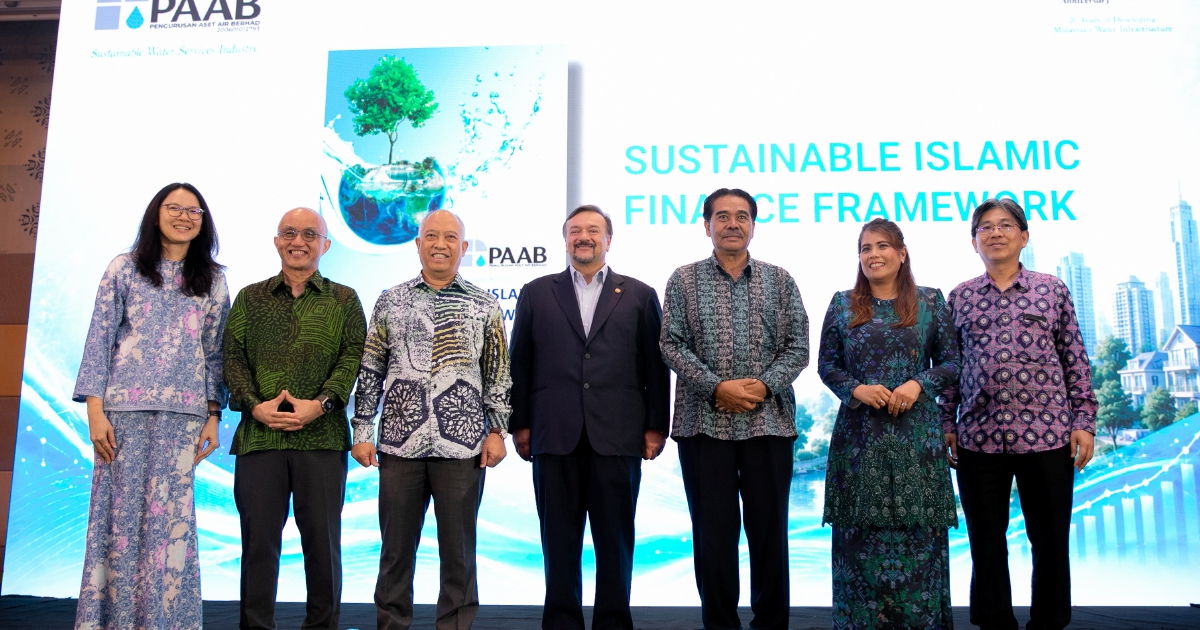
Malaysia's water asset management sector has deepened its participation in Islamic finance markets with the RM720 million sukuk issuance announced by Pengurusan Aset Air Bhd (PAAB). The offering represents a significant capital-raising exercise for the national water utility asset manager, demonstrating sustained investor appetite for Islamic bonds labelled as blue sukuk—instruments structured to finance environmentally sustainable projects and water infrastructure.
The issuance was executed through Pengurusan Air SPV Bhd (PASB), a special purpose vehicle established specifically to facilitate financing activities under PAAB's broader RM2 billion Islamic Commercial Papers Programme. This structure provides operational flexibility and enables the organisation to access capital markets efficiently while maintaining its asset management responsibilities across Malaysia's water systems. The use of a dedicated SPV is a standard practice that insulates the parent entity's operations from direct refinancing pressures while allowing for ring-fenced project financing.
The RM2 billion Islamic Commercial Papers Programme framework within which this issuance sits reflects PAAB's strategic commitment to leveraging Shariah-compliant capital markets. Commercial papers programmes of this scale typically provide issuers with significant flexibility to tap markets opportunistically when conditions are favourable, spreading fundraising across multiple tranches rather than relying on sporadic large offerings. For a utility operator like PAAB, which manages essential water assets serving Malaysia's population, this recurring access to Islamic capital is critical for financing infrastructure maintenance, expansion projects, and modernisation of treatment facilities.
Blue sukuk instruments have gained prominence globally and in Southeast Asia as investors increasingly align capital allocation with environmental, social and governance (ESG) criteria. For Malaysia, a nation facing water security challenges in several states and confronting climate-related volatility in rainfall patterns, Islamic financing for water infrastructure carries particular relevance. The labelling signals to institutional investors that proceeds fund activities aligned with sustainable development goals, specifically the UN Sustainable Development Goal 6 on clean water and sanitation.
The timing of this capital raise aligns with broader trends in Malaysia's water sector, which has faced mounting pressure to upgrade ageing infrastructure, reduce non-revenue water losses through leakage, and expand capacity to accommodate population growth and industrial demand. Recent droughts in Peninsular Malaysia and the persistent challenge of water treatment quality underscore the infrastructure investment needs that PAAB must address. By accessing the Islamic capital markets, PAAB positions itself to finance these critical interventions without straining government budgets directly.
Islamically-structured financing mechanisms like sukuk have become increasingly attractive to Malaysian water authorities and asset managers for several reasons beyond religious compliance. The instruments often feature stable, predictable financing costs given their typically longer tenors compared to conventional commercial paper. For essential infrastructure providers facing long-term capital needs, this predictability enables better financial planning. Additionally, the global pool of Shariah-compliant investors continues expanding, particularly among sovereign wealth funds and institutional investors from Gulf Cooperation Council nations and Asia-Pacific jurisdictions.
PAAB's repeated access to the RM2 billion programme reflects the confidence that Islamic finance markets have in Malaysian water sector financing. The existence of such a substantial authorised programme—larger than the current issuance—suggests management expects continued capital needs and anticipates further tranches may be required. This forward-looking approach provides PAAB with the flexibility to respond to emergency infrastructure needs or accelerated project timelines without requiring additional regulatory approvals or programme establishment delays.
The structure through PASB, the special purpose vehicle, also enables potential asset securitisation strategies if PAAB's management determines such approaches would optimise the capital structure. SPVs facilitate segregation of specific cash flows or assets from the operating entity, allowing investors to assess and price risks more precisely. While the current issuance is framed as a sukuk offering under the existing programme, the use of an SPV infrastructure enables PAAB to potentially explore asset-backed structures in future should operational circumstances warrant such refinement.
For Malaysian institutional investors and regional Shariah-compliant funds, this sukuk offering provides diversified exposure to the domestic water sector within an Islamic framework. Given the essential nature of water utilities and their typically predictable revenue streams from government and consumer usage charges, blue sukuk backed by water assets represent relatively lower-risk fixed income alternatives compared to higher-volatility equity or conventional corporate bond markets.
The issuance also reflects Malaysia's positioning as a leader in Shariah-compliant finance within ASEAN. The country's deep Islamic capital markets, combined with its regulatory infrastructure supporting sukuk issuances, continue attracting both domestic and regional issuers. For PAAB specifically, tapping these markets affirms the organisation's role as a sophisticated financial market participant, not merely a utility operator but an institution capable of accessing diverse funding sources to support Malaysia's essential water infrastructure needs.
Moving forward, PAAB's continued reliance on Islamic capital markets may signal expectations that the utility sector will increasingly fund expansion and modernisation through such mechanisms. As climate volatility intensifies water scarcity concerns across Malaysia and the region, the alignment of Islamic finance principles—which emphasise social welfare and environmental stewardship—with water infrastructure financing appears particularly well-suited, potentially attracting substantial capital flows toward these essential projects.

