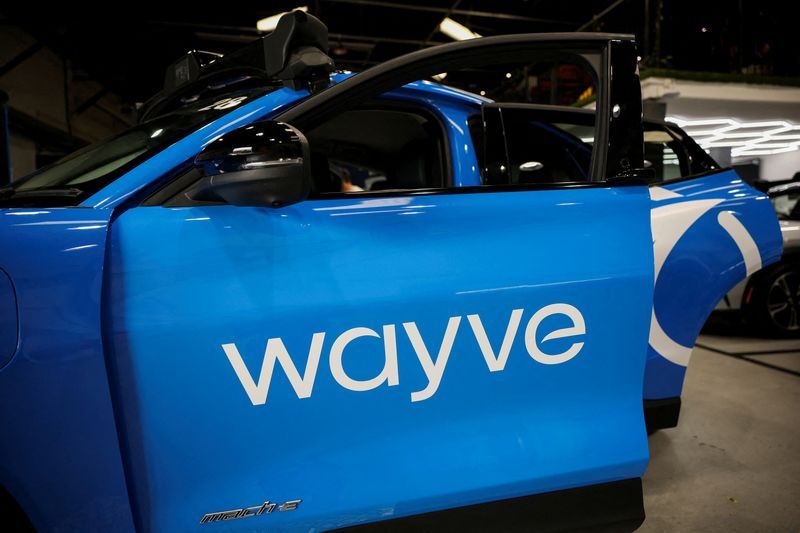
Wayve, a London-based autonomous-driving company, has capitalised on surging investor enthusiasm for self-driving technology by assembling a formidable funding round of $2.8 billion. The capital infusion reflects confidence from an elite consortium spanning the technology and automotive worlds, including semiconductor giant Nvidia, German luxury automaker Mercedes-Benz, and Japanese manufacturer Nissan. Most notably, the startup has secured a deployment agreement with Stellantis, the parent company of Jeep, to integrate its driving system into robotaxis operating on Uber's ride-hailing platform beginning this year. This convergence of financial backing and commercial partnerships underscores a pivotal shift in how the autonomous-vehicle industry is addressing the challenges of full self-driving deployment.
At the heart of Wayve's proposition lies an artificial intelligence methodology called end-to-end machine learning, a technology that fundamentally departs from how most autonomous vehicles have traditionally operated. Rather than relying on pre-programmed rules, discrete software modules, and detailed high-definition maps, this approach processes raw sensor data and translates it directly into real-time driving decisions. The system mimics human driving cognition by learning patterns from extensive real-world data, enabling vehicles to respond fluidly to a spectrum of road conditions and unforeseen circumstances. The philosophical underpinning appeals to engineers and investors alike: if human drivers can safely navigate complex urban environments through adaptive learning, why should machines require exhaustive rule-based programming?
Wayve's methodology shares conceptual kinship with Tesla's autonomous-driving approach, which similarly abandoned traditional pre-coded systems years ago in favour of neural-network-based learning. A critical distinction, however, lies in technological architecture. While Tesla relies exclusively on camera-based vision systems, Wayve's framework integrates multiple sensor types and diverse artificial-intelligence chips. This hardware agnosticism transforms Wayve from a closed proprietary system into a licensable platform. Chief Executive Officer Alex Kendall, a 33-year-old New Zealander who founded the company in 2017 and holds a doctorate in AI deep learning from Cambridge University, has articulated an ambitious vision: enabling autonomous driving across any vehicle brand globally. During a demonstration this year in San Francisco's Bay Area, where the company maintains significant technical operations, Kendall piloted a Ford Mustang Mach-E outfitted with Wayve's system through complex neighbourhood scenarios, illustrating the technology's practical maturity.
The autonomous-driving sector has experienced a pivotal reset following years of broken timelines and exaggerated claims. Alphabet's Waymo has emerged as the primary catalyst for renewed investor conviction, having built an operational network offering paid autonomous rides across approximately a dozen cities after more than a decade of systematic development work. This visible progress has revalidated the broader category, creating momentum that benefits capable competitors like Wayve. Notably, end-to-end machine learning itself has undergone a dramatic transformation from academic curiosity to industry standard. A decade ago, only a handful of researchers—including Kendall during his doctoral work—explored this methodology seriously. Today, most autonomous-driving developers incorporate at least some end-to-end learning components into their systems, reflecting genuine technological convergence.
Yet this widespread adoption masks a persistent technical controversy. End-to-end AI systems operate as sophisticated black boxes, their decision-making processes opaque even to engineers. Traditional rule-based approaches permitted engineers to trace and justify specific vehicle behaviours with explicit logic chains; end-to-end systems provide no such transparency. Understanding why a neural network chose to brake in a particular situation remains genuinely difficult. Wayve addresses this opacity partially through a safety mapping layer that visualises traffic situations and identifies viable driving paths, providing at least some interpretability of the system's geometric reasoning. The company's vice president of AI, Vijay Badrinarayanan, articulates a compelling counter-argument to transparency concerns: conventional programming-intensive approaches become fragile precisely when confronted with genuinely novel situations, because engineers cannot possibly pre-code responses to every conceivable scenario. Human drivers remain safe by adapting conservatively when encountering the unknown—a quality that end-to-end systems may capture through learned representations.
Waymo, despite pioneering end-to-end methodologies, retains traditional rule-based safeguards layered atop machine learning components. The company has explicitly stated that end-to-end models alone prove insufficient for commercial-scale safety assurance, maintaining that hybrid architectures combining neural networks with conventional software logic remain necessary. This stance reflects Waymo's vast accumulated experience with edge cases and failure modes across thousands of real-world miles. The tension between Wayve's AI-centric philosophy and Waymo's hybrid conservatism encapsulates a genuine technical disagreement about the path forward in autonomous driving safety, with no clear consensus yet established across the industry.
Nissan, one of Wayve's significant partners, exemplifies automotive manufacturers' cautious approach to this technological departure. The Japanese automaker plans to deploy Wayve's system in its Elgrand people-mover van in Japan during the fiscal year ending March 2028. Nonetheless, Nissan's Chief Technology Officer Eiichi Akashi has acknowledged persistent reservations. While characterising Wayve's technology as among the most advanced available, Akashi emphasised the challenge of understanding the system's decision-making mechanisms—a concern particularly acute in Japan's regulatory environment, where automotive safety requirements demand demonstrable technical accountability. This hesitation reflects broader industry caution: even enthusiastic adopters harbour legitimate concerns about deploying systems they cannot fully audit or justify to regulators and customers.
Wayve's competitive advantage, according to company executives, derives from circumventing the exhausting process of road mapping and local code development that traditional approaches require. Because the system learns driving patterns rather than relying on pre-mapped geography, the company contends it can deploy across new cities rapidly without intensive preparatory work. Wayve reports successful testing across hundreds of cities globally without such preparation, a claim that resonates powerfully with automakers seeking quick market entry. Major operational hubs in Tokyo, Stuttgart, and Vancouver position the company to serve diverse regional markets while maintaining technological coherence. This scalability proposition has clearly resonated with investors and manufacturers, offering a pathway to global autonomous-vehicle deployment that circumvents geographic customisation bottlenecks.
Academic expertise offers measured perspectives on Wayve's trajectory. Siddartha Khastgir, a professor of safe autonomy at the University of Warwick, acknowledges that end-to-end systems should demonstrate faster development and commercial deployment timelines than traditional approaches. However, he resists definitively declaring one methodology safer than alternatives, reflecting genuine uncertainty about which technical architecture will ultimately prove most robust in production environments. Phil Koopman, an autonomous-technology expert at Carnegie Mellon University, similarly characterises end-to-end learning as one viable approach among potentially multiple viable paths forward, while cautioning that safe, nationwide driverless deployment across the United States likely requires at least another decade and continues to demand unforeseen technological innovations. These assessments temper enthusiasm without dismissing Wayve's potential, capturing the industry's current state: genuine progress alongside persistent technical unknowns.

