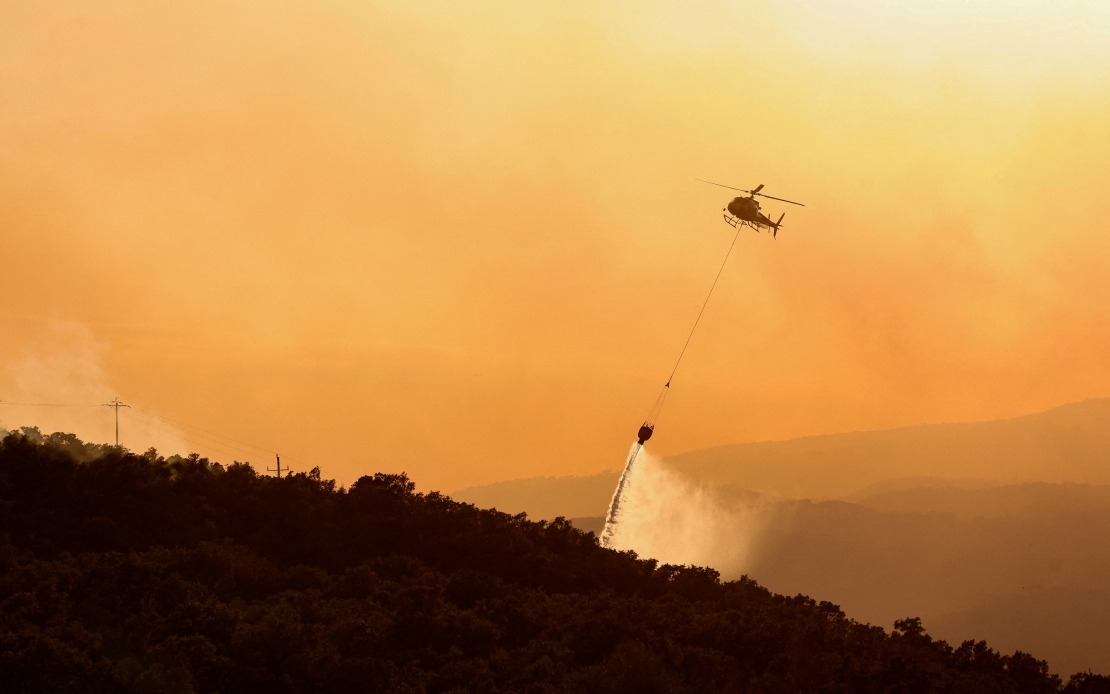
Communities across the western United States are scaling back Independence Day celebrations this year as an exceptionally severe combination of drought, active wildfires, and dangerous weather conditions forces the cancellation or restriction of fireworks displays that traditionally mark July 4. The timing is particularly poignant as Americans commemorate the 250th anniversary of the nation's founding, a milestone that would normally trigger expansive festivities from coast to coast. Instead, officials are prioritising public safety over celebration, recognising that the atmospheric conditions across much of the region create an unprecedented risk for additional fire ignitions during what is statistically one of the most dangerous days for wildfire incidents.
The scale of the current wildfire emergency underscores the gravity of the situation. A national incident report issued on Friday documented 41 large fires burning across the country that remain uncontained, while the nation's wildfire preparedness system has been elevated to its second-highest alert level. This assessment reflects the widespread nature of the crisis, which extends far beyond isolated pockets of dry weather to encompass entire regions grappling with historically severe conditions. The frequency and intensity of active fires suggest that even minor ignition sources pose substantial risks during a period when humidity levels drop and winds pick up across large areas of the landscape.
Utah exemplifies the extraordinary severity of current conditions. State drought measurements reveal that 94 percent of the state is experiencing either severe or extreme drought—a figure that underscores the desiccated landscape across which fires spread with alarming velocity. Governor Spencer Cox's office implemented a temporary statewide restriction on fireworks use, a significant step that grants local governments authority to designate only limited zones where fireworks may legally be discharged through July 5. Utah State Forester Jamie Barnes characterised the wildfire situation as unprecedented in living memory, noting that fires are advancing more rapidly than in previous years. Most strikingly, the state has already consumed more acreage to fire damage in 2024 than during the entire preceding four-year period—a metric that illustrates the acceleration of fire seasons in the American West.
Neighbouring Colorado faces similarly dire circumstances. The state's Division of Fire Prevention and Control has documented more than a dozen significant wildfires burning simultaneously across its territory this week, prompting multiple jurisdictions to abandon their traditional Independence Day spectacles. Cities including Durango, Vail, and Pueblo have all cancelled their fireworks programmes. Vail's decision carries particular weight given that this marks only the sixth cancellation since 1998—yet officials note that this year's wildfire distribution across the state is notably more diffuse and threatening than in most previous years. Colorado Springs, the state's second-largest municipality, similarly cancelled all Fourth of July fireworks displays, with the city's fire department citing extreme fire danger levels. City administrators drew a sobering parallel to conditions preceding the 2012 Waldo Canyon fire, which destroyed over 300 residences and killed two people, suggesting that current risk assessments reflect comparably hazardous atmospheric circumstances.
The geographical reach of these restrictions extends across multiple states, indicating a regionwide phenomenon rather than isolated local concerns. Wyoming, Nebraska, and New Mexico have all imposed limitations on fireworks due to either active drought or elevated wildfire threat levels. This multi-state coordination reflects the interconnected nature of western weather patterns and fire ecology, where meteorological conditions that create danger in one jurisdiction often affect neighbouring regions simultaneously. Notably, professional fireworks displays mounted by established companies are expected to proceed as planned in most locations, suggesting that official celebrations will continue even as private and community-based fireworks use faces restrictions.
Meteorological forecasting compounds anxiety among fire management officials. The national incident report warned that strong winds combined with extremely low humidity will substantially elevate fire danger across southwestern territories during the period coinciding with Independence Day celebrations. Simultaneously, much of the eastern and central United States is contending with dangerously elevated temperatures, with heat index values reaching 46 degrees Celsius in certain areas according to measurements from the National Weather Service. These temperature extremes not only dry vegetation and lower relative humidity but also create conditions where any ignition source can rapidly develop into a spreading fire.
Scientific research validates officials' concerns about the specific hazard posed by fireworks on Independence Day. Philip Higuera, a fire ecology specialist at the University of Montana, explained to the Durango Herald that July 4 consistently sees elevated wildfire ignitions attributable to fireworks displays. The single day generates numerous new fire starts across the landscape as celebrants set off fireworks across diverse locations, many lacking professional fire suppression infrastructure. Lauren Lowman, an associate professor at Wake Forest University, cited research demonstrating that nearly fifty percent of all western acreage burned since 2001 occurred either during or immediately following heat wave episodes, establishing the strong linkage between temperature extremes and fire behaviour. Lowman's analysis of historical wildfire records documented approximately 15,000 wildfires recorded on July 4 nationwide between 1992 and 2020—an average of roughly 500 additional fires on that single day compared to typical conditions.
The cumulative damage from fireworks-related ignitions extends beyond holiday-specific incidents. National fire statistics indicate that fireworks caused an estimated 32,000 fires across the United States during 2023 alone, a figure encompassing both holiday-related and non-holiday incidents. When these aggregate statistics are considered alongside the current exceptional drought and wildfire conditions, the calculus for public officials becomes clear: permitting widespread fireworks use during the Fourth of July would introduce tens of thousands of potential ignition points into a landscape already stressed to near-breaking point by drought and heat.
For Malaysian and Southeast Asian observers, the American situation offers instructive lessons regarding climate change impacts on fire ecology and public safety decision-making. Southeast Asia itself confronts annual transboundary haze episodes originating from large-scale agricultural and forest fires, often exacerbated by drought conditions related to El Niño patterns. The willingness of American officials to cancel major celebrations in order to prioritise fire prevention demonstrates a precautionary approach that regional governments have sometimes struggled to implement, particularly when economic interests or cultural traditions intersect with fire risk management. The American experience suggests that transparent communication about fire danger, coordinated regional restrictions, and public acceptance of celebration modifications—even during momentous anniversaries—reflect mature institutional responses to climate-driven environmental hazards.

