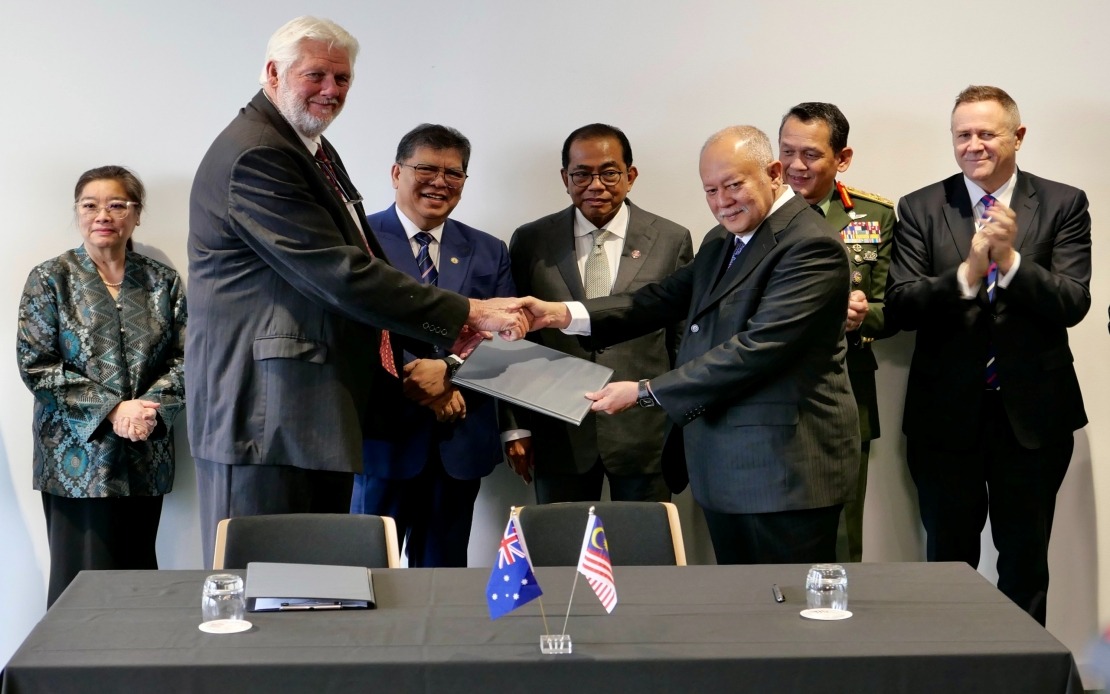
Malaysia has taken a significant stride toward developing indigenous rocket and missile manufacturing capabilities through a strategic partnership between Weststar Defence Industries and Australian firm Rocket Technologies International. Defence Minister Datuk Seri Mohamed Khaled Nordin announced the collaboration as a transformative move that positions the nation to reduce reliance on foreign defence suppliers whilst building the technical expertise necessary for long-term sovereign security. The agreement, signed in Canberra during Mohamed Khaled's three-day working visit to Australia, represents the kind of technology-transfer arrangement increasingly vital for Southeast Asian nations seeking to modernise their armed forces independently.
The partnership directly supports Malaysia's National Defence Industry Policy, a framework designed to cultivate domestic competence in developing and manufacturing advanced defence systems. Rather than merely purchasing finished weapons systems from established suppliers, the Weststar-RTI collaboration enables Malaysia to build its own production ecosystem, creating opportunities for knowledge transfer and skills development across the local defence sector. Weststar Group founder and group managing director Tan Sri Dr Syed Azman Syed Ibrahim and RTI founder Allan James Payne formalised the agreement at the National Convention Centre in Canberra, signalling serious commitment from both parties to establish genuine manufacturing capacity rather than assembly operations.
The venture's timeline is notably ambitious, with rocket manufacturing expected to commence within two years of the facility's establishment in Malaysia. This relatively rapid deployment suggests both parties have prepared extensively for the partnership and possess clear technical roadmaps. The subsequent expansion into missile production indicates a phased approach that prioritises establishing foundational rocket manufacturing expertise before advancing to more complex systems. Such sequencing is strategically sound, allowing Malaysian engineers and technicians to develop competency progressively whilst building supply chains and quality assurance protocols.
Beyond the immediate manufacturing benefits, the partnership opens pathways for Malaysian companies to participate in Rocket Technologies International's global supply chain. This integration into an international defence ecosystem carries substantial implications for Malaysia's industrial base, potentially attracting component manufacturers, specialised service providers, and technology firms to establish operations in the country. The multiplier effects of such participation typically extend across sectors—advanced materials production, precision engineering, software development, and logistics—creating a broader industrial foundation that extends well beyond defence applications.
During his Australian visit, Mohamed Khaled and a delegation including Royal Malaysian Air Force chief General Tan Sri Muhamad Norazlan Aris toured the Institute for Space, Defence and Advanced Technologies at the University of Southern Queensland. The examination of industry-academia collaboration models proved particularly instructive for Malaysian planners considering how best to structure their own research and development infrastructure. The delegation's exposure to Australia's advanced composite manufacturing and hypersonics laboratories—many developed alongside defence contractors including RTI—provided practical insights into the institutional arrangements that support cutting-edge defence innovation.
The visit also encompassed higher-level diplomatic engagement, with Mohamed Khaled meeting Australian Deputy Prime Minister and Defence Minister Richard Marles to explore broader opportunities for bilateral defence cooperation. Such ministerial-level discussions typically precede formal defence agreements and joint acquisition programmes. Malaysia and Australia share overlapping security interests throughout Southeast Asia and the Indo-Pacific region, and deepening defence ties creates opportunities for joint exercises, intelligence sharing, and coordinated responses to emerging maritime and cyber security challenges. Mohamed Khaled's emphasis on strengthening defence relations reflects recognition that regional stability increasingly depends on networked partnerships rather than isolated national efforts.
Parliamentary engagement constituted another dimension of the visit, with Dewan Rakyat Speaker Tan Sri Johari Abdul and Malaysia's High Commissioner to Australia Datin Paduka Sharrina Abdullah accompanying Mohamed Khaled to Parliament House in Canberra. Meetings with Speaker of the House of Representatives Milton Dick and various Australian parliamentarians underscore the multi-layered nature of modern strategic partnerships, which require political and legislative support alongside military and industrial cooperation. Such exchanges facilitate mutual understanding of defence priorities and build constituencies in both nations committed to sustained partnership.
The Weststar-RTI arrangement arrives at a moment when Southeast Asian nations increasingly recognise the necessity of developing indigenous defence industrial capabilities. Regional countries have historically depended on foreign suppliers for advanced weaponry, a situation that constrains strategic autonomy and creates supply chain vulnerabilities. Malaysia's decision to invest in domestic rocket and missile production reflects broader regional trends toward defence self-sufficiency. Comparable initiatives are underway in Vietnam, Indonesia, and Thailand, suggesting that Southeast Asia is transitioning from a region of defence consumers to one of defence producers.
The partnership also carries technological implications extending beyond military applications. Rocket technology development generates spinoffs in materials science, propulsion systems, precision manufacturing, and guidance systems with civilian applications in space exploration, satellite deployment, and telecommunications infrastructure. Malaysia's nascent space ambitions, reflected in interest in satellite launches and scientific space missions, could benefit from the technical expertise cultivated through military rocket programmes. This duality—military and civilian applications—typically justifies substantial government investment in such capabilities.
For Malaysian defence planners, the Weststar-RTI arrangement addresses a critical capability gap. The region faces increasingly complex security challenges, from maritime domain awareness and anti-ship operations to emerging threats in cyber and space domains. Indigenous rocket and missile manufacturing provides options for rapidly deploying defensive systems tailored to Malaysian geography and strategic requirements. Rather than waiting months for foreign procurement processes, Malaysia could eventually manufacture replacements or additional systems domestically, improving operational responsiveness.
The investment's economic dimensions merit consideration as well. Defence manufacturing typically requires sustained government commitment, substantial capital outlays, and long-term workforce development. However, the sector generates well-paying technical employment, attracts foreign investment, and builds engineering expertise applicable across advanced industries. Malaysia's experience with automotive and electronics manufacturing suggests the nation possesses foundational industrial capabilities and workforce discipline necessary for precision defence production.
Mohamed Khaled's statement emphasising strategic investment in sovereign defence capability for future generations frames the partnership in generational terms. This rhetoric acknowledges that building indigenous defence industrial capacity requires patience and sustained commitment, with full benefits emerging over years rather than months. It positions current government investment as laying groundwork for Malaysia's security posture in the coming decades, when the nation must respond to challenges its leaders cannot yet fully anticipate.
The Weststar-RTI partnership represents more than a commercial transaction between two companies. It embodies Malaysia's commitment to strategic autonomy, recognition that regional security increasingly depends on indigenous capabilities, and determination to participate meaningfully in advanced technology sectors. As Malaysia continues navigating complex regional dynamics and emerging security challenges, the ability to design and manufacture advanced defence systems will prove increasingly valuable, whether for operational deployment or as a foundation for broader strategic partnerships.

