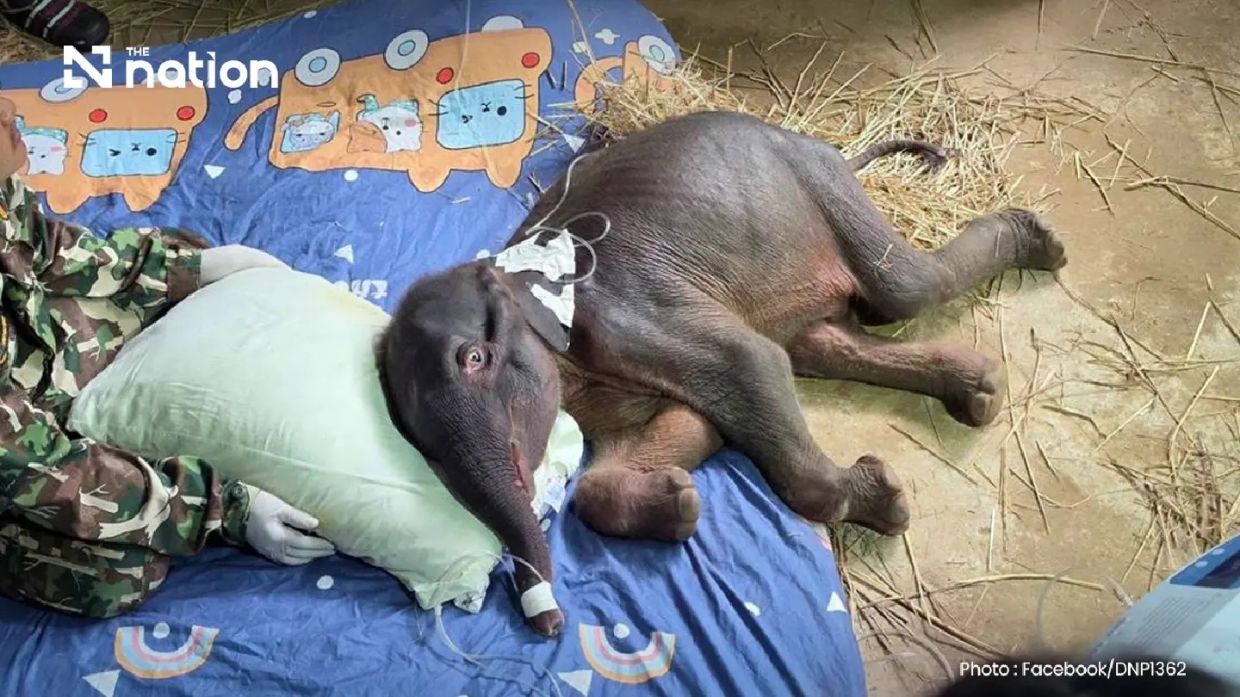
A month-long rescue and care operation for a young wild elephant ended tragically on Tuesday when Jiew Sai Yok, a separated calf discovered wandering alone in Thailand's Kanchanaburi province, succumbed to acute kidney failure at Sai Yok National Park. The Department of National Parks, Wildlife and Plant Conservation announced the death came peacefully at approximately 2am, marking a heartbreaking conclusion to what had become a high-profile conservation effort involving veterinarians, park rangers, and local villagers working in difficult jungle conditions.
The calf's ordeal began on July 30 when residents near the Huai Mae Nam Noi waterway noticed the distressed young elephant struggling alone on the riverbank. With the terrain being nearly impassable on foot, rescue workers deployed boats to reach and extract the animal, which showed obvious signs of severe physical distress and appeared to have been separated from its mother for approximately two days. Throughout the first night after discovery, the calf repeatedly trumpeted calls searching for its herd, yet no mother or family members emerged from the surrounding forest to reclaim the stricken juvenile.
When veterinarians arrived on July 31 to conduct their initial assessment, navigating through rising water levels caused by heavy continuous rainfall, they encountered a calf in deeply troubling condition. The examination revealed extensive damage across multiple body systems: severe dehydration, numerous sores covering the mouth including a lesion roughly the size of a 10-baht coin, canker-like wounds, abrasions and blisters throughout the trunk, a wound at the navel, and conjunctivitis from insect infestation around the eyes. The animal's dark yellow-red urine suggested either serious infection or critical fluid depletion, while its loose, foul-smelling faeces and minimal milk intake further indicated systemic distress. Remarkably, despite these grave findings, no signs of bacterial infection or parasitic infestation were immediately detected.
Transported to the national park headquarters, Jiew Sai Yok entered intensive care under 24-hour supervision from dedicated veterinary teams and park staff. The treatment protocol combined intravenous fluid replacement with continuous oxygen therapy, essential interventions for an animal showing such profound physiological deterioration. During the following days, veterinarians administered 350 to 500 millilitres of milk through feeding every two to three hours, and the calf demonstrated remarkable resilience by continuing to consume nourishment and periodically attempting to stand despite overwhelming weakness. Yet persistent diarrhoea and dark urine indicated that underlying organ dysfunction continued progressing despite aggressive supportive care.
The precise mechanism of the calf's decline remains uncertain pending comprehensive post-mortem examination and laboratory analysis. Veterinarians have preliminarily attributed death to acute kidney failure based on blood test findings, though they also suspect possible congenital abnormalities of internal organs may have contributed significantly to the calf's inability to survive. The department has committed to conducting a full necropsy and collecting tissue samples for further investigation, a process that may take weeks to complete and could yield valuable insights into wild elephant calf survival challenges in the region.
The case highlights the profound difficulties facing orphaned or separated young elephants in Southeast Asia's remaining wild habitats. While adult wild elephants possess mobility and foraging knowledge necessary for survival, calves depend entirely on maternal guidance for survival during their vulnerable early years. Separation from the herd, whether through accident, conflict, or illness, typically results in death in natural settings, making the months-long rescue attempt itself an exceptional undertaking reflecting Thailand's commitment to wildlife preservation despite the odds.
For Malaysian and regional conservation observers, the tragedy underscores both the fragility of wild populations and the limits of human intervention in natural systems. Though veterinary teams performed admirably under challenging circumstances, providing care equivalent to that offered to domesticated animals, the calf's multiple pre-existing conditions—likely acquired during the distressing period of separation and exposure—proved insurmountable even with unlimited resources and expertise. The incident serves as a sobering reminder that prevention through habitat protection and human-wildlife conflict mitigation remains infinitely preferable to attempting rescue of already-compromised animals.
The Department of National Parks, Wildlife and Plant Conservation has acknowledged the extraordinary efforts expended by its veterinary teams, rescue personnel, and park staff, recognizing that despite the heartbreaking outcome, every intervention followed best practices and reflected genuine commitment to preserving Thailand's elephant heritage. For the regional conservation community, Jiew Sai Yok's story will likely become instructional, informing wildlife rescue protocols and potentially prompting broader discussions about elephant corridor protection and habitat connectivity necessary for wild populations to maintain their own social and familial structures without depending on human rescue operations.
The calf's passing also raises broader questions about habitat fragmentation and human encroachment across Southeast Asia. As forests shrink and human settlements expand, elephant populations face mounting pressures that increase the likelihood of family separations and orphaned animals wandering into populated areas. Thailand, along with neighbouring nations including Malaysia, faces mounting challenges in maintaining viable elephant populations, making each loss—especially of young animals representing future breeding potential—particularly significant for long-term species survival in the region. Conservation efforts must therefore shift increasingly toward preventive measures protecting elephant corridors and reducing human-wildlife conflict rather than treating symptoms of habitat loss through rescue and rehabilitation.

