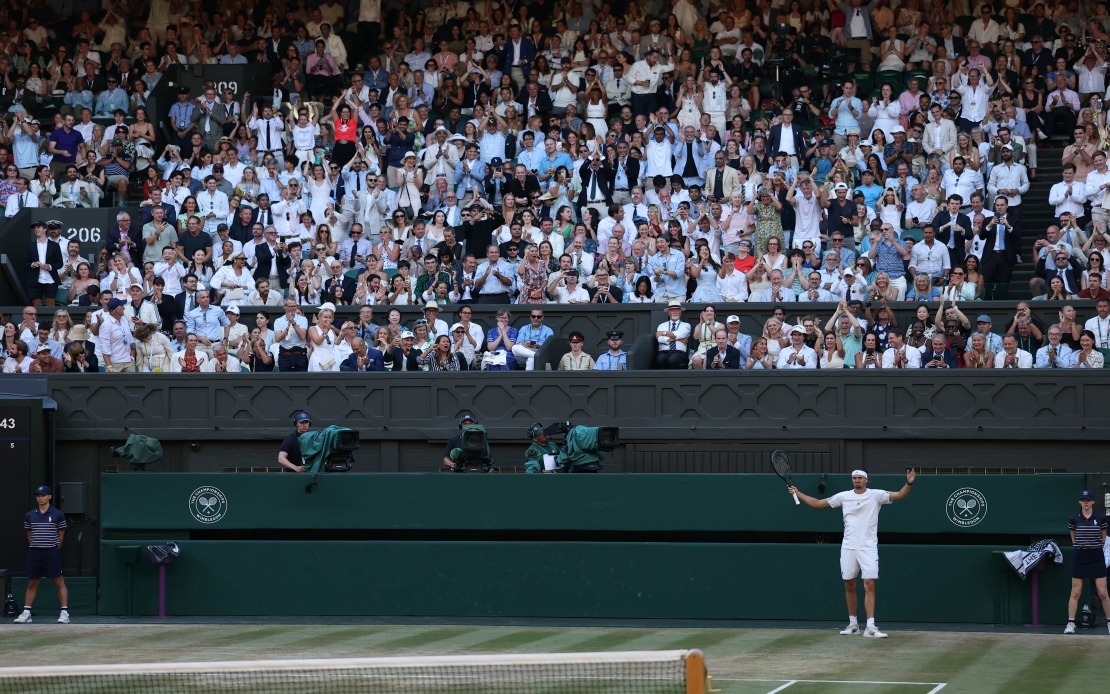
Jannik Sinner's commanding four-set victory over Alexander Zverev in the men's singles final capped off a memorable fortnight at Wimbledon, delivering the kind of climactic finish that has made the All England Club a cornerstone of professional tennis for generations. The Italian's triumph underscored his emergence as one of the sport's elite competitors, yet it was merely one chapter in a tournament brimming with remarkable narratives that extended far beyond the showcase courts.
The women's final itself provided one of the year's most emotionally resonant sporting moments, as 21-year-old Marketa Noskova claimed her first Grand Slam title in extraordinary fashion. Appearing in a major final for the first time, Noskova faced the prospect of devastating heartbreak when she squandered five championship points during a dramatic second-set collapse, allowing her opponent to level the match and force a decider. The psychological burden of such a reversal would have crushed most competitors at that stage of their careers, yet Noskova demonstrated the mental fortitude required at sport's highest level. Her composed declaration upon returning from a bathroom break—a vow to claim "the big one"—reflected the steely determination she would need to navigate the final set. The moment evoked memories of another Czech champion, the late Jana Novotna, whose tearful shoulders in the arms of the Duchess of Kent following her 1993 final loss to Steffi Graf remains one of Wimbledon's most poignant images. Unlike Novotna, who endured five years of anguish before claiming her 1998 title, Noskova's redemption came immediately, demonstrating how contemporary players harness sports psychology to overcome seemingly insurmountable emotional obstacles.
British wild card Fery emerged as the Championships' most captivating underdog story, his improbable run capturing the imagination of a home nation starved of homegrown success. The 23-year-old from Wimbledon itself, ranked a modest 114th globally, delivered a performance of astonishing resilience that speaks to the unpredictable nature of tournament tennis. Facing Zizou Bergs, a player ranked 37 places higher, Fery found himself staring down defeat repeatedly across an extended match on the baking hot Court 18. He trailed 4-1 in both the fourth and fifth sets while battling three separate nosebleeds—the kind of physical and mental trials that separate champions from contenders. With British fortunes dire across the tournament as a whole, Fery became a symbol of defiance, levelling the match through a tie-break before converting the decisive 10-point super-tiebreak when his higher-ranked opponent crumbled under pressure. His progression to the second week represented a milestone moment for British men's tennis this century, becoming only the fifth homegrown player since 2000 to achieve such depth in the draw.
Separately, Novak Djokovic's five-hour-15-minute quarter-final marathon against Felix Auger-Aliassime proved simultaneously magnificent and costly. At 39 years old, Djokovic continues to produce age-defying performances that defy conventional wisdom about athletic decline, yet this particular encounter exacted a severe toll on the 24-time Grand Slam champion's reserves. The match concluded merely eight minutes before the 11pm curfew, making it the longest quarter-final in Wimbledon's storied history. Beyond the physical demands, Djokovic engaged in a heated dispute with tournament referee Denise Parnell regarding roof closure before the third set, adding an unwelcome layer of mental strain. A calf injury required mid-match treatment, forcing Djokovic to manage his physical condition while maintaining competitive intensity. Though he prevailed against Auger-Aliassime, the exhaustion from this encounter proved decisive in his semi-final against Sinner, where his depleted physical reserves could not sustain another marathon performance.
The women's semi-final between Coco Gauff and Karolina Muchova distilled the tournament's drama into a single mesmerizing tie-break lasting 18 minutes. The deciding set featured a relentless back-and-forth that hinged on marginal moments and nervous errors, with both competitors holding match points before the momentum swung decisively. A time violation against Muchova proved costly, and when Gauff squandered her initial opportunity on what appeared to be a simple drop-shot winner, the contest seemed destined for a dramatic conclusion. Muchova's next match point appeared within reach until a dramatic slip sent her off-balance mid-volley, allowing Gauff's cross-court forehand to slip past. Muchova ultimately converted her subsequent opportunity, demonstrating the mental resilience required to navigate such emotionally charged moments.
Serena Williams' return to competitive tennis at age 44, nearly four years after publicly stepping away from the sport, captured the public imagination as perhaps no other storyline throughout the fortnight. The American sporting icon's wild card appearance represented a full-circle moment for one of tennis's all-time greats, drawing a standing ovation upon Centre Court entry. Against Ashleigh Barty—a 24-year-old Australian—Williams competed with the intensity and power that defined her legendary career, even taking an early break in the deciding set and raising hopes of an improbable victory. However, she faded considerably as the match progressed, unable to sustain the physical demands against an opponent half her age. The American subsequently revealed that a knee injury sustained during the first set had severely compromised her mobility, ultimately eliminating any prospect of a doubles partnership with her sister Venus. Williams' appearance, though ultimately unsuccessful, reignited global conversation about her legacy and the possibility that competitive tennis might retain a small corner for its greatest practitioners, even as they enter their fifth decade.

