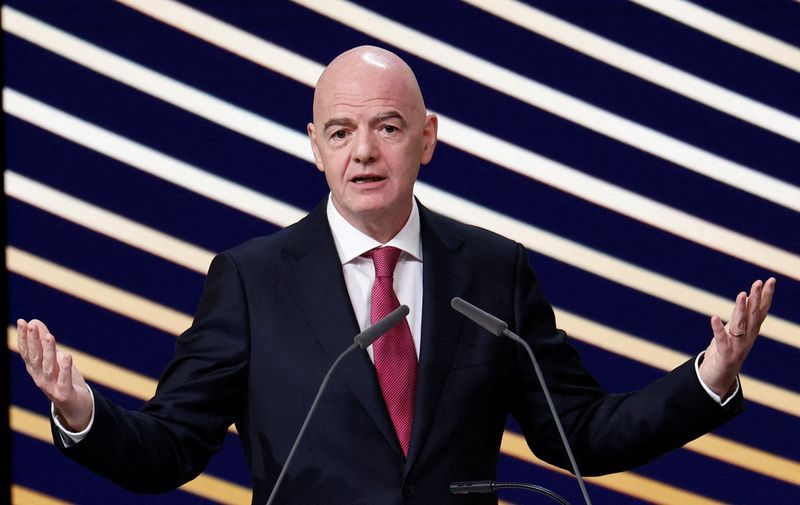
The governance crisis engulfing FIFA has found its most articulate critics in two women occupying the highest ranks of European football administration. Laura McAllister of Wales and Lise Klaveness of Norway, the sole female representatives on UEFA's executive committee, have emerged as principal architects of the resistance against FIFA President Gianni Infantino following the spectacular collapse of his private equity-backed Football Enterprises venture. Their prominence in this institutional rebellion has reopened a fundamental question about whether the world's most popular sport is finally ready to entrust its global leadership to a woman.
The immediate flashpoint for this governance crisis was Infantino's ambitious attempt to introduce the FFE initiative, a move that encountered fierce resistance from UEFA and other continental football governing bodies. The backlash proved swift and comprehensive: Wales became the first national association to withdraw support for Infantino's re-election, triggering a cascade of dissent that eventually reached FIFA's internal structures. An emergency meeting in Morocco was hastily scheduled as the institutional challenge to his leadership accelerated, underscoring the severity of the revolt.
McAllister, operating in her capacity as a UEFA vice-president, frames the current turmoil as symptomatic of deeper institutional malaise rather than a single policy disagreement. She identifies multiple controversies that have systematically eroded confidence in Infantino's stewardship: FIFA's entanglement with the failed European Super League project, governance failures surrounding recent World Cup editions, and a particularly egregious incident in which the governing body rescinded a red card after American striker Folarin Balogun received one during tournament play—a reversal made following pressure from U.S. President Donald Trump. Collectively, these incidents paint a picture of an organisation whose decision-making apparatus has become dangerously compromised.
Yet McAllister is measured in her assessment of women's readiness to assume FIFA's presidency. While publicly welcoming the prospect of female leadership, she cautiously observes that the sport has not yet aligned its governance structures with contemporary standards of institutional integrity. "It would be wonderful to see a woman elected as president of FIFA," she acknowledged in remarks to Reuters, before tempering this optimism by noting that football remains "far off" from achieving such a milestone. The constraint, she suggests, is not female qualification but rather football's persistent insularity from broader societal evolution.
The pathway to female leadership in FIFA, McAllister emphasises, cannot rely on meritocratic principles alone. While a female candidate might demonstrably represent the most capable choice for the position, pretending that FIFA's selection process functions as a straightforward meritocracy would be naïve. The organisation's power structures are intertwined with geopolitical interests and established power networks that extend far beyond Europe. Any serious female challenger for the presidency would require support from football associations distributed across continents, a requirement that amplifies the complexity of her theoretical candidacy.
Former International Olympic Committee marketing director Michael Payne provides instructive international context. He notes that the IOC, now led by Kirsty Coventry, has pioneered gender equity initiatives spanning two decades, fundamentally restructuring Olympic competition to achieve approximate numerical parity between male and female athletes. Football, by contrast, has failed to implement comparable systemic reforms. The World Cup, football's flagship competition, remains profoundly unequal in its resource allocation and visibility when contrasted with men's tournaments, reflecting the sport's glacial progress on gender equity.
Klaveness, who holds the distinction of being one of merely ten female presidents among FIFA's 211 member associations, has garnered public support from an unexpected quarter. Former FIFA President Sepp Blatter recently praised Klaveness publicly and urged the sport to embrace female leadership, adding institutional weight to arguments that the time for female governance has arrived. Her background as a lawyer provides intellectual credibility to her institutional critiques, while her experience as an international player for Norway grounds her perspective in authentic football experience.
Both McAllister and Klaveness trace their advocacy orientation to their formative careers within women's football before transitioning into governance roles. McAllister, trained as a political scientist, and Klaveness, grounded in legal practice, bring professional rigor to their critique. They articulate a values-based framework for football governance centred on the sport's fundamental purpose: universal accessibility, grassroots development, equity across gender lines, and freedom from both private capital capture and political manipulation. From their perspective, Infantino's FFE proposal represented a categorical betrayal of these foundational principles.
McAllister articulates a particular conviction about women's positioning within football governance. She suggests that female administrators often maintain greater distance from football's purely commercial dimensions, allowing them to focus on the sport's intrinsic social value. This perspective, she contends, protects against the corruption of football's essential character through the subordination of sporting values to financial imperatives. When football surrenders its values, she argues, it forfeits its fundamental legitimacy and purpose.
The institutional resistance McAllister orchestrated bore concrete fruit. Her proposal for a potential UEFA boycott of FIFA events received unanimous backing during UEFA's emergency meeting, signalling extraordinary consensus within European football's highest councils. This unified stance transformed her from a single critical voice into a spokesperson for continental football governance.
Regarding the path toward female leadership in FIFA, McAllister counsels patience and strategic incrementalism rather than confrontational revolution. She advocates for gradual momentum-building and incremental advancement of women into positions of authority, arguing that "softly softly" approaches often prove more effective than attempting forced institutional transformation. This cautious optimism reflects her understanding that FIFA's byzantine political geography renders rapid change unlikely, particularly when championed only by European voices.
The broader significance of McAllister and Klaveness's emergence as principal critics extends beyond their individual roles. Their prominence in the anti-Infantino movement demonstrates that women can command authority within football's elite institutional structures, providing concrete examples that challenge football's historically male-dominated power arrangements. Yet their measured rhetoric about female presidential prospects simultaneously acknowledges the immense structural barriers that remain embedded within FIFA's governance architecture, suggesting that genuine institutional transformation will require far more than simply identifying qualified female candidates.

