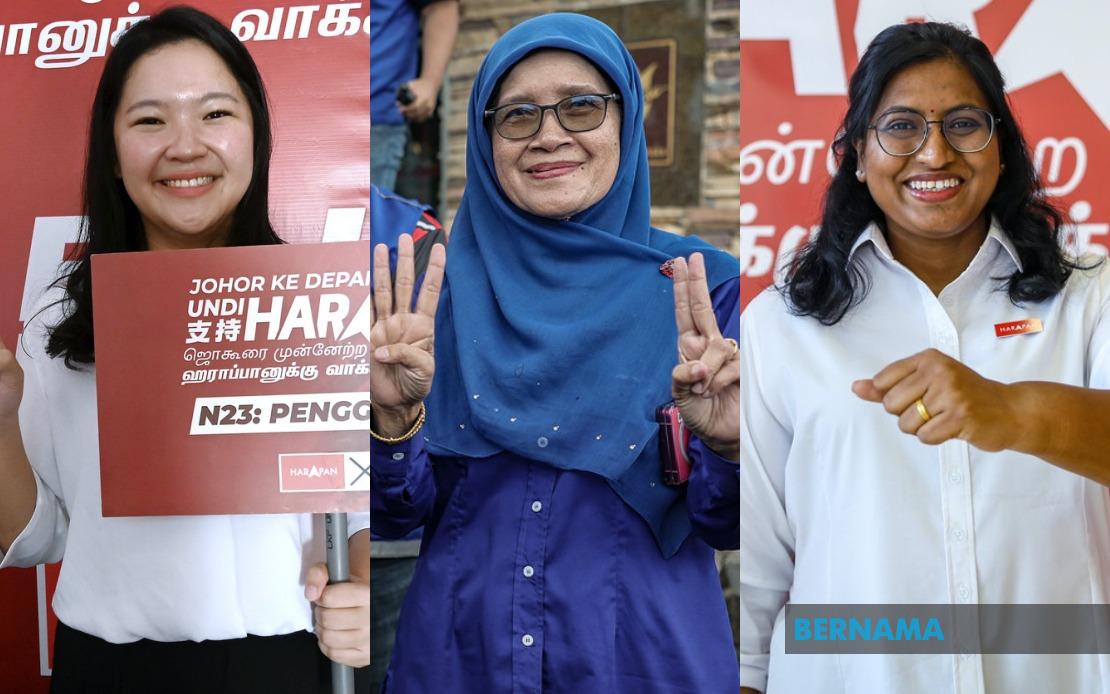
Women candidates in Johor's 16th State Election achieved a mixed but symbolically important outcome, with ten of the 34 female contenders successfully winning seats in the State Legislative Assembly. The results reflect an evolving narrative around women's political participation in Malaysia's most developed state, though the overall proportion of female candidates—just under twenty percent of the 172 contestants—suggests barriers to greater representation remain entrenched across party lines.
The ideological split in the victories highlights the competitive dynamics shaping Johor politics. Barisan Nasional captured seven of the ten successful female candidates, consolidating its commanding position in the state following a decisive victory that saw the coalition claim 48 of 56 seats overall. Pakatan Harapan's three female winners represent the opposition's limited but strategic footholds in constituencies where it maintains traditional support bases or where demographic shifts favour the coalition's messaging.
Barisan Nasional's female representatives demonstrate the coalition's ability to mobilise support across diverse constituencies. Nadhirah Afiqah Abdull Rahim's victory in Serom marked an accomplished electoral debut for the Ledang Puteri UMNO chief, who secured a comfortable majority of 9,406 votes against opponents from Perikatan Nasional and Pakatan Harapan. Her triumph illustrates how institutional party structures can facilitate women's entry into elected office, particularly when combined with grassroots organisational networks and established political machinery.
Crucial momentum swung toward Barisan Nasional in several constituencies where female candidates performed particularly strongly. Nor Rashidah Ramli's dominant performance in Parit Raja revealed a significant rightward shift in voter sentiment, with her tally of 19,572 votes producing a majority of 13,576—more than triple the 4,219-vote margin achieved during the previous 2022 state election in an identical three-way contest. This surge suggests either substantial voter migration between elections or enhanced local organisation and campaign effectiveness. Norlizah Noh's commanding 16,344-vote majority in Johor Lama similarly demonstrated decisive endorsement for the incumbent, whilst Fauziah Misri's 15,776-vote landslide in Penawar underscored Barisan Nasional's capacity to achieve substantial victory margins in mixed electoral contests.
The most symbolically significant outcome involved Chan San San's capture of the Johor Jaya seat, traditionally regarded as a Democratic Action Party stronghold and a bellwether for opposition strength in the state. Chan's achievement of 35,971 votes—defeating Pakatan Harapan, independent, and Parti Bersama Malaysia candidates—represents a notable reversal of political geography in Johor and suggests that Barisan Nasional's appeal transcends traditionally polarised constituencies. This breakthrough carries implications for how political competition will unfold in subsequent elections across the broader Klang Valley corridor.
Packatan Harapan's female victors concentrated in constituencies where the coalition maintains structural advantages. Felicia Poh Rui Ling's maiden victory in Penggaram at just 28 years old exemplifies how opposition parties are cultivating younger female talent in strategic locations. Her 4,137-vote majority against the Barisan Nasional candidate in a straightforward two-way contest reflects the competitive equilibrium maintained in several constituencies where local incumbency and voter familiarity provide security. Chu Poh Yee's retention of Mengkibol with a 4,213-vote margin preserves Pakatan Harapan's position in what remains a contested urban seat, whilst Kartiyaini Jeyapalan's 15,280-vote majority in Skudai demonstrates how professional credentials and candidate quality can generate substantial support in suburban constituencies with educated electorates.
The broader context for these female candidates' performance encompasses significant structural considerations about gender representation in Malaysian politics. The near-twenty percent share of women among total candidates represents incremental progress but remains substantially below parity, indicating that both major coalitions continue to navigate cultural expectations, internal party hierarchies, and candidate recruitment practices that favour male contestants. The concentration of female victories within Barisan Nasional's broader landslide suggests that party size and organisational reach create greater opportunities for female candidates to navigate to electoral success, whilst opposition parties face tighter margin constraints that may limit opportunities for less experienced or less established figures regardless of gender.
Hashrunizah Hassan's successful defence of her Pulai Sebatang seat with a substantially increased majority of 13,590 votes—up from a 7,265-vote margin in 2022—indicates that incumbent female candidates can benefit from the same anti-incumbent or pro-incumbent shifts that affect their male counterparts. Her straight-fight contest against a single Pakatan Harapan opponent contrasts with the multi-cornered contests that several other female candidates navigated, suggesting that electoral dynamics favouring simplified two-way contests may have benefited her campaign and simplified voter choice in her particular constituency.
The implications of this result for Malaysian politics extend beyond Johor itself. The state's election functions as a significant bellwether for national political trends, and the strong showing by Barisan Nasional female candidates suggests that the coalition's broader messaging and organisational capacity resonates across gender lines. Conversely, Pakatan Harapan's inability to translate its overall political presence into greater female representation—securing only three of ten victorious female candidates despite contesting in numerous constituencies—raises questions about candidate selection processes and whether opposition parties are deploying female talent strategically across winnable seats.
Moving forward, the modest success of female candidates in Johor creates both opportunities and challenges for political parties seeking to broaden their appeal. Barisan Nasional's success with female candidates provides a template that may be replicated in other state elections, though whether this represents genuine institutional commitment to gender parity or tactical deployment of female candidates in selected constituencies remains unclear. Pakatan Harapan faces pressure to accelerate recruitment and candidate development among women if it seeks to match or exceed Barisan Nasional's female representation in future elections. For female politicians themselves, these ten victorious candidates establish a precedent and proof of viability, potentially encouraging greater participation in subsequent electoral cycles across Malaysian states.

