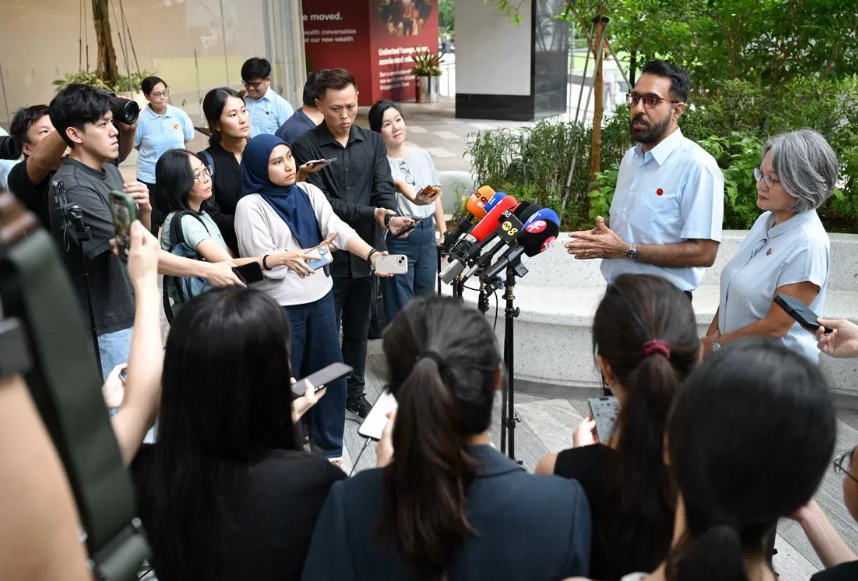
After weathering his most serious internal challenge since assuming office, Workers Party secretary-general Pritam Singh emerged from six hours of tense meetings on June 28 with his leadership firmly intact and party unity seemingly restored. Singh faced a vote of no confidence initiated by dissatisfied cadres, followed by a biennial election where the opposition party selects its leadership. He survived both proceedings decisively, with 82 of the 106 party cadres voting to retain him as leader, though he abstained from voting himself. His composed demeanor as he addressed reporters afterward—with relaxed body language and measured responses—conveyed a politician confident that the turbulence engulfing his party had finally subsided.
The meetings represented a watershed moment for the Workers Party, as they formally closed the chapter on a saga that has consumed the party's political oxygen for four years. The immediate trigger for Sunday's proceedings was Singh's conviction on charges of lying to Parliament, stemming from his role in a scandal involving former Sengkang GRC MP Raeesah Khan, who had fabricated a parliamentary account of police mistreatment of a sexual assault victim. When Khan's fabrication unraveled, a parliamentary Committee of Privileges investigation determined that Singh had abetted her deception by knowingly allowing the false narrative to persist. He was subsequently convicted in the lower courts and his guilty verdict was upheld by the High Court in December 2025 following an appeal.
The conviction triggered a parliamentary motion that formally deemed Singh unsuitable to remain as Leader of the Opposition. Prime Minister Lawrence Wong subsequently removed him from that post, a humiliation that exposed the party to sustained public criticism and internal questioning about whether Singh could or should continue leading the organization. A Workers Party disciplinary panel investigation concluded that Singh had violated the party's Constitution, yet the party's top leadership body issued only a formal letter of reprimand—a punishment that many observers characterized as remarkably lenient given the severity of the infraction and the damage to the party's reputation.
What makes Sunday's outcome particularly significant is not merely that Singh survived, but that the party's grassroots membership has demonstrated an almost complete absence of meaningful dissent. The group of cadres who triggered the no-confidence vote had invested considerable effort in attempting to recruit a challenger to contest Singh's leadership, lobbying potential candidates right up until the week of the conference. None agreed to stand. Furthermore, even during the questioning session itself, reports indicate that party members who stood to address Singh included supporters as well as critics, suggesting the challenge lacked the organizational coherence or passion that typically characterizes genuine leadership disputes in political parties.
The endorsement of veteran party chief Low Thia Khiang carries particular symbolic weight within Workers Party circles. As the architect of the modern Workers Party, Low's public declaration that he still supported Singh provided crucial legitimacy to the decision and signaled to the broader membership that institutional continuity remained paramount. Party chair Sylvia Lim, who has held her position for 23 years, further reinforced this message by emphasizing that while the party acknowledges the importance of leadership renewal, such transitions would occur through orderly processes rather than through crisis-driven upheavals.
The swift consolidation of party ranks offers significant tactical advantages heading into the party's future parliamentary work. By foreclosing internal debate and presenting unified public messaging, the Workers Party has prevented the kind of organizational hemorrhaging and public infighting that has damaged opposition parties in comparable democracies. The party can now redirect its energies toward legislative scrutiny, constituency work, and the careful cultivation of its political profile across Singapore's diverse voter demographics. The party's performance in the May 2025 general election, held after Singh's conviction in the lower court, demonstrated that the electorate did not punish the party at the ballot box, as the Workers Party not only consolidated its existing constituencies but gained two Non-Constituency MP seats.
Yet the very decisiveness of the cadre vote and the apparent absence of real contestation raises uncomfortable questions about whether political pragmatism has overridden principled accountability. When Singh was directly asked how he responds to those who characterize his party as being led by a "convicted liar," his deflection was notable: he directed questioners to his website and reiterated that his parliamentary position had not changed. For a party that has built its brand on standing for integrity and holding the government accountable, this represents an uncomfortable paradox. The Workers Party demanded that Prime Minister Lawrence Wong and his government accept personal accountability for various policy failures and governance lapses, yet when confronted with Singh's own legal accountability, the party essentially voted to move forward without substantive reckoning.
The pathway forward for the Workers Party presents genuine strategic challenges regarding voter expansion and demographic reach. While the party has demonstrated growth and resilience among its core supporters, capturing the support of middle-ground and swing voters—particularly among older, more conservative-leaning Singaporeans—depends significantly on questions of trust and character. The Workers Party's ability to present Singh as a credible alternative to incumbent leadership hinges on whether middle-income voters, professionals, and those concerned with standards in public office can distinguish between political opposition and legitimate questions about judgment. The party's current underdog status relative to the People's Action Party may initially insulate it from intensive voter scrutiny, but this comparative advantage could evaporate if the party attempts to broaden its appeal beyond traditional bases of support.
Looking forward, party chair Lim's hints about leadership renewal suggest the Workers Party may be preparing for an eventual transition from Singh, albeit on a timeline of the party's choosing rather than under pressure from external crises. Such a transition would allow the party to reset its public narrative and position itself as having learned from the Raeesah Khan episode. The timing and manner of that succession will prove crucial in determining whether the Workers Party can expand beyond its current electoral ceiling or whether it remains confined to constituencies and voter demographics where institutional loyalty and anti-establishment sentiment outweigh concerns about leadership character.
The resolution of the internal party proceedings removes a significant source of organizational uncertainty and allows the Workers Party to project confidence and stability to both supporters and potential defectors from other parties. However, it does so at a cost: the party has demonstrated that internal cohesion and political survival take precedence over the kind of rigorous accountability that opposition parties typically champion as a core principle. How effectively Singh and his colleagues can manage this tension between institutional loyalty and principled governance will likely determine whether the Workers Party represents a genuine alternative government or remains a perpetual protest vote for discontented voters.

