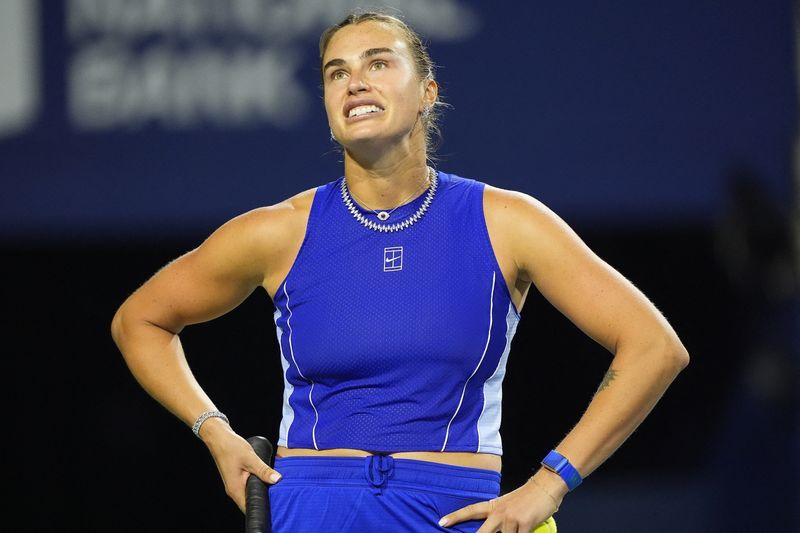
World number one Aryna Sabalenka encountered an unexpected obstacle in her U.S. Open preparation when she fell to Russia's Ekaterina Alexandrova in the fourth round of the Canadian Open in Toronto on Saturday. The match ended 7-6(3) 4-6 6-4 in favour of the 16th-seeded Alexandrova after nearly two and a half hours of intense competition, marking an unwelcome setback for the Belarusian just weeks before the year's final Grand Slam tournament.
Sabalenka's loss carries particular significance given her status and recent form. As a four-time Grand Slam champion and the defending U.S. Open winner, the world number one had arrived in Canada as a heavy favourite to capture the title. The Canadian Open remains one of the most prestigious hard court events on the women's tennis calendar, serving as an ideal preparation ground for players fine-tuning their games ahead of the U.S. Open. For Sabalenka, who has dominated much of the professional circuit this season, the unexpected exit raises questions about her form and readiness for the demanding schedule that lies ahead.
The match itself revealed the competitive determination required at elite levels of professional tennis. Sabalenka secured an early break in the opening set, appearing poised to control the encounter. However, Alexandrova demonstrated remarkable resilience, clawing her way back into the set to force a tiebreak, which she won decisively to claim the opening frame. This initial reversal showcased the Russian's capacity to maintain composure against one of the sport's most formidable competitors.
Sabalenka responded emphatically in the second set, reasserting her authority with a break of serve that established a 4-3 lead. She subsequently held her serve to level the match and create the conditions for a decisive third set. At this juncture, many observers may have expected the world number one to impose her superior ranking and experience, pushing towards a semi-final berth. Instead, the decider proved decisive in Alexandrova's favour.
The final set encapsulated Sabalenka's afternoon struggles and Alexandrova's unwavering composure under pressure. As the match progressed into the decider, the Belarusian's unforced error count began to accumulate, a worrying sign for a player typically known for her aggressive baseline dominance. Facing a critical juncture at 4-5, Sabalenka demonstrated her fighting spirit by saving two consecutive match points. However, the pressure ultimately proved decisive when she committed a double fault on the third match point, handing Alexandrova victory and a quarter-final berth.
Alexandrova's perspective on the victory emphasised the mental discipline required to overcome a top-ranked opponent. In her on-court interview, she articulated the philosophy that guided her performance, explaining that she approached every point as potentially her last opportunity. Against a player of Sabalenka's calibre, such point-by-point intensity becomes essential, as lapses in concentration or tactical missteps can rapidly prove costly. Alexandrova's strategic approach involved minimising her analysis of the scoreline, instead focusing purely on shot-making and engagement with the contest itself.
For Malaysian tennis enthusiasts and regional observers, Sabalenka's unexpected exit offers perspective on the competitive depth present in women's professional tennis. While the world's top-ranked player typically commands significant attention, tournaments regularly produce surprises that demonstrate the narrowing gap between elite performers and highly talented competitors positioned slightly outside the sport's absolute peak. Alexandrova's victory suggests that consistency and mental toughness remain as valuable as raw talent in determining match outcomes at this level.
Alexandrova will progress to the quarter-finals where she faces Ukraine's Elina Svitolina. Svitolina advanced by dismantling American eighth seed Amanda Anisimova with a commanding 6-2 6-4 victory, showcasing the Eastern European player's improved form as the North American summer hard court season progresses toward its climax. This quarter-final matchup presents an intriguing regional narrative, pitting two accomplished competitors from the former Soviet sphere against one another with elevated stakes.
Sabalenka's exit from Toronto carries implications beyond the immediate tournament context. The Canadian Open loss, occurring in the final weeks of hard court preparation, may necessitate tactical adjustments or renewed training emphasis as she transitions focus toward Flushing Meadows. For a defending U.S. Open champion, maintaining momentum and confidence becomes crucial, and an early exit in Toronto contrasts unfavourably with her title defence objectives. However, the compressed timeline before the U.S. Open provides limited opportunity for extensive recalibration, placing added weight on Sabalenka's capacity to analyse this match, extract necessary lessons, and rapidly restore her competitive edge during the critical preparation phase ahead.

