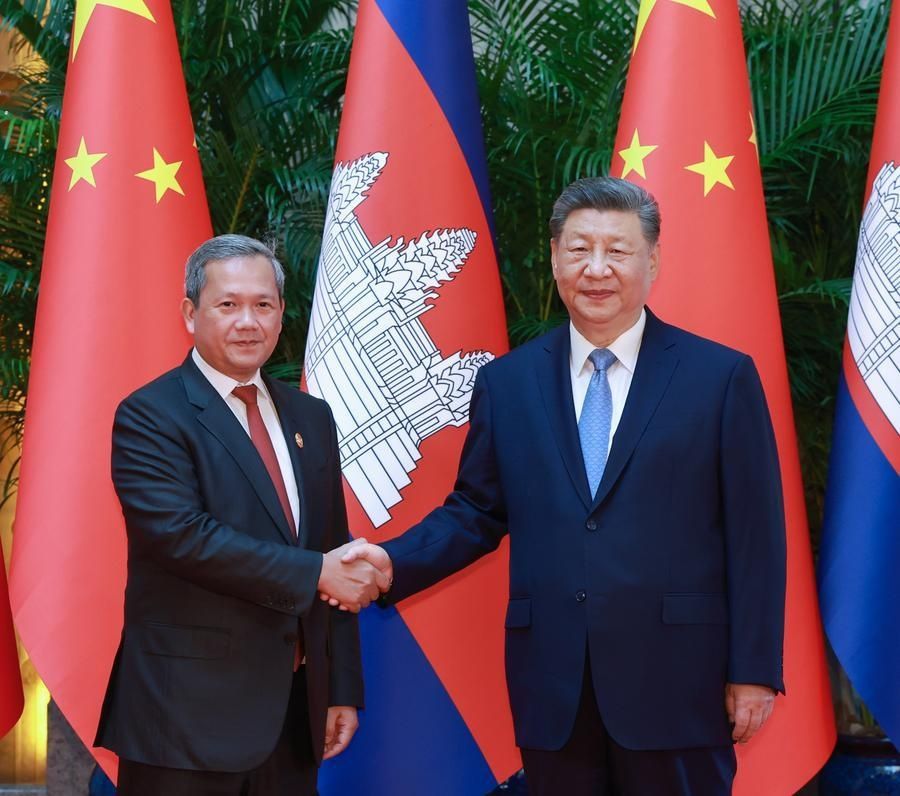
Chinese President Xi Jinping used a high-level meeting with Cambodian Prime Minister Hun Manet on Friday to reinforce Beijing's commitment to strengthening bilateral relations, characterizing the partnership as an "ironclad friendship" built by previous generations of leaders. The encounter took place in Shanghai, where Hun Manet was attending the 2026 World Artificial Intelligence Conference and High-Level Meeting on Global AI Governance, combining multilateral engagement with bilateral diplomacy in a style increasingly common among regional leaders navigating overlapping international agendas.
The meeting underscored China's strategic focus on Southeast Asia at a time when great power competition and regional realignments are reshaping the geopolitical landscape. Xi's emphasis on carrying forward the legacy of earlier leaders suggests Beijing views its Cambodia relationship as foundational to its broader regional influence, particularly given Cambodia's geographic position and historical alignment with Chinese interests. For Malaysia and other Southeast Asian nations, this reaffirmation of China-Cambodia ties reflects the deepening nature of Beijing's bilateral relationships across the region, each tailored to specific national circumstances yet collectively reinforcing China's presence.
The two leaders agreed to operationalize the "Diamond Hexagon" cooperation framework, a multilayered arrangement designed to coordinate action across multiple domains. Rather than remaining symbolic, both sides committed to enriching this framework and advancing what they termed an "all-weather China-Cambodia community with a shared future in the new era." The use of such language signals permanence and mutual commitment transcending temporary political shifts, a messaging strategy that resonates across diplomatic circles in Asia where stability and long-term partnership are paramount concerns.
Economic cooperation featured prominently in Xi's remarks, with particular attention to infrastructure corridors that directly tie Cambodian development to Chinese investment and market access. The Industrial Development Corridor and the Fish and Rice Corridor represent attempts to integrate supply chains and agricultural production in ways that benefit both nations while potentially reshaping regional trade patterns. Xi's call to upgrade traditional sectors such as electricity and agriculture while simultaneously fostering emerging industries including artificial intelligence and the digital economy reflects recognition that Cambodia, like its neighbours, must balance immediate development needs with positioning for future competitiveness.
Security cooperation formed another pillar of the discussion, with Xi placing notable emphasis on combating transnational crime. The specific mention of counterfeiting, smuggling, online gambling, and telecom fraud suggests these remain significant concerns affecting both countries, with criminal networks exploiting porous borders and weak enforcement across parts of Southeast Asia. Telecom fraud in particular has emerged as a regional scourge, with criminal operations sometimes operating across multiple countries, making bilateral and multilateral cooperation essential for effective enforcement.
Xi's comments regarding the Cambodia-Thailand border situation and ceasefire arrangements revealed China's careful positioning as a mediator while firmly supporting Cambodia's interests. By emphasizing dialogue and consultation as preferred mechanisms for resolving disputes, Beijing presents itself as a supporter of peaceful resolution while signalling that it maintains Cambodia's side in bilateral friction. This approach allows China to maintain its relationship with both countries while providing cover for Cambodian government policy through external validation from a major power.
Hun Manet's reciprocal statements emphasized Cambodia's unwavering commitment to the one-China policy and pledged resistance to any international pressures that might shift this alignment. His expression of gratitude for Chinese economic and development support acknowledged the material foundations undergirding Cambodia's foreign policy orientation. For observers in Malaysia and Singapore, Hun Manet's reaffirmation that Cambodia's friendly cooperation with China remains unchanged "regardless of shifts in the international situation" represents a notable declaration of policy constancy that deserves scrutiny, particularly given how international situations do shift and affect smaller nations' policy flexibility.
The Cambodian prime minister's commitment to deepening political mutual trust and expanding bilateral trade positions Cambodia as a willing partner in Beijing's economic integration agenda. By foregrounding major infrastructure projects and intensifying anti-fraud cooperation, Hun Manet signalled that Cambodia views Chinese partnership not merely as political alignment but as instrumental to achieving development objectives. This transactional dimension, often overlooked in headlines about "friendships," actually explains much about the durability of China-Cambodia relations across different administrations and international contexts.
The emphasis on combating telecom fraud warrants particular attention for the broader region. This crime category has metastasized across Southeast Asia, with criminal syndicates operating from bases in Myanmar, Cambodia, and Laos to target victims across the region and beyond. Malaysian authorities have repeatedly highlighted telecom fraud as a priority security concern, and the China-Cambodia commitment to cooperation suggests recognition of this shared vulnerability and willingness to coordinate responses.
Cambodia's geographical position as a crossroads between Southeast Asia's more developed economies and China makes it a natural hub for infrastructure investment. The corridors mentioned by Xi could theoretically benefit the broader region through improved connectivity, though experience suggests such projects often prioritize bilateral flows rather than generating broader regional benefits. Malaysian policymakers have reason to monitor these developments to understand how regional trade and investment patterns may shift as China deepens its infrastructure footprint across Cambodia.
The timing of this meeting, coinciding with Hun Manet's attendance at a major artificial intelligence conference, also signals recognition that technology cooperation will define future great power competition. By specifically mentioning artificial intelligence and the digital economy as emerging cooperation areas, both leaders acknowledged that Cambodia's relevance to Chinese strategic interests extends beyond geography and traditional sectors to encompass cutting-edge domains where technological transfer and capacity building will determine relative competitiveness.
For Southeast Asia more broadly, the reinforcement of China-Cambodia ties represents a steady continuation of Beijing's patient, consistent approach to regional relationships. Unlike dramatic announcements or sudden policy pivots that capture headlines, this incremental deepening of cooperation across multiple domains reflects a long-term strategy that systematically extends China's influence while avoiding the appearance of coercion or dominance that might provoke regional balancing responses. This sustained engagement approach, applied across multiple Southeast Asian partners simultaneously, arguably represents Beijing's most effective regional strategy.

