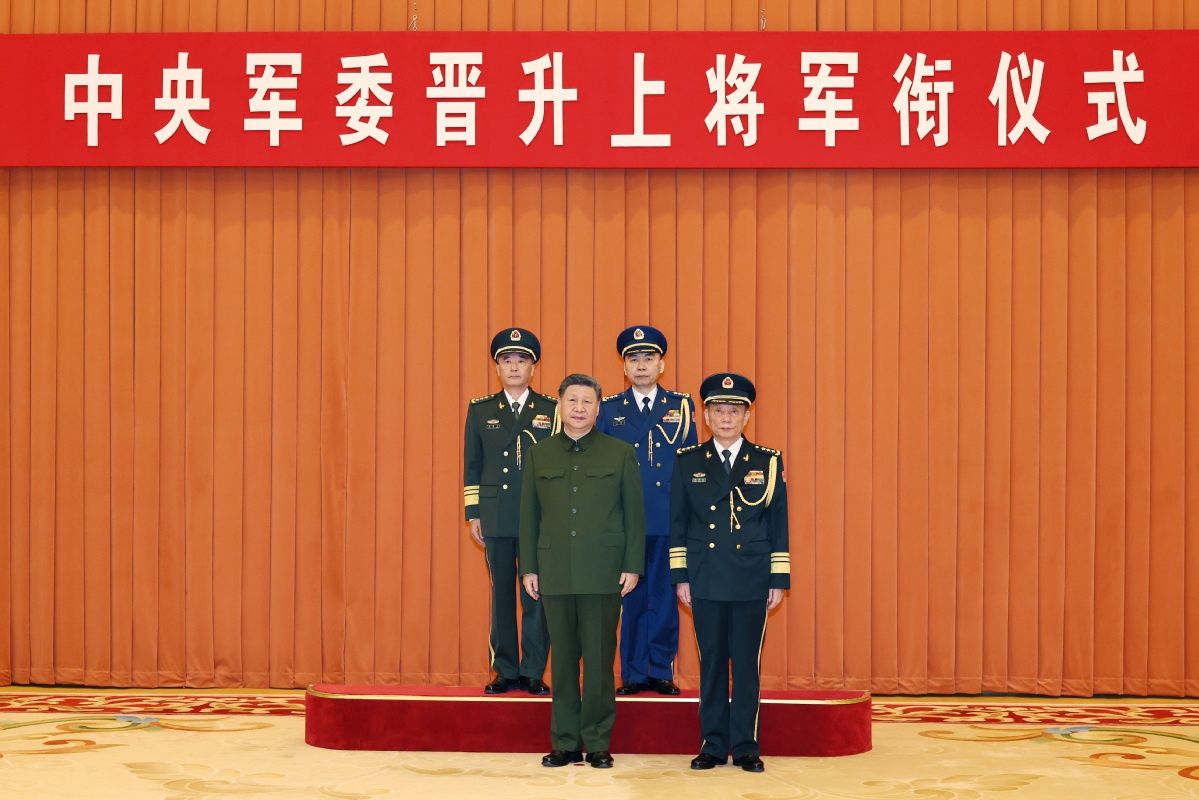
Chinese President Xi Jinping has consolidated his grip over the People's Liberation Army by installing fresh leadership in the military's anti-corruption apparatus, marking another significant step in what has become the country's most sweeping defence sector purge in decades. Zhang Shuguang has assumed the position of secretary of the Central Military Commission's discipline inspection commission, a role previously held by Zhang Shengmin, who has been elevated to vice chairman of the CMC itself. The announcement came during a ceremony presided over by Xi in Beijing on Friday, July 3, underscoring the president's direct involvement in military restructuring at the highest levels.
Simultaneously, Wang Gang has taken command of the People's Liberation Army Air Force, replacing Chang Dingqiu whose next assignment remains undisclosed. Both newly promoted officials have been elevated to the rank of general, China's senior-most active military rank, reflecting their enhanced standing within the defence hierarchy. The timing and coordination of these appointments suggest a deliberate effort to place trusted lieutenants in sensitive positions overseeing military discipline and operational command, consolidating Xi's authority over institutional structures that might otherwise challenge his strategic direction.
The restructuring cannot be divorced from the broader anti-corruption campaign Xi initiated in mid-2023, approximately six months after he secured an unprecedented third term as party leader. This drive has fundamentally reshaped China's defence establishment, removing obstacles to Xi's military modernisation agenda and eliminating potential rivals or dissenting voices within the officer corps. The scale of removals has been extraordinary by historical standards, extending to the forced departure of two vice chairmen of the Central Military Commission, three other CMC members, a former defence minister, and at least a dozen senior generals commanding major military regions and strategic forces.
For Southeast Asian observers, this consolidation carries significant implications. A more tightly controlled Chinese military under Xi's direct authority potentially reduces internal debate about regional military posture and risk assessment in sensitive areas like the South China Sea. Military establishments often contain pragmatists who privately caution against aggressive policies; their removal tilts decision-making toward those more aligned with Xi's vision of assertive power projection. This structural change has already influenced how China's military interacts with neighbouring countries and how it responds to perceived challenges to its interests in maritime territorial disputes.
The investigation launched against Zhang Youxia earlier this year represents perhaps the most dramatic manifestation of Xi's willingness to target even his closest military allies. Zhang Youxia, who served as Xi's top general and enjoyed a relationship built over decades, became the subject of formal scrutiny for alleged misconduct. This action demonstrated that no official, regardless of personal connections or historical association with Xi, can assume immunity from the anti-corruption machinery once it focuses attention upon them. Such moves send clear signals throughout the military establishment about the consequences of disloyalty or perceived resistance to Xi's priorities.
The removal of six military lawmakers from their seats in the national parliament last week extended the purge into civilian-military interface structures. These disciplinary actions suggest a comprehensive audit of military leadership across both active-duty command structures and their representatives within China's legislative apparatus. The breadth of this campaign indicates concern about embedded networks of officials whose allegiances might derive from patronage relationships predating Xi's rise to power, or whose professional interests diverge from his strategic vision.
The appointment of Zhang Shuguang to oversee anti-corruption efforts within the military carries particular symbolic weight. Control over discipline inspection mechanisms grants influence over investigations, prosecutions, and the pace at which officials are removed or rehabilitated. By placing a trusted figure in this role, Xi ensures that investigations will proceed according to his preferences and timeline, and that the narrative surrounding removals will align with his characterisation of necessary institutional renewal. The position functions as both a tool for rooting out genuine malfeasance and a mechanism for eliminating political rivals cloaked in anti-corruption language.
Military reform has been a cornerstone of Xi's governance approach since his ascent to power in 2012. He has pursued modernisation efforts intended to streamline command structures, enhance technological capability, and ensure absolute loyalty to his vision of China's military role. Previous restructuring initiatives have reorganised regional commands, reformed the defence procurement system, and emphasised the supremacy of the Communist Party—and by extension Xi himself—over military institutions. The current personnel changes continue this trajectory by removing officials whose advancement predates Xi's era and installing those whose careers depend upon his patronage.
The implications for regional security dynamics warrant careful consideration. A military establishment cleansed of potential moderating voices and reorganised according to Xi's preferences may prove less constrained by institutional checks or counter-arguments in crisis situations. This could affect calculations regarding military coercion, miscalculation risks, and escalation dynamics in disputed areas. Nations across the Indo-Pacific, including Malaysia and other ASEAN members navigating complex relationships with Beijing, must recalibrate their assessment of how decisions emanate from Chinese power centres and whether institutional constraints that might previously have checked aggressive impulses remain intact.
The broader pattern reveals Xi's determination to eliminate any structural independence within the military establishment. By replacing the anti-corruption chief, installing air force leadership, and continuing removals at multiple levels, he has created a defence institution increasingly characterised by personalised authority rather than institutional routines or bureaucratic norms. This transformation extends China's military vulnerabilities alongside its capabilities—a more loyal military may prove more willing to undertake risky operations, but it may simultaneously lose the institutional expertise and cautionary perspectives that prevent catastrophic errors.
Looking ahead, Malaysia and Southeast Asian nations should monitor how this restructured military leadership approaches regional issues. The consolidation of power under Xi's direct authority, achieved through systematic removal of potential rivals and installation of loyal subordinates, establishes a military command structure optimised for rapid decision-making according to the paramount leader's preferences. Whether this translates into more aggressive or more measured conduct in regional disputes remains an open question depending on Xi's own strategic calculations.

