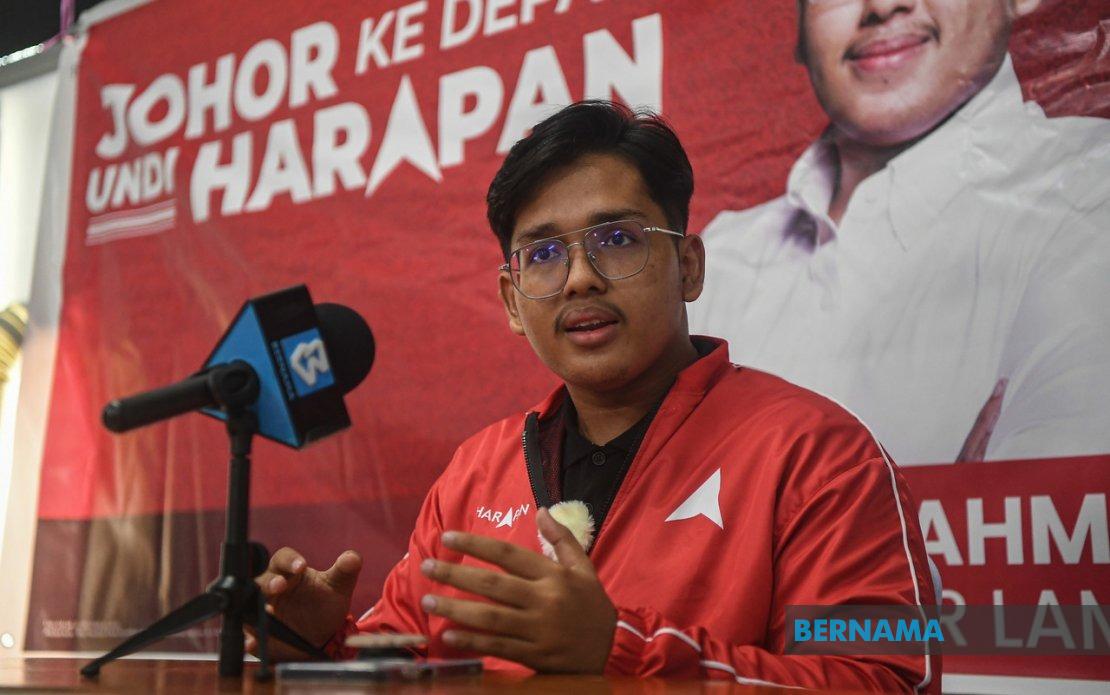
Danish Hossman Abd Rahman, a 23-year-old Information Technology postgraduate student, is running as Pakatan Harapan's representative in the Johor Lama state constituency and has emerged as the youngest contender in the 16th Johor state election. The enthusiastic reception he has encountered during campaigning has reinforced his conviction that meaningful change is within reach, transforming initial grassroots engagement into a genuine electoral strategy that could reshape the political dynamics of the traditionally competitive seat.
The UTHM student attributes much of his growing confidence to sustained ground-level work that has exposed him to the genuine concerns of different demographic groups within Johor Lama. Rather than limiting himself to formal campaign events, his approach involves repeated interactions with communities across towns, villages, and Felda settlements, allowing residents to develop familiarity and assess his sincerity beyond political rhetoric. This methodical engagement strategy appears particularly effective in rural and semi-rural areas where personal connection often outweighs party affiliation in voter decision-making.
A striking dimension of his campaign resonates specifically with older constituents and war veterans, demographic segments that frequently lean toward established parties. Contrary to conventional wisdom that younger candidates face automatic disadvantages with senior voters, Hossman has positioned his youth as a marker of genuine commitment to public service. Veteran voters, according to his observations, respond positively to a candidate willing to conduct extensive fieldwork and engage in face-to-face dialogue rather than rely on ceremonial appearances and delegated representation—a pattern they have evidently grown weary of from longer-serving incumbents.
Crucially, Hossman articulates a governing philosophy that avoids the common pitfall of youthful candidates dismissing experience entirely. Instead, he frames himself as a "strategic bridge" connecting the accumulated wisdom of previous generations with the forward-looking aspirations of younger Malaysians. This positioning allows him to appeal across age groups without appearing naive or dismissive of institutional knowledge, an important rhetorical distinction in Malaysian politics where respect for seniority remains culturally embedded. He repeatedly emphasizes that generational renewal need not entail wholesale rejection of existing expertise.
The substantive policy agenda he has developed addresses two interconnected challenges affecting Johor Lama's demographic stability. Chronic housing affordability and insufficient local employment opportunities have catalyzed outmigration, particularly among working-age youth seeking better prospects in urban centres. Rather than offering vague promises of development, Hossman has identified specific economic strategies aligned with the constituency's existing advantages: downstream agricultural processing, livestock operations, and targeted industrial investments that would create value-added employment while retaining the young people upon whom the area's long-term viability depends.
His emphasis on investment attraction and industrial alignment represents a substantive departure from simplistic appeals or infrastructure promises. By focusing on downstream activities and enterprises that leverage existing agricultural potential, Hossman implicitly acknowledges that sustainable rural prosperity requires building upon comparative advantages rather than attempting wholesale economic transformation. This approach carries particular relevance for Malaysian constituencies like Johor Lama, where communities possess demonstrable productive capacity but lack the value-capture mechanisms that would enable capital accumulation and youth retention.
The broader campaign strategy emphasises judging candidates by capability and track record rather than affiliation or personal attacks, a message that gains traction amid growing voter fatigue with toxic political discourse. Hossman's explicit rejection of politics built on hatred or personal animosity reflects broader sentiment within the electorate, particularly among first-time and younger voters increasingly sceptical of divisive campaigning. This framing also implicitly critiques the incumbent administration's performance, suggesting that capability gaps rather than partisan loyalty explain the perceived need for change.
The Johor Lama contest has crystallized into a three-way battle between Hossman representing Pakatan Harapan, the incumbent Norlizah Noh of Barisan Nasional, and Aisah Esa standing for Perikatan Nasional. This configuration creates the possibility of vote fragmentation that could significantly impact the outcome, particularly if any candidate succeeds in consolidating support from a specific demographic segment. Hossman's youth appeal and generational messaging could prove decisive if substantial numbers of younger voters turn out, a demographic historically prone to lower participation rates in state elections.
The election occurs within the broader context of the 16th Johor state election, where 172 candidates are contesting 56 seats. The timing and scale of this exercise reflect the state's political significance within Malaysia's federal structure and its status as a crucial battleground between competing national coalitions. For Pakatan Harapan, fielding generationally diverse candidates like Hossman represents both a practical necessity—addressing the recruitment challenges inherent in opposition politics—and a strategic asset in presenting themselves as forward-oriented and inclusive.
Hossman's campaign illustrates evolving Malaysian electoral dynamics where younger candidates are increasingly willing to contest competitive seats rather than defaulting to positions in non-competitive constituencies. This shift reflects confidence that age can function as a campaign asset rather than liability if articulated effectively through substantive policy messaging and demonstrated commitment to community engagement. The apparent receptiveness to his candidacy suggests that voter scepticism toward establishment politics extends across generational lines, creating openings for candidates who can bridge rather than exacerbate age-based divides.
The final campaign week preceding the Saturday polling day will test whether Hossman's grassroots momentum translates into actual electoral support. His intensified focus on youth, women, and small business constituencies indicates recognition that winning requires mobilizing traditionally underengaged groups rather than simply appealing to loyal party voters. The outcome in Johor Lama will provide significant data points about whether generational freshness and authentic community engagement can overcome the structural advantages—incumbent advantage, organizational resources, established voting patterns—that typically favour established candidates in Malaysian state elections.

