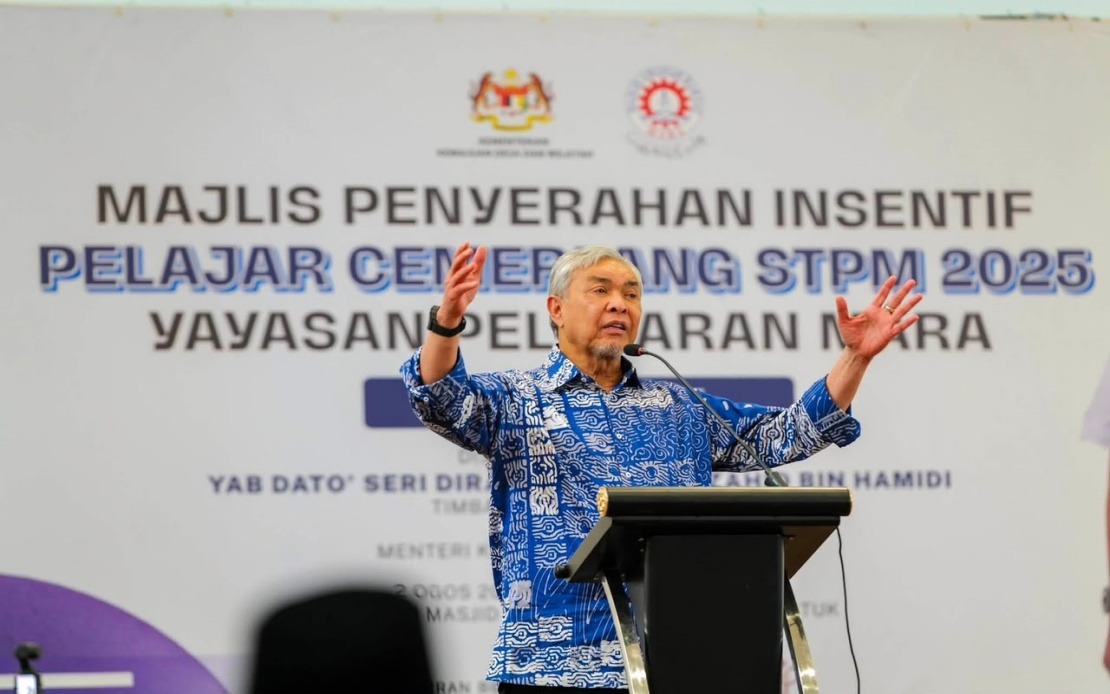
Thirty-eight high-achieving students from two secondary schools in the Perak district of Bagan Datuk have been awarded the 2025 STPM Excellence Incentive by Yayasan Pelajaran MARA (YPM), marking a significant acknowledgement of their academic accomplishments in Malaysia's pre-university examination. The recognition ceremony underscores the nation's commitment to nurturing exceptional talent among secondary school graduates and providing them with financial support to pursue further studies.
The recipients come from SMK Khir Johari and SMK Tun Abdul Razak, two institutions that have demonstrated consistent strength in academic performance across the region. Deputy Prime Minister Datuk Seri Dr Ahmad Zahid Hamidi, who also serves as the Member of Parliament for Bagan Datuk, announced the honour and expressed his satisfaction with the district's educational trajectory. The announcement reflects broader efforts to celebrate and incentivise academic excellence at the state and federal levels, particularly within constituencies where such recognition can inspire younger cohorts to pursue similar goals.
Beyond the STPM Excellence Incentive recipients, the cohort achieved additional milestones that extend the impact of this academic success. Three students from the district have gained admission to Al-Azhar University in Egypt to pursue Islamic studies, specifically in the fields of Syariah and Usuluddin—a development that speaks to the diversity of educational pathways available to Malaysian students and the continued appeal of prestigious international institutions for specialised religious studies. This represents a meaningful achievement for a district-level cohort and positions Bagan Datuk within a network of Malaysian communities sending scholars abroad for advanced Islamic education.
Simultaneously, 23 students from the same schools have qualified for support through the YPM Education Compassionate Fund, a safety-net programme designed to assist capable but economically disadvantaged students in completing their secondary education. This dual-track support system—combining merit-based incentives with need-based assistance—reflects YPM's comprehensive approach to identifying and nurturing talent across different socioeconomic strata. The breadth of assistance extended to Bagan Datuk students indicates robust institutional capacity within the district's schools to identify eligible candidates and facilitate their applications to these schemes.
Dr Ahmad Zahid Hamidi's public commentary on the matter emphasised the transformative role of educational opportunity, noting that Bagan Datuk's youth demonstrate considerable potential when provided with appropriate guidance, mentorship, and financial support. His assertion that education represents an optimal investment vehicle for personal development and community progress reflects a consistent policy position within Malaysian governance circles, where education remains framed as fundamental to socioeconomic mobility. This messaging, directed toward both students and parents, seeks to reinforce cultural attitudes toward learning and perseverance as engines of advancement.
The distinction between potential and realised achievement animated Dr Ahmad Zahid's remarks, suggesting that external enablers—structured opportunities, parental encouragement, and institutional frameworks—often determine whether academic capacity translates into tangible success. This framework acknowledges that talent alone is insufficient without accompanying investment and support mechanisms. For policymakers, such observations underscore the importance of maintaining and expanding funding for merit and needs-based scholarship programmes, particularly in districts where demographic or economic factors might otherwise constrain educational attainment.
The public celebration of these achievements serves multiple functions within Malaysia's political and educational ecosystem. For the students and their families, formal recognition validates years of academic effort and reinforces the value proposition of rigorous study. For the district itself, clustering these accolades within Bagan Datuk elevates its profile as an educational hub and potentially influences parental investment in schooling and student performance. For state and federal policymakers, such visible success provides measurable evidence of programme effectiveness and justifies continued appropriations to bodies like YPM.
Dr Ahmad Zahid's expression of hope that Bagan Datuk's graduates will return to contribute locally after completing tertiary studies abroad introduces an important tension within development strategy. Brain drain has long been a concern for Malaysian regions outside the Klang Valley and Kuala Lumpur metropolitan corridor, as talented young people tend to migrate toward employment centres after qualification. The implicit appeal for reverse migration and local contribution suggests an understanding that district-level development depends partially on retaining or recapturing human capital, even as international mobility is celebrated as an opportunity.
The YPM scheme itself represents decades of institutional evolution within Malaysia's higher education support architecture. Originally established to identify and nurture talent among Bumiputera students, YPM has expanded its reach and refined its targeting mechanisms to encompass merit-based incentives alongside needs-based assistance. The 2025 STPM Excellence Incentive reflects this evolution, signalling institutional confidence in identifying high-performing students and providing them with resources to transition into tertiary education. For Malaysian students contemplating their post-secondary options, such schemes reduce financial barriers and expand the feasibility of pursuing studies both domestically and abroad.
The concentration of achievement within two schools suggests either exceptional institutional capacity, demographic advantages favouring academic success, or effective mobilisation of student support within those institutions. Understanding which factors drove this concentration would provide valuable intelligence for replication elsewhere. Whether success stemmed from teaching quality, peer effects, family socioeconomic circumstances, or targeted student support efforts remains unspecified but would inform efforts to scale achievements across other districts facing similar starting conditions.
For Southeast Asian readers monitoring Malaysian educational policy, this announcement reflects broader regional trends toward professionalising scholarship administration and explicitly linking educational achievement to national development objectives. Countries across the region have similarly invested in merit-based incentive schemes aimed at identifying and retaining talent. The Malaysian experience, with its combination of domestic excellence recognition and international opportunity facilitation, offers a model that balances celebration of local achievement with openness to global educational mobility.
Looking forward, sustaining Bagan Datuk's educational momentum will require continued investment in school infrastructure, teacher development, and scholarship availability. The enthusiastic endorsement from the parliamentary representative and Deputy Prime Minister indicates political will to maintain support, but converting such sentiment into sustained budgetary commitment remains an ongoing challenge. As the cohort of 38 STPM-excellent students and their peers progress through tertiary education, their subsequent outcomes—employment, further advancement, community contribution—will ultimately determine whether these early incentives translate into transformative life trajectories and district-level development gains.

