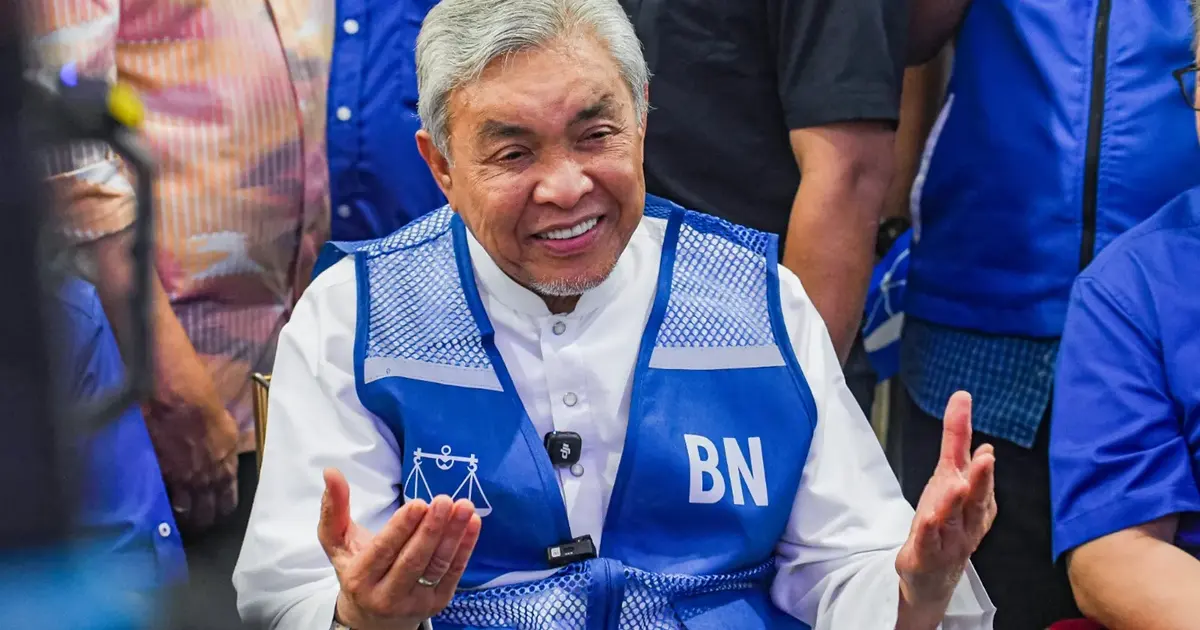
Deputy Prime Minister Ahmad Zahid Hamidi and Prime Minister Anwar Ibrahim have reached a fresh understanding on maintaining institutional cooperation at the federal level, even as their respective political coalitions compete for electoral advantage in upcoming contests. This alignment between the Barisan Nasional chairman and the sitting Prime Minister represents a significant endorsement of the unity government framework that has held Malaysia's political landscape stable since its formation.
Zahid's public agreement with Anwar reflects a pragmatic approach to coalition management in which party-level electoral rivalry and state-level competition can proceed without fracturing the federal partnership. The BN chairman explicitly acknowledged that campaigns mounted by opposing coalitions during polling periods should remain compartmentalised from the machinery of federal government, where both major political blocs maintain representation through cabinet positions and institutional roles.
This understanding carries particular weight given the historical tensions between UMNO-led Barisan Nasional and the Pakatan Harapan coalition that underpinned Anwar's administration. The unity government, formed to provide Malaysia with political stability following the 2022 general election, has often faced scepticism about its durability precisely because it brings together parties that have previously stood in direct opposition. Competition for parliamentary seats and state governments has periodically tested the partnership's resilience.
Malaysian political analysts view the Zahid-Anwar consensus as an important clarification of how the coalition intends to navigate the tension between maintaining electoral integrity and preserving institutional functionality. The statement effectively establishes a boundary between the commercial side of politics—where parties compete for votes and power—and the administrative side, where federal governance requires genuine cooperation across party lines. This demarcation helps explain how the unity government has managed to endure despite internal strains.
The implications for Southeast Asia's largest economy extend beyond symbolic politics. A stable federal coalition at the centre allows Malaysia's government machinery to function effectively on critical economic, security, and social policy matters that require sustained cross-party engagement. Investor confidence, which has been sensitive to Malaysian political uncertainty in recent years, benefits from clear signals that electoral contests will not precipitate governmental collapse or institutional paralysis.
For the Barisan Nasional specifically, Zahid's position acknowledges that UMNO's long-term interests are best served through measured participation in federal governance rather than through destabilisation tactics that might trigger early elections or constitutional crises. This represents a notable shift from the immediate post-2022 period, when uncertainty surrounded how the coalition would manage its new subordinate role after decades of dominance. The evolution suggests institutional maturation and recognition that Malaysia's political system requires multiple power centres working in tandem.
The agreement also holds implications for state-level politics, where Barisan Nasional and Pakatan Harapan maintain their traditional adversarial relationship across different regions. By compartmentalising federal cooperation from state competition, both coalitions preserve their separate identities and activist bases while enabling federal programmes to proceed. This permits local political campaigns to proceed with full vigour without triggering fears that electoral losses in one state might threaten the national government.
International observers and foreign investors monitoring Malaysia's political development will likely interpret the Zahid-Anwar alignment as evidence that the nation's democratic institutions have matured sufficiently to accommodate competing blocs within a shared federal framework. Such arrangements are commonplace in European coalition governments but represent a relatively recent phenomenon in Malaysian politics, where single-party dominance characterised governance for most of the post-independence period.
The commitment from both leaders also addresses concerns within their respective party bases about whether participation in a unity arrangement represents compromise of political principles. By explicitly stating that elections remain zones of unrestricted competition, Zahid and Anwar provide cover for their parties' campaign efforts while maintaining that voters' electoral choices need not determine whether different coalitions can cooperate on matters of national importance. This framing helps retain activist enthusiasm on both sides.
Moving forward, the sustainability of this arrangement will depend on whether major policy disputes emerge that divide federal coalition partners, or whether unexpected electoral results in state contests destabilise the federal partnership. The Zahid-Anwar understanding provides a template for managing such eventualities, but real-world pressures will test whether this framework can withstand significant political shocks. Malaysian observers will continue monitoring whether both leaders maintain sufficient influence within their respective organisations to enforce this compact across their party structures.
The significance of this agreement extends beyond the immediate political moment. It reflects an evolving Malaysian political culture in which electoral competition and institutional cooperation coexist, and where parties increasingly recognise that governance effectiveness depends upon maintaining professional relationships regardless of electoral positions. Should this model prove durable, it could reshape how Malaysian politics functions and potentially influence governance models across Southeast Asia as other nations grapple with coalition arrangements.

