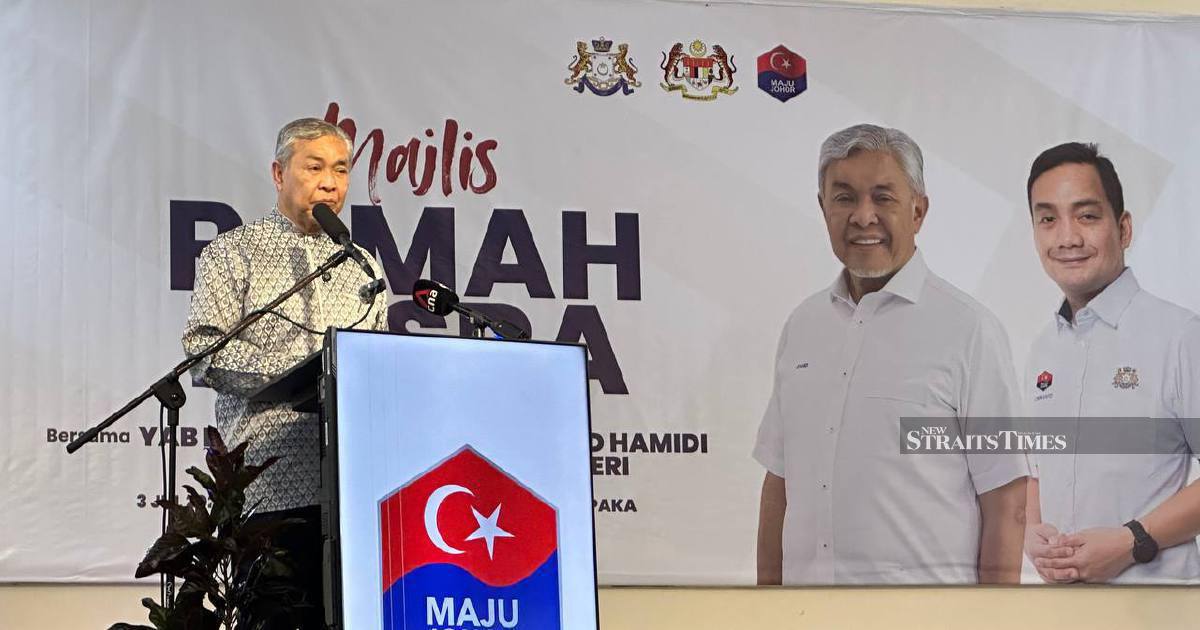
Barisan Nasional chairman Datuk Seri Dr Ahmad Zahid Hamidi has called for unity government partners to move past historical grievances against Umno and the broader coalition as they enter the Johor state election campaign. The appeal signals an attempt to maintain cohesion among the ruling alliance's disparate factions, which have sustained considerable friction since the formation of the unity government framework.
The timing of Zahid's remarks underscores the delicate balance required to keep the coalition intact during a pivotal electoral test. Johor, traditionally a Barisan stronghold and one of Malaysia's most politically significant states, represents both an opportunity to demonstrate unity government strength and a potential flashpoint where internal tensions could surface publicly. Any perception of discord among alliance partners could undermine voter confidence and weaken the coalition's electoral prospects in a state where Umno historically commands deep organisational roots.
Zahid's directive reflects broader concerns within Barisan leadership about maintaining message discipline during campaign activities. When coalition members publicly resurrect past controversies or criticisms, they risk fracturing the carefully constructed narrative of unity and forward momentum that the government has attempted to project to voters. The implicit acknowledgment that such tensions exist speaks to the underlying fragility of arrangements that have brought together political partners with fundamentally different electoral constituencies and policy preferences.
The unity government framework itself emerged as a pragmatic response to Malaysia's fractured political landscape, bringing together Umno-led Barisan, Pakatan Harapan components, and other political entities. However, this marriage of convenience has never fully resolved the grievances that accumulated during previous periods of intense competition and mutual criticism. Local and state-level elections have historically served as venues where partners test each other's commitment to the coalition while also pursuing individual political survival, creating pressure to highlight perceived slights or policy disagreements.
For Umno specifically, which has faced years of institutional and reputational challenges, the Johor campaign represents a critical opportunity to demonstrate party resilience and organisational capacity. Any perception that coalition allies are using the campaign to air past criticisms of the party could complicate this narrative, suggesting that unity remains conditional rather than genuine. Zahid's intervention indicates that party strategists view the risk of internal recrimination as sufficiently acute to warrant direct intervention from the coalition's highest levels.
The Malaysian political context has transformed significantly since the 2022 formation of the unity government arrangement. Previous elections, including federal and state contests, revealed deep fractures within the system that parties attempted to manage through institutional mechanisms rather than organic consensus. The Johor election thus tests whether those mechanisms can withstand the pressures of competitive campaigning in a state where multiple coalition members have historical influence and voter bases.
Zahid's appeal also reflects calculations about voter sentiment in Johor. Electorate fatigue with political bickering and internal conflict has become a recurring theme in Malaysian polling and campaign analysis. Voters increasingly punish coalitions perceived as dysfunctional or mired in internal disputation, particularly when such conflicts are played out in public forums like election campaigns. By instructing allies to avoid historical attacks, Zahid signals an understanding that the coalition's electoral viability depends partly on projecting internal discipline and cohesion.
The directive carries implicit warnings about consequences for non-compliance. While ostensibly a request, such statements from coalition leadership typically function as binding guidance that member parties breach at political cost. Coalition partners who continue raising past controversies risk marginalisation in future electoral arrangements, resource allocation decisions, or government position negotiations. The unspoken leverage inherent in such appeals often proves sufficient to enforce discipline without explicit sanctions.
For Malaysian observers and political analysts, Zahid's remarks illuminate the continued fragility of the unity government project. Rather than suggesting resolution of fundamental tensions, the need to explicitly discourage partners from historical criticism indicates that underlying disputes remain unresolved. The appeal represents management of symptoms rather than treatment of underlying causes, a palliative approach that may suffice for individual election cycles but raises questions about long-term coalition durability.
The Johor election carries additional significance as a regional barometer for national political trends. Outcomes in Malaysia's second-largest state by electoral weight often foreshadow dynamics in subsequent federal or larger state contests. A coalition victory achieved through evident unity would reinforce narratives of governmental stability and effectiveness. Conversely, a campaign marked by visible internal conflict or partner defections could signal broader fractures that opposition forces might exploit in future electoral opportunities.
Zahid's intervention also reflects the particular vulnerabilities of Umno within the broader coalition framework. As the largest party by parliamentary representation but facing reputational and institutional challenges from recent history, Umno occupies a structurally ambiguous position within the unity government. Partners simultaneously depend on Umno's organisational strength while remaining wary of the party's historical dominance. This dynamic creates incentives for allies to reassert their independence through occasional criticism, even if such actions undermine coalition cohesion.
Moving forward, the effectiveness of Zahid's directive will depend on whether coalition partners internalise the message of restraint or view it as temporary guidance applicable only to the formal campaign period. The broader question facing Malaysia's unity government concerns whether institutional arrangements can sustain political cooperation absent genuine alignment of interests and values. The Johor election will provide empirical evidence about the coalition's capacity to manage such tensions while competing effectively for voter support in one of the nation's most strategically important electoral contests.

